
The Legend of Zelda: Skyward Sword is my one of my favorite games released in 2011. Here’s why I hate it.
. . . oh, man! Usually it’s not until some point buried deep within the labyrinth of one of these articles that I admit I’m being a jerk on purpose and just trying to get a rise out of people. Here’s me, in paragraph number two, admitting that I don’t really hate the game. I’m just having some fun! There. So anyone commenting under the impression that I am a jerk on accident clearly didn’t read beyond the first paragraph. And anyone commenting that they love the game as much as I do didn’t read beyond the first sentence.
If you’re still with me: hi! I played The Legend of Zelda: Skyward Sword all week, and had me a good old time doing so. Zelda games are a bit of a weird one for me, because I can’t stop bleating out obsessive groans about the user interface for darn near the first third of the experience. Then, at some point, there I am, shutting up and enjoying myself—mostly enjoying the sparkling, intelligent parts of the level design.
The Legend of Zelda games, you see, start out as grandma’s way of tricking you into taking out the trash. If you stick with them long enough, they become like that house guest who asks you inappropriate questions while you’re working (“Hey, do you think my ex-girlfriend from high school has boobs now that she’s married and has a kid?” (one from my actual experience of suffering houseguests)) and snores or mouth-breathes deep into the night. Then, when you’re at work during the day, he vacuums your carpet or washes your dishes. Sometimes they’re dishes he got dirty, and sometimes they’re not. Either way, the point is that this person is Just Trying To Be Helpful and really Has Nowhere Else To Go. That’s how I feel about the user interface hiccups in The Legend of Zelda: they’re weird and I don’t like them, though they don’t stop me from living an active life.
When I look at the notes I took while playing The Legend of Zelda: Skyward Sword, I notice that the notes cease to exist around the discovery of the second dungeon. This is interesting, because I am usually thorough in my critical note-taking while playing a video game. Did I stop finding things to criticize? Yes and no. Yes in that the game did get better; no in that The Same Old Things kept driving me nuts (luckily for me, I am already nuts).
If I wanted, I could delve into my brain and compose a beautifully-organized portrait of what I enjoyed about the game. Let’s not do that. Instead, let’s dip into the time capsule of my vigorously exclamation-point-riddled notes on the subject of the game’s opening six hours. Before doing this, I’d like to lay out the hypothesis that I only continued playing this game because I am a long-time fan of the Zelda games and a fan of Zelda dungeon design in general, and that somewhere in my notes is encoded the secret reason why Nintendo is never able to acquire a vast mainstream audience for this series.
1. I don’t like the Wii.
Here it comes—the old “The Wii doesn’t do HD and Zelda doesn’t have voice-acting” argument. Let’s put another paragraph between this one and the one where I moan about the Wii not having high-definition graphics.
I don’t like the Wii. I don’t like my Wii, and I certainly don’t like your Wii. I like some of the games on it. I like those games just fine. I don’t particularly like the controller—it’s got a remote controller wearing a condom connected by a cord to a little runt-banana-sized / -shaped feather-light nub with an analog stick on it. Connect that remote to a Motion Plus accessory and that nunchuk nub and drop the whole bundle on your grandma’s sofa if you want her to have a heart attack when she comes out of the bathroom. It looks like a sexual facilitation instrument used to guarantee impregnation of unicorns. I feel silly with this thing around my wrist and in my hands, which is funny, because Nintendo’s reason for making it was that it’d simplify video game controllers and make them easier for people to get their heads around. Well, all they’ve done is make it easy to get around your head—and your neck. Every time I find myself enjoying a Wii game I get to a point in my exuberance where I realize I am a millimeter from strangling myself. These moments are real buzz-kills, and because The Legend of Zelda: Skyward Sword is full of arm-flapping exuberance, I found myself running into a buzz-kill every 47 seconds on the nose.
As I said, I like some Wii games just fine. Some of them I like legitimately, and some of them I like because they’re so cutely awful, so delightfully dirty, that I can’t help keeping them around to point at and giggle. I have no problem with The Old School. I probably played Elevator Action Returns for more total minutes this year than I even played Skyrim
It just feels odd that it’s 2011 and one of the biggest games of the year has graphics like this. I played most of it on an LCD HDTV through component, and the smoky warbly jaggies were nauseating. I plugged it into a mammoth CRT for a bit, and I enjoyed it a little bit more, remarking at one point (aloud, to no one (so lonely)) that “It’d be just like playing a GameCube game, if it weren’t for this dumb controller!”
I mean, I can put up with PlayStation 2-quality graphics, though can we at least not having loading times every time I come out of a building? Rogue Galaxy came out in 2005, and it sure had seamless transitions between shops, towns, forests, dungeons, your spaceship, and space
And you know—just saying—all of the Skyward Sword trailers on the Nintendo YouTube channel have a 720p option.
2. Seriously, why isn’t there voice-acting?
And why doesn’t this game have voice-acting, again? The “fans” moan like deflating gazelle carcasses whenever the words “voice-acting” and “Zelda” are brought up in the same sentence. I bet they’d even moan peremptorily if someone said “It’d be cool if Zelda Williams did voice-acting in a game”.
The creators have said, for many years, that they are “not sure” how voice-acting would “fit” into a Zelda game. Hey, guys, hire me as a consultant and I’ll give you some advice. Here’s a freebie: you can fit voice-acting into the parts where you’ve got characters’ faces in close-up and there’s text scrolling into a window at the bottom of the screen.
I like Zelda. I like Zelda a lot. I therefore feel qualified to confess that Zelda fans are by and large raving psychos. The most intelligible of fan-screams regarding voice-acting is that “Previous Zelda games didn’t have voice acting”. That’s true! They also didn’t have 3D graphics. DWI, people. Deal With It.
This isn’t the last time I’ll mention this today: Zelda games just aren’t world-inflaming with popularity. They are popular primarily with “hardcore gamers”, which is only a tiny subset of Nintendo’s current target demographic (which is called “The Entire World”).That’s why Nintendo reboots the story in every installment. That’s why the game holds the players’ hands from start to finish: to make sure everyone is on board every step of the way. They don’t want to lose anybody—in fact, they want to gain some people. So:
She stared at the screen for a while and was eventually like, “Man, why aren’t these people talking? Why do I have to read this? This is dumb.”
I’m not making this up—I swear I am not making this up: I was playing Twilight Princess on my big HDTV, way back on Wii Launch Day in 2006. My girlfriend at the time came over and watched me play for a bit. She wasn’t a gamer. She stared at the screen for a while and was eventually like, “Man, why aren’t these people talking? Why do I have to read this? This is dumb.”
Why do Zelda fanpsychos presume that voice-acting will ruin the sanctity of the series? I remember when it was announced that Ocarina of Time would be 3D, and not a single shriek of complaint was heard anywhere in the world outside of my house, where I had decided that there was no way 3D could be as well-implemented mechanically as Link to the Past‘s 2D. Well, I was neither wrong nor right, though you know what? I came around.
Also, Hayao Miyazaki’s films, which are an obvious source of inspiration for this new Zelda game, sure do have voices in them, and they hold up as fan-sacred classic entertainments. The next Zelda better give it right up.
And anyone who says “Well, voice-acting in games is always bad”: it’s not. Batman: Arkham City did just god darn fine.
3. The writing is pretty bad.
To those same people who say voice-acting in games is always bad, I will also say that writing in games is bad, too. Zelda: Skyward Sword‘s sentence-to-sentence writing is some of the worst I’ve ever seen in games, and I’ve seen a lot of games. Here is one screenshot I took with my phone. I would have taken more, though the Herculean task of removing the remote strap from my wrist every time I wanted to take a photo with my phone would have stretched six hours of play-time into thirty.
Notice that the first sentence includes the curious usage “I have sat”. Is this old sage from Kentucky? Not making fun of Kentucky, or anything. George Clooney’s from there.
George Clooney aside, this grammar is hardly a noticeable sort of kitsch that would warm a player or viewer’s heart. It’s just kind of stuck there, squirming. I’m sure the Japanese original is, at the very least, clean and sparkling, because they have a workmanship over there when it comes to writing game scripts. This English script, however, is just terribly clumpy, obviously rushed, and constantly weird. This might have something to do with the game being made by a Japanese team, and the English version being scheduled to release first.
Also notice that the second sentence in that screenshot is a fragment.
Again, I’d have included a bunch of other screenshots, though by then I would literally have gotten started on something that would take all of us literally forever to get to the bottom of. So, the bottom line is that the writing is weird, and I don’t like it. I will not dare to say that I would or could write better, though I will say that I have read much better—usually in books!—and that the difference between this and literature is a much larger ocean than the ocean of difference between, say, literature and Batman: Arkham City (it’s like a Pacific to an Atlantic).
4. Please, please, please stop talking to me.
So it goes, then, that when I discover something I like, all the world conspires to shove it down my throat for six hours. The Legend of Zelda: Skyward Sword is a big fan of not letting me play the game for more than 30 god darn seconds before a widget beeps or my robo-fairy helper implores that I press down on the control pad, or I come around some bend in the forest and for the third darn time in 30 minutes red forest goblins are assaulting some tertiary character and I have to endure some “Help me!” dialogue before swatting the enemies away and then enduring some drawn-out soliloquy of a “Thank you!”
In the first 20 minutes of the game, literally (by which I mean “figuratively”) every character and their second cousin stops you in the street to tell you that your red bird is unique among these bird-riding people, who ride birds, because most of the birds that these bird-riding people ride are blue, and also that the birds pick the riders at a young age (this they swiped from the dragon scene in Avatar), and that your bird, who is red—which is unique here, where most of the birds (which people ride) are blue—chose you at a young age, too, and that it must have been some kind of fate, even though technically, hey, it’s fate that any birds choose anybody up here, where people ride birds who choose them as riders at a young age.
Skyward Sword tells you everything about everything at least twice.
Skyward Sword tells you everything about everything at least twice. You spend an hour learning the history and customs of Skyloft, a floating island, only to, once on the surface, encounter a traveling scholar (who you must save from red forest goblins, of course) who relates to you all the stories he’s heard of the island. I guess this makes you feel cool: that’s the part of the world I just experienced for an hour, and it’s special to this guy. Then the game just…does it again. And again.
It’s not just the plot details: Skyward Sword will pause to tell you what a such-and-such is every darn time you pick up a such-and-such in an environment where you’ve never picked up a such-and-such before. You’ll pick up a “jelly blob” after killing an enemy, and then we’ll zoom into Link’s big dumb face. There’s a text window: “This may look like a piece of useless gunk”—whoa, whoa, let’s just stop right there. The game is recognizing one of its elements as looking “like a piece of useless gunk”. Aren’t we supposed to be making these games enthralling and full of exciting details? Earlier this year I noticed that The Sims Social‘s description text for less expensive items is outright insulting of the item: this is because the game wants you to hate these things, and prefer the things you have to pay actual money for. Is Nintendo turning Zelda into Farmville? Oh god . . . they are, aren’t they?
Then the game forces a menu open and shows you where the jelly blob is being store. With a flash and a schwing, the numeral by the jelly blob icon increases by one. The next time you get a jelly blob, it doesn’t give you the description.
When you power the game down and then power it back up later, it gives you the description again. Holy lord—it’s maddening.
5. “It gets really good about six hours in.”
Around the time where the game sends me on the third fetch quest revolving around teaching the player how to use the “Dowsing” ability to search for some laundry list of objects, I told a friend I was bored.
“How long have you been playing?” he asked. I told him I’d been playing for three hours, at which point he said “It gets really good about six hours in.”
You know what else you can do in six hours? You can watch There Will Be Blood twice, and then sit and think about it in the dark and silence for 44 minutes.
Dear game developers: Please: let me play your lovingly-crafted adventure-questing video game for more than 30 seconds at a time at some point in the first two hours.
It takes literally three hours of solid uninterrupted play for you to enter the first dungeon of this game. For those three hours you are mowing the game’s lawn for crisp single dollar bills.
The Legend of Zelda: Skyward Sword doesn’t immerse you in its world so much as it dangles you by the pinkies and lowers you in one foot-sole molecule at a time. The idiot-proofing on display here borders on obsessive.
Again, we come back to the struggle Nintendo faces: in this increasingly casual-game-saturated market, it’s hard to position a huge, deep single-player adventure game like The Legend of Zelda without going all-in financially and making it a slam-bang mainstream entertainment blockbuster. Nintendo’s policy these days is to make things cheaply—handheld game consoles made out of last-generation cellular phone parts, game controllers that use AA batteries—so putting together a full-featured Zelda adventure is a gracious and extravagant gesture.
“Extravagant” is the key word, here: without Huge Mind-Blowing Graphics or some other market-skewering hook, Nintendo will need to position their massive hard-core game, at the very least, as “accessible”. And so the game plods on deliberately, introducing one new character, locale, item, or concept at a time, careful to allow every player ample opportunity to practice the new techniques a half-dozen times before the game mixes in something else.
The idiot-proofing on display here borders on obsessive.
Then, all of a sudden, that feeling you and I might share from childhood comes back: we are, finally, hopelessly and joyfully alone in a richly imagined world. It’s coming inevitably: why does Nintendo bury this, the essence of Zelda, so deeply, these days? It’s because they want to “invite new fans”, one might say, and to that I say: Okay! Invite all the fans you need. Get a whole darn bunch of them. Build a lasso and start looping them around the shoulders and dragging them over. I want these games to be popular because they are some of the best-made games in existence.
I just think that you might be overkilling the invitation. Do we literally need to have every single townsperson grab Link’s arm (figuratively), stop him from whatever he’s doing, and say, “Hey! You and Zelda have been best friends since childhood”? It’s maddening. “Show, don’t tell” isn’t a fiction-writing mantra because it only worked once or twice: it’s worked over and over again. Here’s where Nintendo could actually learn something from Miyazaki, instead of just being like every single other Japanese entertainment provider and listing him as an influence, considering that check box ticked, and walking away whistling: Miyazaki’s films are home to cartoon characters who need only look in one another’s eyes for a half a second before you know that, right there, in this hand-drawn created reality, is True Love.
Look at that character design for Zelda in Skyward Sword. She’s gorgeous. She’s precious. I knew a girl with that sort of impish face, once. I’m sure other people can look at her and remember other things. That’s the sign of art being good.
Now, Nintendo, just dip a calligraphy brush into the subtlety exhibited in some of the character designs, and paint the whole darn game that way.
Here’s where I point out that the opening of The Legend of Zelda: A Link To The Past saw the player defenseless for a total of two minutes before he met his dying uncle in a sewer, earned a sword and shield, and was then embroiled thick in the middle of a fast-paced, compellingly designed dungeon which, with not a moment’s tutorializing, somehow managed to teach the player the basics of movement, combat, puzzle-solving, and the overarching plot themes in less than fifteen minutes. Why can’t the games start like that, anymore? Seriously, where did that go?
6. Please pick an art direction already.
Some of the same psychos who shriek when they hear “Zelda” and “voice-acting” mentioned in the same sentence also shrieked when they saw the debut trailer for The Legend of Zelda: Wind Waker. I read comments about it on some scurvy internet forums the day the trailer launched—back in those days, I did (more) things to hurt myself. Horror struck me: why did these people hate this look? How could you hate this look? One poster chimed in that “Nintendo lost a sale” because he didn’t want to be seen bringing the game up to the register, obviously because a woman seeing a large-eyed little yellow-haired cartoon elf in the vicinity of this guy would eliminate his chances of ever having sex ever again. Another poster commented that they’d get the game “Because it’s Zelda,” though that, “lol”, he’d get the cashier to wrap it in a paper bag.
Technically, being employed at the time as a Professional In The Field Of Marketing, I knew that what I was about to admit to myself had been true since the day the first caveman shed a tear at the way the surface of a lake cuts the sunset’s reflection into infinite orange triangles: people who don’t know any better really do mess up everything for everyone else. “A bad apple spoils the whole bunch,” as someone had said.
In short, there I was, knowing that one day I’d be sitting in on a Nintendo press conference where they debuted a Zelda game that looked like The Lord of the Rings had a tryst with a Vaseline-coated Nintendo 64, and the enthusiastic cheers of the enthusiast press would be enough to cause long-term ear damage.
I went down to the convenient store and bought earplugs.
So now I’m going to say this. This is for the record. Everyone, listen to me. I am putting my hand on the Bible, and I am coming straight at you:
The Legend of Zelda: Wind Waker, despite being a game that I don’t personally care for very much, was the best thing that ever happened to video game graphics. The oceanic depth of expression in characters’ animations and faces was nearly breathtaking. Wind Waker‘s visual style was fruit-turgid with blinding confidence. It was clearly the work of a talented group of people being trusted to do what they loved doing in a way they loved doing it. It was a visual style pieced together lovingly from fragments of ideas seemingly as they occurred to a person who was (and is) probably a Real Artist. The more picturesque moments of Wind Waker can be stood up alongside the best offerings of the legacy of comic books or animation, hand- or computer-drawn. Played on a mammoth CRT television, The Legend of Zelda: Wind Waker makes all LED HDTVs beg for forgiveness.
The Legend of Zelda: Wind Waker, despite being a game that I don’t personally care for very much, was the best thing that ever happened to video game graphics.
Then there was Twlight Princess, which looked . . . sorta real, though sorta not? And Now here’s Skyward Sword, which looks sort of like a cartoon…though not totally! It has some textures on the ground that look sort of real…-ish. Skyward Sword looks like someone taped together five different unsuccessful, unheard-of PlayStation 2 RPGs. Then—every now and again—there’s a character who has a darn good face, and I kind of hold my breath for a microsecond, and wonder how cool this whole game would look if it were a Wind Waker style where everyone were a little bit taller and thinner.
So: maybe this is my fault, though in my head, that’s what “Zelda” looks like, artistically. Like Wind Waker, except the people are all taller and thinner.
7. The same old lock-and-key dance.
Zelda‘s game design manifesto is to be all about questing through dungeons full of things you can’t do. You slog until you find an item that will help you do the thing you previously couldn’t do. Like, maybe it’s The Hookshot, which lets you pull yourself over to far-off ledges. It would be cooler if you had a Spider-Man level of freedom. You don’t: you can only grapple over to specific types of panels. So that’s the thing: you get this item, and then you go back to a room where there’s a ledge you couldn’t reach before. Now you grapple over to it, and continue the dungeon.
It’s simple enough, until you consider that the game will then, in the middle of another dungeon many hours later, sandwich a “low-stress” room between two “higher-stress” encounters. “Low-stress” rooms in Zelda dungeons (I could give a heck of a university lecture about Zelda dungeons) are typically quiet—and free of enemies. Sometimes, they’ll ask you to remember that you have an item that can do a thing which you need to do to get out of this room. Take your time, though: the room will just chill here while you “figure it out”.
Figuring it out means looking at the door at the end of the hall and going, “Oh, there’s a hookshot panel there, and that’s certainly a spike pit in front of it.” So you open up the menu, put on the hookshot, and grapple over.
In summary, in Zelda games, new items are “keys”. They “unlock” the “door” of “impeded progress”. They are the situational “currency” used to “purchase” “more game content”—in the form of progress through the game.
I noticed this trend for the first time in the original Legend of Zelda. Yes, I was a hyper-critical eight-year-old. A Link to the Past hammered this in, with a situation I have cited in more conversations on the subject of game design than any other situation in the history of game design: The Four Torches.
At the beginning of The Legend of Zelda: A Link to the Past, you obtain a lantern. The game teaches you to light torches with the lantern. When you light a torch with a lantern, the previously dark room lights up. It’s a neat little effect.
Not too much later in the game, you will enter a dungeon, cross through one room, and find yourself in a room with the angry-looking type of metal door you know cannot be opened without solving some sort of puzzle.
Also in the room are four unlit torches.
The room, however, is perfectly bright. All its elements are perfectly visible.
You look at the torches for not half a moment before you realize—before you know that lighting those four torches will open that door.
Why will lighting torches open a door? Where does a wacky wizard even come up with a magic spell like that? Whose idea is that? If you don’t want people getting through, why not just light the whole room on fire?
No, these aren’t the questions to ask.
The prime question is: why do we know? Why do we instantly know that we have to light the torches to open the door?
The answer is a little deflating: because in the back of our brain we’re remembering that one of our functions in this game-shaped exercise is a function which results in a lit torch.
We are remembering that we Have An App For That.
We are remembering: “There is a thing that I can do to those things.”
In a lightning-flash, we deduce: “There is nothing else in this room for which I have a thing which can do a thing to any of the other things in this room.”
So we light the torches, and the door opens, and . . . and that’s the moment where we’re hooked. We are now A Zelda Fan For Life. This is the sort of moment Zelda chief Eiji Aonuma is talking about when he says that Zelda dungeons are supposed to “make the player feel smart”.
They make the player feel smart. They do not, however, actually make the player smarter for real—outside his head.
I am pretty sure that The Four Torches is to thank, by the way, for my never having contracted herpes or chlamydia. Thanks, Link to the Past (Thlinktothepast).
Anyway: it’s easy to say “let’s make level design which actually makes the player smarter instead of just lying to them”. It’s another thing to actually go and make that level design.
Hmm. I’m giving it a think now. Hmm. Still thinking . . . nope, I sure don’t deserve a job at Nintendo!
All I was able to come up with in the 30 seconds between the last paragraph and this one is that The Perfect Zelda Game would be somewhere between Super Mario 64 and Gears of War 2. Yeah, there’s a game design homework assignment about as easy as finding a flea on a football field.
How about this:
They need to make a Zelda game where the hero is armed from the very first moment with a sword, a shield, a boomerang, and a bow and arrow. Here you go: Link is on a horse. Yes, let’s give him his horse right at the beginning, too. Why not? He’s one knight of many in a group that is racing through a forest. Okay: there’s an armored carriage in this convoy. Horses draw this carriage. A huge fireball lands in the road, spilling horses limbs-up on the ground, blowing the carriage over. Link hits his head on the ground. He’s stunned. He gets up to see one knight fried with a fireball. Then there’s a dragon—or something—with a fearsome rider, descending on the scene. With the flick of his wrist, an evil wizard levitates Princess Zelda out of the wreckage of the carriage. Okay, now he’s got her. Zelda and Link make eye contact. She screams—oh man: she screams, “Link! I . . . I love you!” Just like that! Yeah! People never say that, in movies, in times like these. I feel like that’s what I’d say in real life if I were being yanked away from a person I’d loved and never admitted it for many years. So yeah, they fly to a temple on a hill. Maybe this temple will be the final dungeon. You race in there in your horse. You do a bunch of stuff! You Learn By Doing! And then you fight the boss; he crushes you; you fall into a stream, which empties into a waterfall, and you wake up lost in the middle of nowhere. Now you find a village. Et cetera. We can start from there.
My favorite Zelda game ever has always been Landstalker, by Climax (published by Sega) for the Sega Genesis. I am not being facetious.
Or, you know what? My favorite Zelda game ever has always been Landstalker, by Climax (published by Sega) for the Sega Genesis. I am not being facetious and I am not trying to sound hipper than everybody else. No, I just am hipper than everyone else (winking smiley face). Landstalker is a Zelda-like game, right down to the hero being an elf and fraternizing with a fairy (actually, she’s a wood nymph). Except it’s approached from a different angle—literally: it’s got an isometric top-down view.
In Landstalker, the character has a sword and he can jump.
. . . That’s it.
Somehow, however (somehowever), the game designers were able to craft enough spectacularly rich, rewarding, deep, dark, tricky, trap-filled dungeons to populate a forty-hour-ish quest. And all of those dungeons are relevant to a story. And the character has actual lines of dialogue! And the writing is fantastic!
Man, I could go on and on—for years. Thankfully, I don’t have to: if you have and enjoy Skyward Sword, that means you also have a Wii. Get on the Virtual Console and buy Landstalker. It is easily, without a doubt in my mind, the 27th-best videogame of all-time.
Someday, I’d like to see a Zelda game as holistically well-designed as Landstalker
I’d back up all these sweeping statements, though it really is simpler for you to just play the darn game. The shortest way to sum up how I feel about Landstalker is to say that it points out that Zelda games have never actually been “about” “technique”—they’ve been about building a knowledge base (“this item has that function”, et cetera). Landstalker, however, is about using your limited technique-vocabulary skillfully.
This takes us, about as gracefully as I can possibly manage, to our next point!
8. I just don’t care about the Motion Plus.
Nintendo, I’m sorry: I just don’t care about the Motion Plus.
I thought I did—that’s why I bothered playing this game. I thought that Skyward Sword would be the first Zelda game to be “about” “technique”. I wasn’t expecting the game to be God Handly in its difficulty or demand of precision. I just wanted something with some teeth. It could have been all molars and I wouldn’t have cared. I am just tired of these games’ difficulty gumming at my ankles. I want at least gentle rows of molars on my forearm. Is that too much to ask? Couple those gentle molars on the forearm with some thoughtful dungeon design—aside from the lock-and-key parts, they sure are unrelenting in their thoughtfulness—and there’s me: shirtless on a sofa with a huge maniacal grin on my face, swinging my white-plastic-shackled arms around in the dark like someone the police are going to bust in on any second now with Mag-Lites and shotguns.
So: I’m sorry I thought I cared about the Motion Plus. See how big I am being by apologizing?
Nintendo: it’s your fault that you kludged it. Wii Sports Resort was a Nice Little Game full of a dozen-some thick-fleshed demonstrations of the potential of this little Motion Plus thing. The one-to-one movement of the player’s hand with the movement of an on-screen character’s Frisbee was fascinating. In the fencing game, when you hold the Wii Remote behind your head, my on-screen player held it behind his head, too, and that just blew my mind.
I wrote, of Wii Sports Resort, that the Motion Plus was too little and too late. It was what we all expected the Wii Remote to do when we first laid eyes on Nintendo’s concept trailer. The Motion Plus was Nintendo finishing their “unfinished” work. Unfortunately, by the time the Motion Plus was released, most of the developers had given up and spiraled entirely down into clones of one another’s lowest-common-denominator remote-shaking games. Here I refrain from condemning motion controls in general: there’s nothing wrong with them, and Wii Sports Resort proved that, though not until after everyone had already figured out the cheapest path from Wiimote to Big Dollars.
Wii Sports Resort was Nintendo putting their shiniest coat of paint on a game that needed only to show players and developers alike that the Neat Thing Grandma Sort Of Liked a couple years ago has way more life left in it than anyone had given it credit for.
I don’t think it worked. Well: it impressed me, for whatever that’s worth. (Note: I also like Breath of Fire V more than Final Fantasy VII.)
I said, not 10 minutes into the Wii Sports Resort experience, that they could make a Zelda game which collected all of these events—Frisbee golf, archery, biplane piloting, waterskiing, and especially fencing—into some super-nifty seamless experience.
When they first showed Skyward Sword at the Nintendo 2010 press conference, the presenter illustrated that the sword on the screen moved one-to-one with his hand holding the Wii Remote.
Now in December of 2011, it certainly doesn’t do that. I can slice vertically, horizontally, or diagonally. I can slice from up to down or from down to up, or from right to left or from left to right. That’s all I get.
This was no doubt done in the name of “accessibility”: to make the game easier for people to grasp. Well, let me tell you something: if we go on Craigslist and search for “Wii” in the “For sale: Games” section . . . well, literally 18 of the 20 listings I just saw are for Wiis that are being sold at literally retail price circa 2007, and the ones that don’t contain a photo of knotted cords on a shag carpet carry a promise that it was “never used”, or that it comes with an unopened copy of Wii Fit or Just Dance
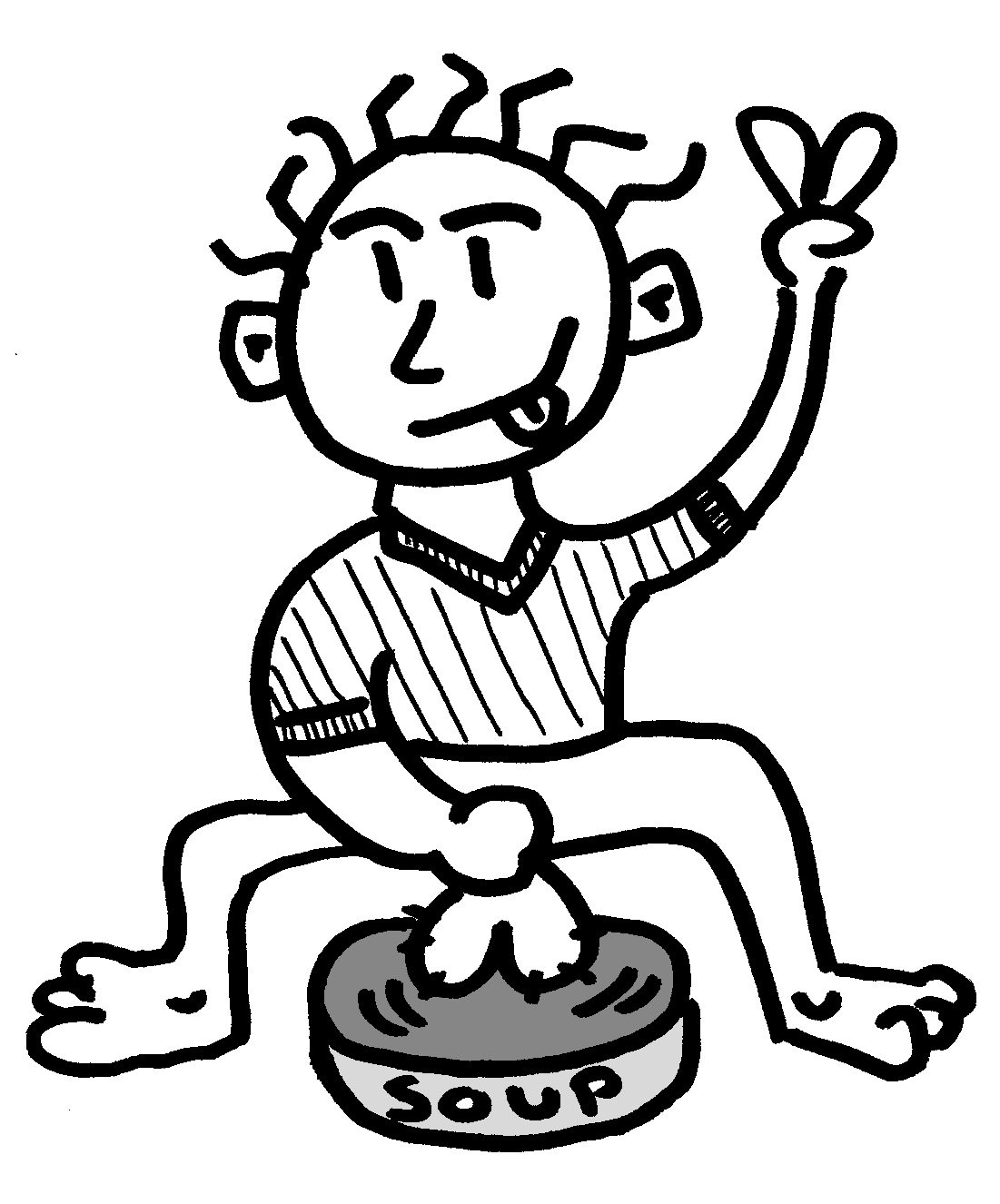
I dare say that if the player has purchased the plastic, he’s no stranger to the danger. I mean: if I have a Motion-Plus-equipped Wii Remote strapped to my wrist and a nunchuk in my other hand, then I am In For The Long Haul. Nintendo, you touched your balls to the surface of this bowl of soup. You need to be dipping them all in, please: you needed to just make this game a Motion Plus fiesta. It needs to be Wii Sports Resort: The Video Game. I want that exacting friction everywhere. I want neat swordplay. You released the Motion Plus—you expected people to pay 20 more dollars for their god-darned already-50-dollar controller—so that you could do stuff like this and make people like it. And here you are, backpedaling.
(Note to Raroo: please don’t illustrate someone dipping their balls into a bowl of soup. (Or . . . do.)) [EDITOR’s Note… you’ll have to click through to see it. The image is, of course, NSFW]
In case you couldn’t tell, I find the Motion Plus’s performance in The Legend of Zelda: Skyward Sword fairly weak. It’s limp, and while it’s certainly more articulate than swinging a naked Wii Remote, it’s not the joyful precision of the Wii Sports Resort fencing game. Well, whatever.
Mostly, my biggest problem with the Motion Plus is the little plastic door on a string that dangles off the bottom of it. It’s meant for you to plug it in to keep the nunchuk connection port protected from dirt or other harm while you’re using the Wii Remote and Motion Plus without a nunchuk, though I frankly find that a little ridiculous. I mean, the remote is made of a specific type of vegetable-fiber plastic that will biodegrade more quickly than dirt could solidify to an uncleanable degree on the delicate nunchuk connectors inside the Motion Plus.
My problem with the little door is that it clacks relentlessly against the plastic of the nunchuk plug as I flail my arms like a psycho / orchestra conductor (psychorchestra conductor) while playing Skyward Sword
Oh, hey—just a moment. I have a call from a reader. It’s Alex Jaffe, of Hollywood, Florida. He asks what color Adidas track jacket one should wear while playing The Legend of Zelda: Skyward Sword. The answer, Mr. Jaffe, is—duh!—green.
Here is a video of me swinging my condom-covered nunchuk-equipped Wii Remote with the Motion Plus attached.
https://www.youtube.com/watch?v=Tnc_A1W6dDg
Listen to that thing clicking there! Imagine how distracted were my finely-tuned ears as they struggled to seek that sound out and obsess on it no matter how loudly the television volume escalated.
A friend suggests that, since I’ve gone on record stating I will burn my Wii when I have had my fill of Skyward Sword, I could always cut the little door off. Well, I don’t want to! I also don’t want to tell the waiter at a restaurant that I want to order such-and-such item, only I’d like it without bacon or without mushrooms. I don’t want to order something “without” something.
Does this mean I am a complete hopeless case? Probably! Does it mean I will never have sex again? Definitely!
Also, note the sound at 0:08. That swirl of the analog stick in the nunchuk—I tell you what: if I keep my Wii around once I’ve finished getting all the heart containers in Skyward Sword, it’s going to be so I can keep hearing that sound on command. What a delicious little friction, that one.
Uhh. Ever since I started talking about plastic, I sort of forgot where I was. And so I delve back into The Notes:
9. The default follow camera angle is too high.
Oh! This is a good one. The camera angle floats just a bit too much higher than Link’s shoulder than would have afforded optimal forward visibility. I’d recommend lowering it a half a virtual meter and angling it up a couple of degrees. This would make it especially easier to look up—which is, unfortunately, so often where objectives are located in a game boasting three-dimensional environments.
I call this the “default” camera angle, though there is unfortunately no other one. The player can’t freely control the camera, understandably because Nintendo wants to make a game that doesn’t put off shy players with too many buttons. The viewer shouldn’t have to work to direct a film he only wants to watch, for example.
However, here is where we come dangerously close to proving that Nintendo doesn’t actually understand the audience for this game: Skyward Sword gives a player a world that sprawls out before, above, below, and around him. It’s a game about a journey, and journeys are about moving forward. Yet the camera seems obsessed with showing us two meters of ground behind the hero as he runs, its upper bound cutting off the sky—the titular sky!—a mere foot and a half above the player’s head.
And then the game gives us environments which necessitate three unique forms of navigation assistance. One is the “beacon” system, which is novel in that it lets the player place a waypoint on the map, and then view the general direction of that waypoint from the ground, as a light on the horizon.
Another of the forms of navigation assistance is “dowsing”, a laborious process by which the player calls out Link’s snoozeboard of a companion, Fi (quite possibly the most boring character ever imagined by a nine-year-old), and then points his sword with the Wii Remote until a beeping sound gets louder and shriller to indicate he is pointing in the right direction.
Okay. This one here is clearly taken from Shadow of the Colossus, a game the Zelda team have been said to admire greatly.
The “dowsing” action was likely implemented because it worked as a minimalist sort of guidance tool in Shadow of the Colossus—just point your sword, and it tells you where to go. In Skyward Sword, it’s just entangled with so much stuff. To use the function we have to open a menu and select a target. And it seems like we’re never using it unless the game adamantly insists upon us using it—to find something it’d take us frustrated, probably angry hours to find without assistance.
The other form of navigation assistance is actually two things so integral yet separate that I am going to cheat and call them one thing: you can press the “C” button to enter first-person mode, and you can also open a map, and then zoom into that map.
When you first enter a new area—this is very important—the game opens the map automatically and then zooms you in three times to your current location. Then it rotates the map so that it is facing the direction Link is facing. Then it closes the map abruptly.
I’m not going to dissect these points. I’m just going to leave this here: most of the non-dungeon environments are vacuous expanses of nonsense junk-fields held together by masking tape. Usually when you’ve placed a beacon, you’re going to have to keep stopping, entering first-person mode, and looking to the sky to see it, anyway. With some better camerawork and outdoor level design that was based around more iconic (or at least interesting or immediately recognizable) landmarks, they might not have lost so many people so early on.
Also, I think the bird is stupid.
10. I hate the stamina meter.
The stamina meter in The Legend of Zelda: Skyward Sword is the absolutely stupidest thing I have seen in a video game in many years.
I could write about it for ten thousand words. I am going to practice restraint.
In Skyward Sword, the Wii Remote’s A button—that biggest, most delicious of buttons, usually reserved for the most essential and satisfying of actions—is used to make Link dash.
Dashing increases Link’s running speed. He can run much faster, and thus traverse the expansive game environments much more quickly, while running.
The instant you press the A button to dash, The Stamina Meter appears outside Link—curiously, to the left of his body and beneath his feet.
It is a big, ugly, round, green thing. It is green like a watermelon in a comic book is green. It resembles a cut-in-half lime. As you run, its little lime segments drain of juice and darken, the brightness representing the stamina remaining in this particular burst.
Being that it only appears while Link is running, and being that it appears literally just to the left and bottom of the middle of the screen—where the character is—this crayon-bright interface intrusion floats over a ground which is whipping by the player at higher than a walking speed. So there it is: steady as it goes, punching a neon hole in my retina for six seconds every nine seconds of the game.
Being that the environments are occasionally expansive to a point of fault, you’ll be running a lot. You’ll be seeing this stamina meter a lot. They probably could have called this game “The Legend of Zelda: The Adventure of a Guy with Half of a Cartoon Lime Floating Outside His Body“.
If I were a game designer on this game, I would have screamed about this probably for nine minutes before the director looked up from his sandwich and was startled to see me there (he’s probably deaf (more on that in a minute)). I’d then bite a pencil in half, walk out, and get a job at the 7-Eleven across the street
Here is my biggest problem with The Stamina Meter—actually, no, maybe my other problem is bigger (they’re both huge): the meter is completely depleted after not five seconds of running. Once it’s depleted, you have to wait maybe five seconds for it to recharge. Then you can run again.
To dissect this problem—gently!—I’ll say that, maybe, if you feel the need to include a run function, maybe your character’s non-run movement is too slow. Maybe!
Or: maybe, if you feel the need to include a run function, your environments are—maybe!—too big.
The first surface environment you encounter in Skyward Sword has you walking down a long, slow, gentle spiral toward a knot deep in the earth.
Then you walk back up.
Of course, you’ll be using your run function a lot, and there’s that god darn lime.
And here’s The Bigger Problem—I’ve just decided it’s The Bigger Problem: The Stamina Meter beeps.
They probably could have called this game “The Legend of Zelda: The Adventure of a Guy with Half of a Cartoon Lime Floating Outside His Body“.
When it’s three-quarters depleted, it starts to beep. It is a hateful, maddening, electronic tell-tale heart of a beep. It’s a tone like a technology start-up CEO would insist on for your alarm clock, because it’s “not as much of a shock to the eardrums”—except he wouldn’t call them “eardrums”: he’d call them “tympanic membranes”, because he’s an asshole.
It beeps, and then you let go of the button, and . . . it keeps beeping as the thing fills up.
This is around where my hair starts to tear itself out.
So, sooner or later, as you dash literally everywhere, you brain-design a sort of game-within-a-game wherein you force yourself to let go of the button just before the meter starts beeping. Sometimes, you win, and you wait for it to recharge. Sometimes, you lose, and there comes that infernal beeping.
This is terrifying. Soon you will share sympathy with a kleptomaniac in a candy store.
Then there are these lock-and-key slopes, where the only way to the top is to dash. So you dash. The slopes are always precisely the distance you can dash if you hold the button down until the meter is empty. So there you have it.
Everything beeps in this god-forsaken game. There’s that familiar dread of being hit so many times the game starts beeping to tell you you’re almost dead. I hate that beeping. It ruined my childhood. I swear: that beeping is why my little brother was afraid well into his college years of being locked in a Target store after they closed. That sound is the reason I jerk my microwave open the second before the timer can count down to zero. That sound is the reason I literally screamed like an electrocuted sheep the night I realized my new microwave oven beeps anyway when you open the door. It’s a “yay!” beep. The low-health sound in The Legend of Zelda is likely also the reason I literally shrieked like a hen dropped into a pot of boiling butter the afternoon I realized my microwave will beep again if I leave my food in there for just one minute after the timer counts down to zero. What fucking business is it of my microwave’s if I don’t snatch my food out of there immediately? What a nosy little machine. Not everyone is that hungry! And then there’s my hair straightener (cue the comments about this whole article is about a guy straightening his hair!), the package of which boasted “automatic shutdown”: it heats up in thirty seconds and then shuts itself down after thirty minutes of un-use, and once it shuts down it beeps shrilly for literally 90 seconds. “Hey! Hey! Hey! Hey! Listen! It’s me! Your hair iron! You left me on! Your house hasn’t burned down yet, or it has, and you’re dead, though obviously you’re not paying attention to me, so I’m just turning myself off over here! I’m already off! I’m just beeping to let you know!”
Skyward Sword walked me through the process of buying a potion early in the game. Down in the first large hostile environment, I’d be darned if I was going to use that potion. I walked around with just two hearts, the beeping filling my living room for 20 godless minutes, the Wii Remote tinkling every three seconds to let me know that, just in case I didn’t get all the information the first time, I can consult my ethereal robot-thing-ish companion about the weak spot of my enemy again—this despite my having set the on-screen interface to “Pro” mode, an option players have begged for in Nintendo games since the debut of the GameCube. Just, here I am in this game, and everything is beeping, and I want it all to just go away so I can enjoy myself. I just want to enjoy the level design and dungeon puzzles and the bosses with the nifty ideas. And sooner or later, The Legend of Zelda comes back to me, and it fits the inside of my skin-shell like an inverse glove, and here I am, making progress, moving forward, dealing with the beeps as they come—”Oh; I guess my shield is going to break again”. Broken shields! Who thought of that one? Every so often when 16 things would be beeping off at once I’d breathe sharply through my teeth and snap out my trance and wonder where I was; I played this primarily late at night, and many times, for a second, I’d reverse-wake and find myself (within a dream), trapped hopelessly in a dark meat freezer full of schizophrenic alarm clocks.
Aside from that little nitpick—fun game! If you’ve ever liked a Zelda, you’ll love this one.
Bonus tip: if you find yourself torn between Skyward Sword and Skyrim for your Holiday Break Game Choice, allow me to cast my slightly-more-enthusiastic vote for Dark Souls
tim rogers is not a writer. he is, however, a game designer, the editor-in-chief of video game review web log action button dot net, and the founder / creative director of action button entertainment, a small game studio that will soon be releasing its first game for iOS. you can follow him on twitter here.
(Illustrations by Bill “Mister Raroo” Sannwald)