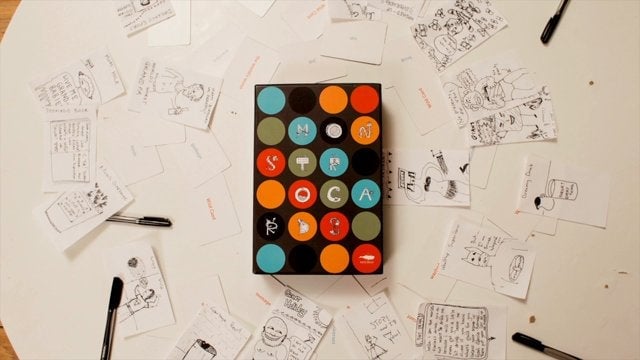
Monstrocards is a card game with almost no rules. Almost. Think Cards Against Humanity, but with your own creations instead of pre-written words. Oh, and it’s been in the works for more than ten years.
The basic idea is that you and a group of friends combine sets of cards from two decks—one with things, another with possible descriptors of those things—to form a series of zany, sometimes oddly thought-provoking prompts. Then, from the individual prompts you receive, you draw a series of monsters.
Not “draw” in the typical card game sense, but rather with your hands. Like some kind of artist or person born before the year 2000. After that people face-off, one-on-one, in verbal debates to determine who has the best/funniest/most creative interpretations of their prompts. For instance, one person’s envisioning of a “muscular toddler” might go toe-to-toe against somebody else’s “award-winning soup.” They can draw these things how ever they like. The award-winning soup I saw had little arms and was holding a Nobel Peace Prize. In my opinion, the toddler didn’t stand a chance, even with its biker tattoo.
The end result is almost always raucous laughter. And it’s basically guaranteed to be different depending on who you play with.
That’s probably why creator George Royer and his friends in various cities, from various walks of life, have carried it with them for more than ten years. It began as a simple game of drawing random pictures on scraps of paper, a way to pass the time in the sleepy town of Tuscaloosa, Alabama. Royer had no idea that it would create so many memories, take on a life of its own, and now, go to Kickstarter as A Real Thing with God of Blades developer White Whale’s stamp of approval on it.
“I’ve wondered why [Monstrocards has] stuck around for so long,” he ponders during an interview in his latest adoptive hometown of Austin, Texas. “I think it’s that I never know quite what kind of form it’s going to take. I do know that every time I play it I’m gonna see something amazing and weird that I never would’ve seen otherwise. Some crazy thing. I think maybe that’s it.”
“It’s been one of my favorite ways to spend time with friends over the years,” he adds, sounding wistful. “A lot of my fondest memories are of playing this game. It led to eternal in-jokes and stuff like that.”
He then tells me the story of the prompt “Undiscovered Cowboy,” which recently evolved into “a legend.” One person just drew a cowboy in a barrel, but another drew a cowboy in someone’s heart—in all of our hearts, symbolically. It’s the cowboy inside us all aching to get out, to lasso life and wrestle it to the ground. To make it our own. Royer chuckles at the silly profundity of it. “That one went on to win, like, three rounds,” he says.
In this moment Royer is giddy. Well, at least, giddy for him. He’s got a gentle demeanor about him, a wit that he wields like a surgeon’s scalpel, cutting to the heart of a matter and plucking out the perfect observation or joke at just the right moment. But he’s so quiet. If you aren’t listening, sometimes it’s hard to know he’s even talking at all.
To hear him tell it, Monstrocards is the perfect game for somebody like him, somebody you might not initially suspect is the life of the party.
“Showing stuff you’ve created to people is scary,” Royer says, grimly. “But this game is actually really fun for [quieter people], and it’s fun for their friends too. I think sometimes it’s people who maybe aren’t, like, the joker or whatever in the group. But then it’s like, ‘Oh, did you see that card so-and-so did?’ It changes the way people think about each other.”
Heck, you don’t even need to be good at drawing to play. In fact, Royer claims it’s usually the ones who snoozed through art class—not the burgeoning card stock Rembrandts—that turn out the most strikingly hilarious material.
“A lot of people, when we were like, ‘Here’s five blank sheets of paper, draw something,’ were like, ‘I can’t do this,’” he says. “That showed me we needed prompts. We needed something for people to lean on. Because with a little bit of nudging, they find that they can totally do it. They might not think they can create really good drawings or that they’re funny, but then they find out, ‘Oh, I actually am.’”
“People with art-heavy backgrounds will spend too much time on detail and have one really good card. Other people will spend more time on the idea behind each prompt—less on the art.”
That’s Monstrocards’ first great strength: its goal is not to create an environment of comedic pushing and shoving, an intellectual rat race, but rather to make everybody feel good about themselves. Even if you don’t win a round, you’ll probably still get some laughs. It’s hard to feel bad when everybody—yourself included—is laughing and smiling.
Sometimes the game is even downright heartwarming. Royer tells me the tale of “Perfect Dog,” a prompt that resulted in a generic ultimate dog who does everything for you and a mangy, busted up mut. The mut won. Again and again and again. Not because of the drawing, but because of the argument its artist made for it. “This dog is all broken and ruined,” says Royer, “but you love him because all dogs are perfect [to their people].”
And these are stories that have only emerged in the past few days. I ask Royer to reach back into Monstrocards’ burbling primordial ooze—back through countless times and places—to pull out some of his favorite memories. He pulls up pictures from his phone that a friend he played with years and years ago sent him. These ones:
Then he asks a simple question: “What the hell is Bandaff?” He chuckles to himself, then tells me the shirt he’s wearing is also a print of an old card from way back when.
Eternal in-jokes indeed.
That’s Royer’s goal with Monstrocards, though: to recreate the feeling of hanging out with a bunch of close friends even if you’ve never played with a group of people before in your life. To help people go from feeling awkward and out-of-place to that sort of warm camaraderie you only get from repeatedly making an ass of yourself in front of people who just get that you’re goofy. We’re all goofy.
“The decks were designed to capture the feel of the stuff my old gang of friends used to make,” says Royer. “So now it’s gotten to the point where people make stuff that feels like it’s coming from an intimate group of friends, even if they’ve never played together. That was not easy to figure out how to do. It took a lot of testing and tweaking.”
Monstrocards has taken a long, strange road to reach this point—not just in terms of being designed and re-designed, but also conceptually. Once upon a time it was a few friends drawing dumb pictures. Now it’s a commercial product. I ask Royer if it’s a little weird to almost be bundling up happy memories of these spontaneous moments and selling them in a box, but he doesn’t think that’s necessarily a bad or artificial thing.
“It’s kinda weird, but it’s cool,” he says. “Monstrocards is a game that makes a lot of people feel good about themselves and what they can do. I’m really excited to start getting cards in from people who are playing it.”
He even started a tumblr to highlight them.
And it’s not just Royer. Turning this little in-joke game into a full product has had another side effect: it’s actually brought Royer’s old friends out of the woodwork.
“When we posted the announcement on Facebook that we were gonna put this thing together and distribute it, there was a huge comment thread of people remembering their old cards and which were the best,” he says, smiling fondly. “Old friends I hadn’t talked to in a long time were like, ‘Do you remember the card for Morphic Sbarro? That was amazing.’ And I was like, ‘Shit, that was amazing.’”
“It’s not just me,” he adds. “People remember this stuff and they hang onto it. It reminds them of their friends.”
With a bunch of cards to draw on in the boxed version, Monstrocards stands to run out of tiny cardboard canvases pretty quickly. Why not just give players, like, dry erase boards or something? Royer and Lammert, though, believe that would defeat the game’s purpose entirely.
“I would never sign off on a marker board,” says Royer. “You’re making treasures with Monstrocards. Ones you can keep.”
“I remember the first time we played Monstrocards during God of Blades’ production,” adds Lammert. “That was a very special moment. This isn’t just a disposable game. It’s about creating memories that last.”
Also, you can always make replacement cards out of paper.
Royer mumbles quietly, almost like he doesn’t want anybody to hear: “One day there will be a Monstrocards art show at the Museum of Modern Art.” He laughs. We all laugh.
That’s just kind of the general mentality Monstrocards creates. It’s nice. It’s friendly. It’s good for a moment, but—at least for Royer and his friends—it has strange way of sticking around.
The Kickstarter for Monstrocards’ boxed version is currently in its home stretch. Alternatively, if you’d like to play now, you can download and print out the full game for free on Monstrocards’ website.