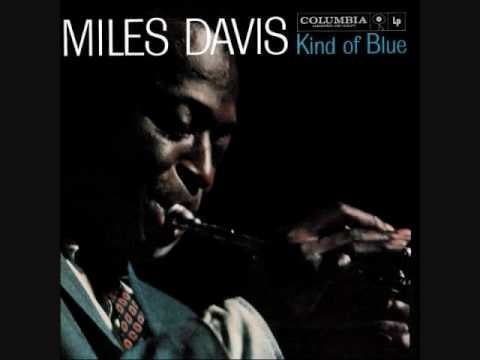
It’s widely held that Miles Davis’ 1959 album Kind of Blue is the greatest jazz album of all time. I believe that in some jazz style-manual or another, it is actually required that people who write or talk about it refer to it as a “seminal.”
While it’s of course impossible to declare that any one thing is the all-time greatest of that category of thing, there’s no denying that Kind of Blue is an artistic triumph, an effortless melding of masterful technique and groundbreaking composition that set the bar for every jazz album that would follow it.
(Fair warning guys, I’m going to kind of go off on a jazz tangent here. It’s Kotaku Melodic, and I want to talk about this tune! So I am.)
It’s in part due to the personnel—in addition to bandleader Miles Davis on trumpet, John Coltrane is on tenor sax, Cannonball Adderley’s on alto sax, Bill Evans is on piano (with Wynton Kelly stepping in on “All Blues,”), Paul Chambers on bass and Jimmy Cobb on drums. (Weirdly, the album’s wikipedia page has those last two reversed.) There has never been a group to equal it—it’s a dream team of hard-bop instrumentalists, each man a visionary player in his own right.
I was like, “Kind of Blue? More like Kind of Boring, amirite?”
But for a long time when I was younger, even as I was learning jazz, I was like, “Kind of Blue? More like Kind of Boring, amirite?” I’m not proud of it, but there it is. I see the same reaction these days when I teach—almost every jazz student I’ve ever had has this album in their house, and almost every student finds it ponderous and dull, too soft, too quiet. Where are the blues riffs, where are the pulsing beats?
It took a long time for my ears to get to the point that I could really hear everything that was going on on this record. Tunes like “So What” and “All Blues” were so much part of my life that I’d stopped really listening to the recordings. I’d played those songs so many times at so many student jazz festivals that I’d lost track of what they were really all about. But then, I listened again. I really heard what Cannonball was playing over “All Blues,” what Trane was doing on “So What.” And it clicked.
Anyway, blah blah jazz blah. I want to tell you about the hidden gem of Kind of Blue, the track that I used to never, ever listen to, but is now my favorite. I’m talking about the last track on the album, “Flamenco Sketches.”
When you listen to it, it might not sound like much. Is there a melody here? Miles is just playing by himself. Soon Trane takes over, then Cannonball plays a solo, then Evans, then Miles takes it out. It’s all very abstract, and I could understand why many listeners would think it’s boring. Is this even a song? What’s the deal?
It wasn’t until I learned and performed this song that I grew to understand what makes it so cool. “Flamenco Sketches” is truly a sketch, a series of five modes placed end to end and navigated at a pace dictated by the soloist. It’s almost free-jazz, and once you know what’s going on, it’s a fascinating listen.
Many talk about how Kind of Blue signaled the rise of “Modal” jazz, which can be a confusing term. Modes are, basically, when you play a scale starting on a different note than the commonly accepted “root.” For example, a standard C major scale is:
C D E F G A B C
So if you play that same scale starting on the second note, “D,” you get:
D E F G A B C D
That’s the second mode of C major, which is also known as Dorian, in this case D Dorian since it starts on D. It’s remarkable how totally different it sounds than C major, even though it contains all of the same notes. There are, of course, seven modes to a major scale, one for each note. Their names are kinda crazy: Ionian is another name for Major, which is the first mode. Then Dorian, which I just showed you. Then… well, here are the major modes in order:
1. Ionian
2. Dorian
3. Phrygian
4. Lydian
5. Mixolydian
6. Aeolian
7. Locrian
Alright, so I won’t bore you a whole theory lesson. (Though I’d imagine that if you didn’t already stop reading due to music theory boredom, there’s no stopping you now! Ha.) But that’s the gist of how modes work.
So, back to “Flamenco Sketches.” The tune is really just five modes placed end to end:
C Ionian
Ab Mixolydian
Bb Ionian
D Phrygian
G Dorian
(Say, are you listening to the tune while you read this? Listen to it!)
If you wanted to read those modes as chords, you could, though there is a slight difference between voicing a mode and doing a more traditional chord-voicing:
CMaj7
Ab7sus
BbMaj7
EbMaj7(#11)/D
Gm7
That’s the whole tune! There’s no melody, just those five “colors” in that order. If you want to picture them on a light-dark spectrum, they go like this:
Bright and placid (Ionian)
Bright with a hint of shadow (Mixolydian)
Bright and placid in a new location (Ionion)
Dark and shadowy, uncertain (Phrygian)
Dark but resolved, with a hint of brightness (Dorian)
The musicians cued when they wanted to change, so no two solos are exactly the same length or structure. Trane stays on the dark D phrygian for 8 bars, while Cannonball plays 8 bars on both of the bright, open ionian chords. Everyone does something slightly different. Bassist Paul Chambers misses the cue to get to G Dorian at the end of Trane’s solo, and winds up sitting on D while Bill Evans plays a G Dorian chord over it. He actually does that again later, and I’m semi-convinced he did it the second time to make that first time sound like it was on purpose. But who knows, maybe Paul really just liked the sound of Gm7/D.
The whole thing is very loose, and each solo gives a small but interesting insight into the mind of each player. When given control over which chords they want to play longest, it’s interesting to look at why they linger on the chords they do. Cannonball is such a bright, lively player, of course he wants to linger on Ionian! Trane is dark, and loves those flat ninths, so it’s natural that he’d spend a lot of time on Phrygian.
https://www.youtube.com/watch?v=8dJuWhPk-ro
The alternate take of “Flamenco Sketches” bears that out—the underlying structure remains the same, but the tune is essentially unrecognizable.
While Miles Davis is credited as the composer for Kind of Blue, there’s a liiittle bit of debate about that, particularly “Flamenco Sketches.” At least, by my college improv instructor’s reckoning, it’s just as likely that pianist Bill Evans sketched out the tune’s simple structure on the train over to the studio, and they laid it down as a kind of experiment.
More than the already spacious, distinctive tracks on the album, I love that the freeist, least composed one is in many ways the most emblematic of everything that makes Kind of Blue such an iconic record. It brings together six musical geniuses and lets them loose on a wide open canvas of harmony, painting shapes and lines in the colors that they know best.
That combination of loose structure and uninhibited performance is unlike anything recorded before or since. Not just despite but because of its simplicity, “Flamenco Sketches” is a classic.
And, because this is a video game blog, here’s the amazing 8-bit version of “So What” that made the rounds a little while back. I was totally blown away by all of these. The whole collection was called “Kind of Bloop.” So cool.