The longer a competitive game’s around, the less its high-level matches resemble matches between typical players. Pros begin whipping out plays that blur the line between technique and exploit. So what happens if you press the reset button on all of that?
Some people consider Quake III and its spin-offs to be the forgotten rulers of eSports. Once upon a time—before eSports were as big as they are now in the US and Europe—Quake was a bonafide star-maker. At least, if you consider people like Johnathan “Fatal1ty” Wendel stars. But as the years have worn on, the arena FPS classic’s competitive scene has become more and more niche. Big tournaments do happen at events like QuakeCon, but they’re increasingly rare. Some blame skill discrepancies between truly top-level players and up-and-comers for a lack of new blood. They claim youngsters who might be interested only see a big learning curve and a bunch of old gatekeepers at the top of the mountain. Where’s the fun in that?
As a result, it was something of a surprise that this year’s thousand-seat Frag-O-Matic 17.0 event in Wieze, Belgium—still a relatively small LAN event—added Quake Live back into its rotation. Johan “Greth” Martens hosted a tournament with €800 (or a bit over $900) on the line as an experiment to see how a bunch of gamers skilled in non-Quake games (think League of Legends, Counter-Strike: Global Offensive, etc) would fare in one-on-one Quake matches. The result was absolutely fascinating, akin to watching fish fresh out of water quickly figure out how to walk and breathe and order a decent drink at Starbucks.
Of the first game in the tournament, Martens said:
“These players were playing Quake as it would have been in 1996. The advanced exploitation of an engine was not known to them. To an experienced Quake player this display might be hilarious, and maybe you’d even want to reach out and teach them. Yet the game I was watching didn’t show player crying for help. They were both well matched, the game was a close one and went to three maps.”
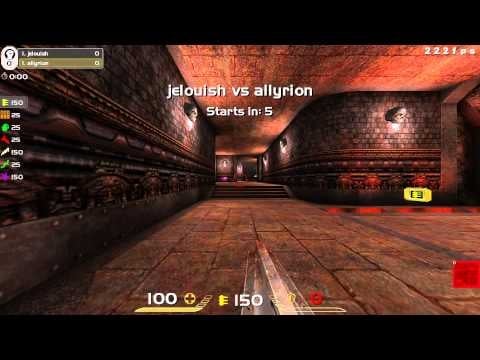
Watch that here:
It was Quake sans time-honored “hidden” skills like strafe jumping or timing item pick-ups. These people were great at FPS fundamentals, but they didn’t know Quake‘s ins and outs, its characteristic dimples and curves.
Not all matches were so close. Some players picked the game up (on a high level) faster than others, and there was, admittedly, one shark swimming with the guppies: a top-4,000 duel player, someone with actual competitive experience in Quake. But even then, watching these players evolve their play styles on a match-by-match basis was utterly entrancing for Martens. He wrote:
“Quake is a game of hard skill thresholds. Once a player has reached certain ‘checkpoints’ in development it becomes very hard, if not impossible, for a player of lower skill to beat this person. Progressing in Quake is a game of losses. Learning how to lose is key. This is of course difficult in a tournament setting, although certain thresholds will be quicker to be overcome as there is a tremendous amount of competitive pressure to do so. The low skilled devour the lower skilled. Sometimes a glimmer of hope, but it is not to be.”
And so, after the one truly experienced player took home gold, Martens turned everyone’s attention to the losers’ bracket. And that’s when all the Quake neophytes really began to shine:
“After being shocked into reality by an active competitive player the veteran newbies are competing again with their own kind. There has been a change however. Notice the flow developing in their playstyle. Notice that beyond the obvious flaws there is grace and skill where there was none before.”
“The true final was a game that wasn’t supposed to be played. It was the game for third and fourth place. I forced it to be played, simply so we could see how far these players had come. And I was impressed. If you are to view any of these games, finish this one. The one true game of Quake played in this haggard little tourney.”
Check out that match here:
Martens declared his experiment a success, albeit a bittersweet one. During his tournament, he witnessed a small sample of competitive gaming’s new, most numerous generation yet. Moreover, he saw them begin to really dig Quake as they picked up its nuances almost instinctively. And yet, the grandpappy of arena shooting continues to fly (and strafe jump) under the radar. Martens conjectured that Quake has fallen out of modern competitive vogue not because it’s outdated, graphically inferior, or full of hard-to-learn techniques, but because there’s not much of a push for awareness from the community or developer id Software.
His plan, then, is to hold another tournament like this, only bigger, with more modes, and more money on the line. He’ll provide the spark, and hopefully the fire will do the rest. Or, as he put it:
“That’s all that needs to happen to get people back into Quake, a sign of life. A sighting in the wild. An introduction to this strange and forgotten beast.”
To contact the author of this post, write to [email protected] or find him on Twitter @vahn16