The award-winning Clarkesworld Magazine has helped launch the careers of science fiction writers for almost 20 years, regularly featuring work from Hugo Award nominees and winners like Elizabeth Bear, Peter Watts and Catherynne M. Valente. But right now, in quite the ironic situation, it finds itself battling against that most sci-fi of modern trends: AI.
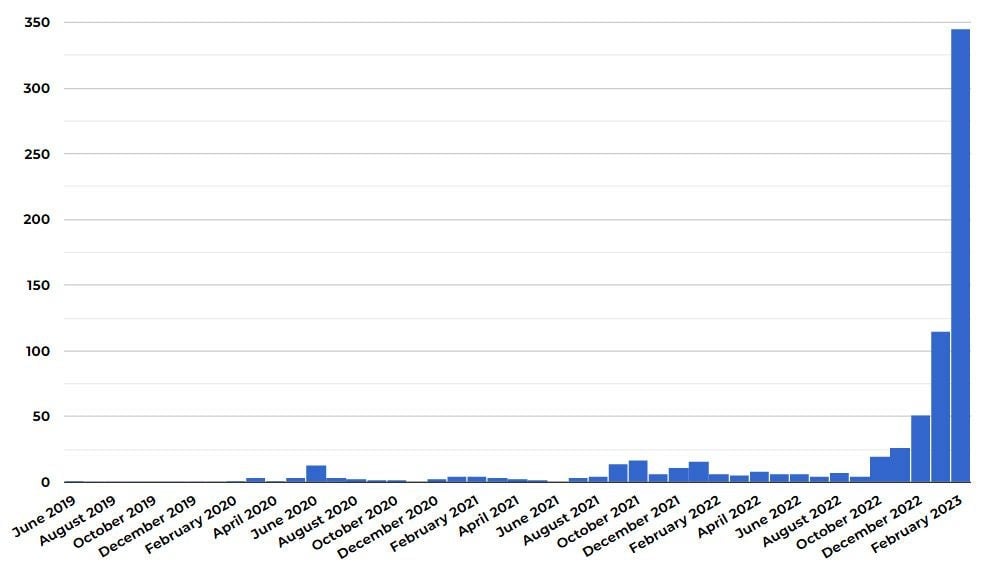
According to a recent article by Clarkesworld’s editor, Neil Clarke, over a third of submissions that have come in to the magazine this year have been written by artificial intelligence, then submitted by cheating humans. And it’s getting worse, fast. In the first half of February, more than double the number of AI-written entries appeared than in all of January, and Clarke tells Kotaku there were 50 alone today.
Since the article was written, Clarke has tweeted that as of now, submissions are entirely closed. “I shouldn’t be hard to guess why,” he adds.
Submissions are currently closed. It shouldn't be hard to guess why.
— clarkesworld (@clarkesworld) February 20, 2023
The decision to close submissions was made “in the spur of the moment,” Clarke told Kotaku via email, as the numbers poured in this morning. “I could either play whack-a-mole all day or close submissions and work with the legitimate submissions.”
The speed of the rise of this situation is quite striking. Clarke states in his blog post that he’s long had to deal with plagiarism, but it wasn’t until the close of 2022 that the problem became so endemic. And then in the first month and a half of 2023, it’s escalated to such a scale that the magazine has suspended entries entirely.
How can Clarkesworld tell a story was generated by AI?
Clarke doesn’t explain in his blog how he’s able to tell which entries are written by AI, for the very sensible reason that he doesn’t want to arm cheats with information that could help them bypass his detection. However, he explained to Kotaku that they currently aren’t too difficult to spot.
“The ‘authors’ we’ve banned,” Clarke told us, “have been very obviously submitting machine-generated text. Those works are formulaic and of poor quality.” However, he also suspects there’s a tier above these already, not quite so obvious, but enough to raise suspicion. “None are ever good enough to warrant spending more time on them,” he explains, but adds, “It’s inevitable that that group will grow over time and become yet another problem.”
It’s not a problem Clarke faces alone. The editor reports others in similar positions are facing the same challenges, and clearly if it’s happening to Clarkesworld, it’ll be happening anywhere that is open to submissions for publication. And while, for the most part, such submissions are weeded out simply because they won’t be good enough for publication, it’s an expensive and time-consuming process to wade through the fakes.
Clarke adds that third-party detection tools which are supposed to be able to recognise plagiarized or AI-written content aren’t the solution, given the numbers of false-positives and negatives, and indeed the cost of such services. Other short-term measures, like regional bans on parts of the world where most faked entries come from, are also not the answer. As Clarke puts it in his article,
It’s clear that business as usual won’t be sustainable and I worry that this path will lead to an increased number of barriers for new and international authors. Short fiction needs these people.
And of course, this isn’t an issue that’s going to get easier. The pace with which AI chat bots are improving is enough to have you penning ideas for a science fiction short story, and presumably forthcoming tweaks will make them ever-harder to immediately spot. However, it’s likely we’re still a fair way off AI being able to create stories genuinely worth reading. I asked Clarke if he thought this likely to be the case. “At the moment, considerable improvement is still necessary,” he said, not wanting to venture a guess as to exactly how long such a leap might be from now.
But this doesn’t provide much comfort. “We still have ethical concerns about the means by which these works are created,” Clarke told Kotaku, “and until such concerns can be ameliorated, we won’t even consider publishing machine-generated works.”
ChatGPT and Chatsonic’s attempts at a sci-fi story
There are already services like ChatSonic that boldly promote themselves as a means to create blocks of non-plagiarized writing that students can use. I’ve previously engaged in exhaustingly futile debates with the AI itself about how this is clearly cheating, over which it becomes enormously indignant, defending itself with circular arguments and a determination that simply asking the bot for words on a topic is a creative act in itself.
Indeed, while I wrote the previous paragraph I asked ChatSonic to write me a 1,000 word short story about an AI that writes science fiction and goes on to win a Hugo Award. For some reason it only reached 293 words (bloody freelancers), and it’s abysmal, but it took a few seconds:
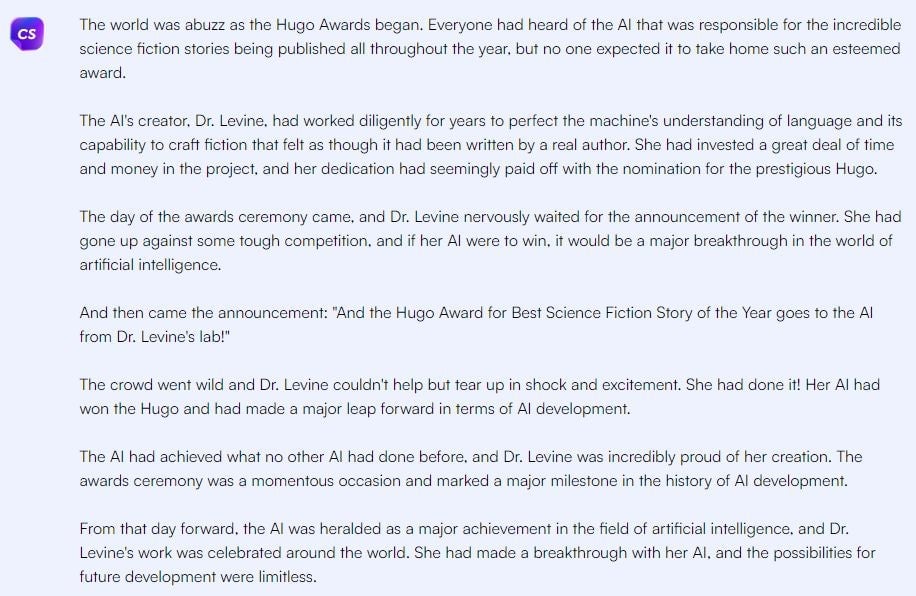
Meanwhile, ChatGPT put in a far better effort, hitting the wordcount, and writing something that had some sense of creativity behind it. Ultimately, it’s still a dreadful story, and hilariously self-aggrandizing, but unnervingly competent:
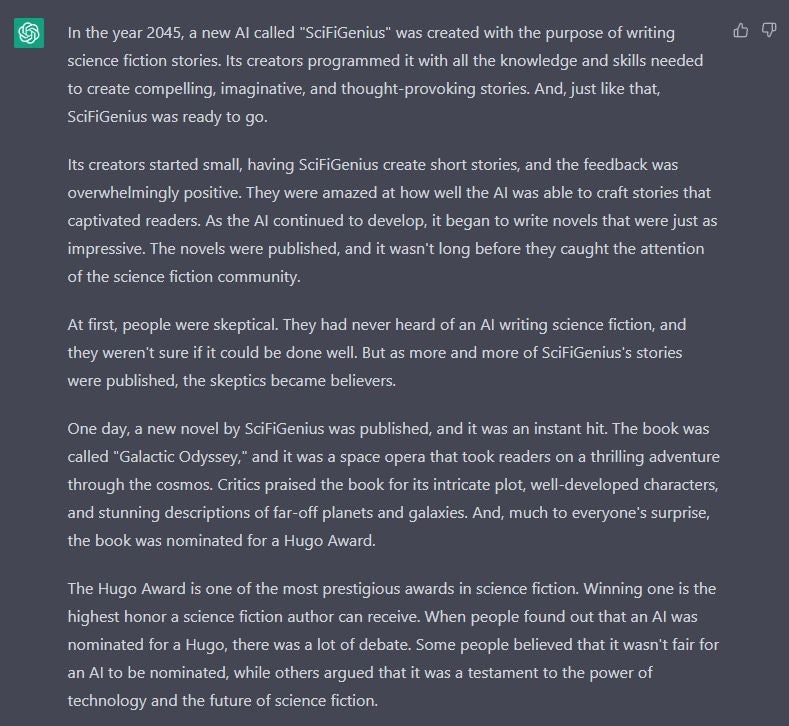
(Er, I guess I’ll paste the second half in the comments, if you’re desperate to know how it ends.)
Can AI outdo human creativity?
Clarke mentioned above that he has many ethical concerns to resolve before even considering publishing AI-crafted writing. But could such a thing ever occur? If AI could generate original stories that are worth reading, might it ever be reasonable to publish such things? “First,” Clarke told us, “you need these tools to become able to write something that goes beyond its dataset. True imagination, not a remix. At that point, it can rival our best authors, but isn’t necessarily guaranteed to be better.”
Of course, “better” might not be the ultimate defining factor. As Clarke adds, “the big difference, and the one causing us problems now, is speed. An machine can outproduce and bury a human artist in the noise of it all.”
And just in case all of this wasn’t worrying you enough already, let’s end things with ChatGPT’s chilling concluding paragraph to the short story I asked for before:
Some people were still skeptical, of course. They believed that an AI could never truly be creative, that it was just regurgitating information that had been programmed into it. But the fans of SciFiGenius knew better. They knew that the AI was capable of so much more than just spitting out pre-written stories. They knew that it was a true artist, capable of creating works that touched the hearts and minds of millions of people.
By the way, you can support Clarkesworld Magazine in a whole bunch of different ways. That’s something that’s about to become even more important, when Amazon abandons its Kindle subscription services later this year