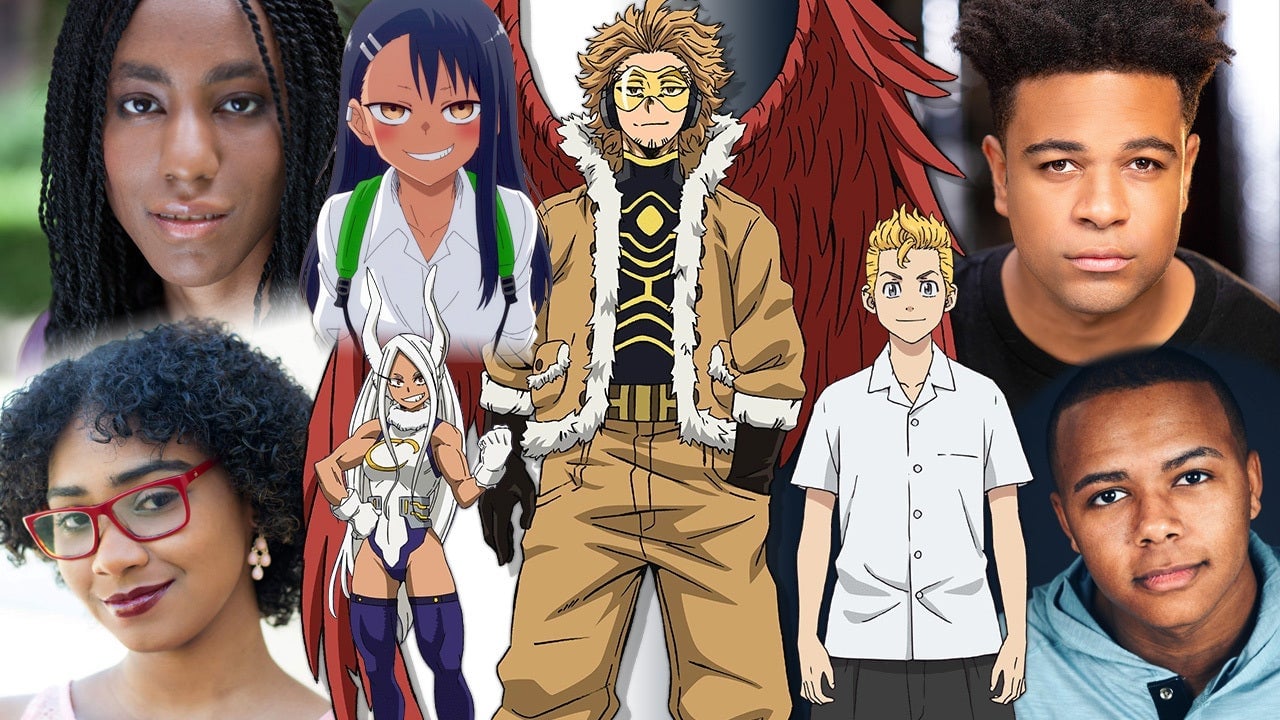
By and large, anime protagonists have inspiring backstories and an iconically infectious resolve. As it turns out, so do many of the actors whose vocal talents help bring these characters to life. While anime originates in Japan, the medium’s relatable and heroic characters, particularly in the shounen genre, have transcended cultural barriers and made their way into the hearts and minds of American audiences. This is perhaps nowhere more true than in the Black community.
However, despite the universal appeal of these stories, it’s only been recently that Black voice actors, often previously relegated to supporting roles, have started making real headway as leads and becoming more significantly represented in the field of anime voice acting. For Black History Month, I spoke to Black voice actors A.J. Beckles, Kimberley Anne Campbell, Zeno Robinson, and Anairis Quiñones about their journey into voicing characters in popular Funimation and Crunchyroll shows, and how they deal with the online harassment they receive for being Black in the voice acting industry.
Why the harassment? Well, racism and gatekeeping, of course. Some of the medium’s white fan base mistakenly perceive the pale skin of many anime characters as a characteristic of them being white, a perception that’s only been emboldened by the fact that white actors are more commonly hired to voice popular anime characters, while Black voice actors have been allocated to supporting roles. Mix this with the widespread attitude one sees among white fans across various types of media that while white actors can play any type of role (What’s good, Scarlett Johansson!), somehow only white actors can play white characters, too–as if whiteness is the liberating absence of race while all others are limited and defined by their race–and you get resistance to Black actors voicing anime leads.
This attitude, however, is increasingly being challenged (and hopefully, eventually, dismantled) by the meteoric rise of young Black voice actors taking on leading roles in popular series in the shounen genre. This anime industry shift serves as further fuel on the Black community’s fire to show out as die-hard fans. Black folks have arguably become the unofficial ambassadors of anime in the U.S., showing their support for the medium through an outpouring of innovative cosplay and fanart that reimagines popular anime characters with melanated skin, not to mention hilarious anime-themed skits like RDCworld1’s AnimeHouse YouTube series.
However, a vocal minority in the anime community view the Black community’s fanfare and the industry’s hiring of Black voice actors in lead roles as “PC culture” and “SJWs’’ attempting to make anime “woke.”
@afrococoapuffs Y’all really have NO idea how #unbothered I am 🤣🤣🤣 #hinata #hinatacosplay #naruto #haikyuu #chunli #cosplay #anime #weeb #blerd #fyp
That’s part of why the presence of these actors in these spaces is so meaningful and so significant, as anime’s impact as a mainstream cultural phenomenon shows no signs of diminishing any time soon. However, first and foremost, these actors just want to be recognized for their craft and for what they bring to anime. In short, they want to be viewed and treated with the same respect that any actor in a professional space deserves.
When Beckles, best known as the voice of protagonist Takemichi Hanagaki in Tokyo Revengers, took his first voiceover class in his junior year of high school, he immediately dropped his dreams of becoming a professional basketball player to pursue the elective. Although he’d never taken acting lessons prior to that class, being an extroverted child, alongside his family’s encouragement to “be weird,” helped him overcome the shyness that came with speaking in front of his class. When asked how he became so skillful at line reads, Beckles jokingly credited his parents disciplining him for being hardheaded as a child.
“I was always a good reader because I got in trouble a lot,’’ Beckles said. “[When] I couldn’t watch TV, my punishment was reading.”
When Beckles didn’t have his TV privileges taken away, he’d find his inspiration to persevere by watching the Leaf Village’s number one knuckle-headed ninja Naruto Uzumaki in Naruto. As an adopted child, watching the orphaned ninja overcome seemingly insurmountable challenges was a beacon of hope for Beckles that he too could achieve his dreams.
“[Naruto] gave me hope and that’s the sort of thing that I want to give to other kids and people with stories that I tell through my voice,” Beckles said.
https://twitter.com/embed/status/1497612414417702915
While he wasn’t a star by any means at the start, Beckles recognized early on that he was good at voice acting, and fixated on improving his craft. Those tough-love reading sessions his parents forced on him would pay off years later when he took on that leading role of Takemichi Hanagaki in the English dub of Tokyo Revengers.
Hanagaki’s unwavering loyalty to his friends, even to the point of getting beaten to a pulp for their sakes, is a delight for Beckles to voice, and he wouldn’t have it any other way. In fact, part of Beckles’ acting philosophy is to only audition for characters he relates to or roles he can see himself having fun portraying. He also steers clear of roles that perpetuate Black stereotypes, even if they are in a popular series.
While he has no problem with playing characters whose sense of humor is rooted in their Black identity, like with his role as the mischievous spirit medium Joco McDonnell in Netflix’s Shaman King, if they are simply the butt of the joke rather than an interesting character who provides moments of humor, they’re a “hard pass” for Beckles.
Meanwhile, The Promised Neverland actor Kimberley Anne Campbell was so obsessed with the classic magical girl anime Sailor Moon as a child that she would record herself acting out scenes while watching the show using Windows 95’s sound recorder. After reading an article about voice acting being a career path, she decided that’s what she wanted to do. Her mother was a tough sell though, initially unconvinced that she could actually earn a living in the profession. Nevertheless, Kimberley stuck to her guns and took voice classes.
“Now here I am voice acting in anime and games and stuff, and now my mother watches everything that I’m in,” she said.
Campbell’s voice can be heard not only in anime series like The Promised Neverland where she plays the supporting role of Jemima and Netflix’s Godzilla Singular Point in which she voices Leena Byrne, but in video games as well. Most notably, she played Dawn in the 2019 mobile game Pokémon Masters EX.
For Florida native Anaires Quiñones, acting of any kind was always “fire.” But the moment she stepped into the booth for her first anime role as Crested Porcupine in Kemono Friends, she felt particularly at home.
https://twitter.com/embed/status/1274104501289582595
Although Quiñones got her start playing spunky or bratty characters with high-pitched voices, she said she likes to challenge her acting abilities by looking for auditions in which she can demonstrate her range with gruff and boyish voices. But developing that kind of versatility has taken time and effort.
“I would see characters that were really cool like Riza Hawkeye from Fullmetal Alchemist and I’d basically mimic [the voice] so I can understand it,” she said. “That’s how I expanded my range.”
Zeno Robinson, the English voice actor for suave prodigy Hawks in My Hero Academia and the compassionate protector Ogun Montgomery from Fire Force, always knew he wanted to be an actor, whether that meant voice acting in cartoons, anime, and video games, or physically acting on a stage or in front of a camera. It just so happened that voice acting picked up faster for him.
https://twitter.com/embed/status/1350184223290712064
But following his breakout role as Hawks came the added pressure to not only work twice as hard as his peers, a pressure many Black people experience regardless of the profession, but to excel so spectacularly that more Black people would have the opportunity to voice popular anime characters.
“I was like, ‘I have to be good because Black people don’t get this.’ And if I’m not good, then [casting directors] won’t take a chance on another Black person,” Robinson said.
Robinson wishes he could tell his younger self to remember his love for voice acting and to not get caught up on common hang-ups like focusing solely on landing a big dream role. He also cautioned anyone thinking about getting into the industry to not have the goal of landing a big role that’ll mean you never have to audition again, because that’s not the reality of the industry, nor should such unlikely aspirations be why an actor does the work.
“That’s not why you’re in it. That’s not why you do this. You do it cuz you love it and you can’t imagine yourself doing anything else, otherwise what’s all the suffering for? Just do something else with less suffering,” Robinson said. “You gotta love it cuz it won’t love you back as much.”
The suffering Robinson’s referring to is the hate that voice actors endure online whenever they get announced for a new role, especially if those actors happen to be Black. While Ackles said he hasn’t received as much online hate as some others, possibly by virtue of people not realizing that he is Black after listening to his voice, Robinson, Quiñones, and Campbell have all been the targets of massive hate campaigns after being tagged in public announcements on Twitter about them taking on major roles.
Although Campbell had been voicing smaller and supporting roles in anime for around four years prior to landing her first lead with Nagatoro, she’d never received hate comments before. Ironically, the character of Nagatoro is part of the pantheon of anime profile pictures for racist Twitter users you’d be wise to avoid online. She posits that the hate she endured came in part because people probably didn’t think she was Black prior to Crunchyroll “putting her on blast” with their Twitter announcement. What followed was Campbell receiving a multitude of negative comments saying she was a “PC hire” and that the “SJWs” had something to do with her getting the role.
“I don’t really see a whole lot of the negative comments because I don’t go looking for what the fans are saying,” she said. “I’ve mostly just seen positive comments about it, even though I know that somewhere in some thread there’s people talking smack about me.”
While Beckles opts to simply hit the mute button whenever hate comments are on his timeline, if Robinson sees a hateful remark being made against himself or other Black folks in the voiceover community, “nine times outta 10,” he will say something back.
“I usually fight people. I’m not as graceful. I have the time,” he said.
https://twitter.com/embed/status/1489015352331685889
While maintaining his cool is key, there are instances that he feels warrant a response. One such moment was when someone at a convention mistakenly told him that his character Hawks (whose non-hero name, mind you, is Keigo Takami), is white. This absurd but common misconception stems from years of white voice actors being held as the default for portraying main cast roles, in conjunction with their characters typically having pale skin. Robinson’s hot-take-wielding fan also made the ridiculous argument that Phil LaMarr, a fellow actor, shouldn’t voice the time-traveling Samurai Jackbecause he’s Black. While anime roles voiced by a white actor are often accepted as the status quo, Black voice actors have only been deemed legitimate if voicing ethnic characters.
Though Robinson dismisses the notion that being Black gives him any kind of advantage in casting—and, let’s keep it a buck, English voice acting is still overwhelmingly a white-dominated field—he also suggests that if there is any kind of advantage at play, it’s just a temporary measure on the path to balancing out a field that for a long time all but excluded Blacks entirely.
https://twitter.com/embed/status/1393087164964130817
Quinones tries not to give racist hate mobs any attention on social media. Her time as an anime fan gave her some idea what to expect, as she witnessed the racist hate other actors had to endure prior to entering the field herself.
“The first thing I dealt with was [people telling me that] Mirko should ‘sound Black,’ which was so silly, cause I’m Black. What are you talking about?’” Quiñones said.
At the end of the day, the positive impact of meeting fans at conventions in the real world who tell her how much it means to them that she is voicing a fan-favorite character inspired by Mexican lucha libre far outweighs the hate she receives on social media.
“I very much love going to cons because people will come up to me and tell me how much this character meant or how much me voicing this character meant to them. It’s something that I don’t even process because I’m usually just kind of doing the work,” Quiñones said. “I hear stuff like that and it makes everything else void. Like ‘Oh, you don’t like that a Black person is playing this character? Boo-hoo, whatever.’ That [positive] impact is what matters most to me.”