It only took a week for Gamers Against Bigotry to be defaced by bigotry.
The website, started by comedian Sam Killermann in late June as a way to fight against offensive slurs and hate speech in the video game community, was almost immediately attacked by bigots (or one single, dedicated bigot). They painted racial slurs on the site’s homepage and inserted pictures of Goatse wherever they could. And this past Saturday, they took the site down entirely.
Killermann says he doesn’t know how many people were involved in what he calls “childish attacks” against his site. He says they began on a small scale, and that they may have originated from 4chan, or at least somebody trying to emulate 4chan’s jokes and memes. (Though he hasn’t seen anything on 4chan to indicate that it might be a unified attack.)
He also says this sort of defacement proves why a site like Gamers Against Bigotry needs to exist in the first place.
“This stuff that we all deal with nowadays—like the harassment and the identity-based bigotry and all that stuff that gets flung around—never really existed until a few years ago,” Killermann told me in a phone interview today. “Like I remember my first time playing Halo 2 on Xbox Live and… that was the first time I ever heard someone say the n-word during a video game. I had never ever experienced that my entire life, and I had been playing games my whole life. It’s only gotten worse since then—or at least more common.”
“This stuff that we all deal with nowadays—like the harassment and the identity-based bigotry and all that stuff that gets flung around—never really existed until a few years ago.”
So Killermann started Gamers Against Bigotry in late June with two main goals. The first is a pledge, an Internet petition that asks readers to swear off using identity-based hate speech in gaming. The second is a call to video game makers, a request that they implement more serious measures to help filter out the garbage. (Like, for example, an auto-mute algorithm that would immediately silence people who have established themselves as trouble users, ones that other people block frequently. “If you play any games you know there are some people who you’re just gonna mute every time,” Killermann says.)
Within days, popular Internet celebrity Wil Wheaton stumbled upon the website and blogged about it on Tumblr. Soon the petition had some 1,500 signatures—and Killermann had barely even started telling people about it.
Gamers Against Bigotry then became a target for some of the very people it set out to stop.
“I was prepared [for backlash],” Killermann said. Just weeks before launch, a subset of the Internet had gotten riled up at Anita Sarkeesian, an Internet personality who was raising money to start a video series about sexist video game tropes. People called her things like “feminist cunt” and even made a Flash game that involves punching her in the face. So Killermann expected some awful reactions.
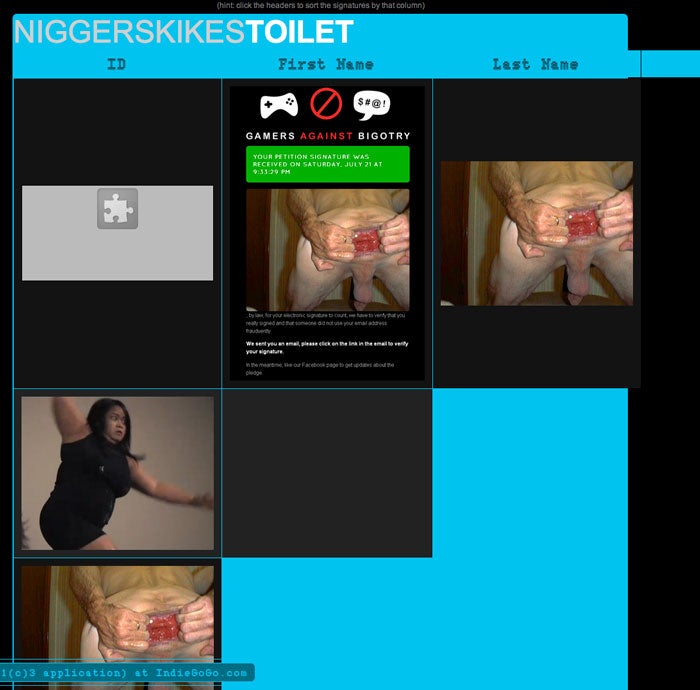
Among other defacing methods, the Internet vandals used exploits to add racial slurs to the list of pledger names. They added “NIGGERSKIKESTOILET” to a banner. They inserted pictures of the horrific Goatse. And they masked their IPs so they appeared to be coming from an address called 69.69.69.
(You can see some of the damage in a very NSFW image here. Don’t click if you’ve got a sensitive stomach.)
“We were, apparently, so threatening to these peoples’ lifestyles that they decided to take down the entire website.”
On Saturday, July 21, the attackers managed to take down the whole website for a few hours. They completely erased the names of all of the people who had pledged so far.
“Sunday, I was like, ‘you know what, I’m done with this,'” Killermann said. He spent a few hours learning how to write a patch that could filter racial slurs out of the petition, and he learned how to add some preventative measures to prevent people from running denial of service attacks against the website. But the damage had already been done.
“We only had 1500 pledges,” he said. “We were, apparently, at 1500 pledges, so threatening to these peoples’ lifestyles that they decided to take down the entire website.”
So instead of using the money they’d earned on crowdfunding site IndieGogo to register as a non-profit and help spread word of the campaign, Killermann says they’ll have to use it to make sure this doesn’t happen again.
“What’s really sad about that is that one person or a small group of people has managed to effectively take away the voices of 1,500 people who have signed the pledge so far,” he said. “That’s gonna get so much worse if, in a month, if we’re up to 100,000 people and one person can come and wipe that all clean. That’s really sad.”
(Photo: l i g h t p o e t/Shutterstock)