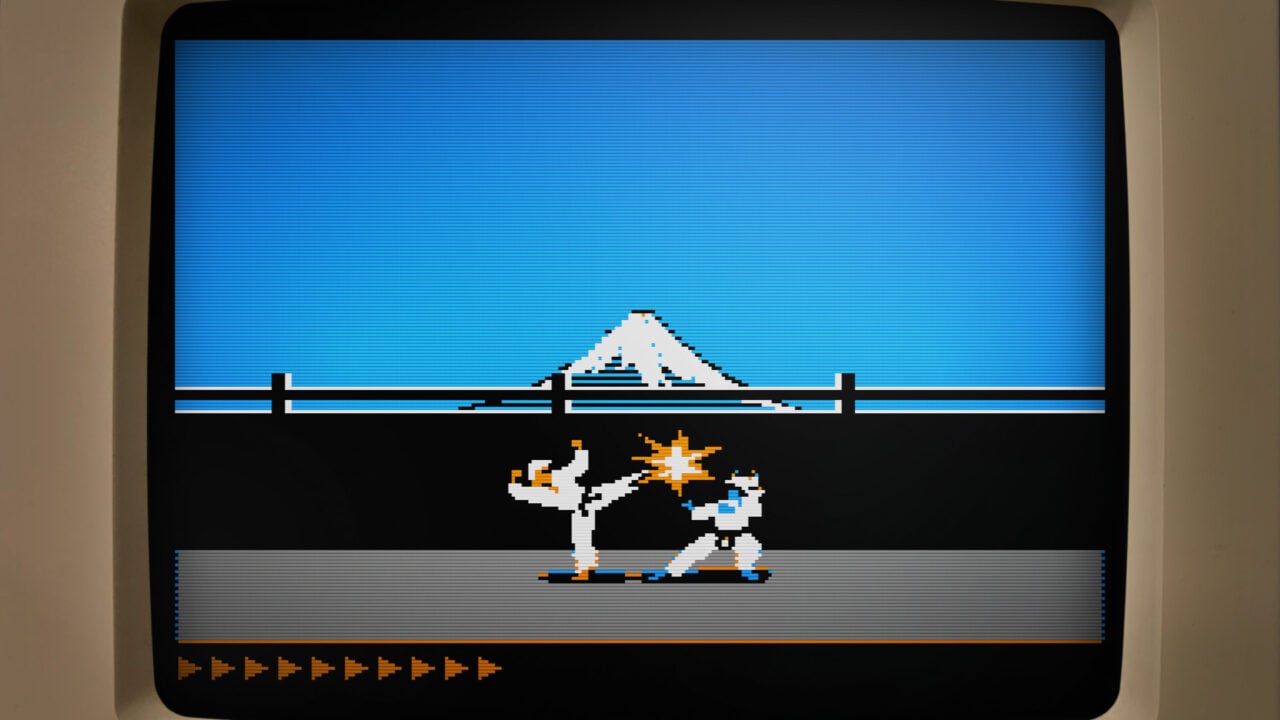
In 1984, a game was released for the Apple II that was totally unlike anything that had come before. Casting you as a martial artist who must infiltrate a warlord’s castle fortress, Karateka had breathtaking animation that was far more lifelike than anything that had preceded it. It also set new standards for martial arts combat and dramatic, movie-like presentation in video games. If ever a game has deserved a retrospective that delved into its making and its colossal influence on game history, it’s this one. And that’s exactly what we’re getting.
As someone who is passionate about both film history and game history, I’ve long lamented that so many great films get special editions packed with commentary tracks, behind-the-scenes featurettes, critical essays, and other features that help put those movies in their historical context and illuminate their greatness, but games almost never get the same treatment. That may finally be changing. Last year, prestige emulation studio Digital Eclipse put out Atari 50, a kind of interactive museum that not only contained a number of important Atari games, but presented them alongside interviews, historical documents, and other things that helped tell the story of Atari’s golden age and beyond.
I’d hoped that Atari 50 might be but a glimpse of what the future of game retrospectives would look like: interactive experiences that do as much to bring a game’s greatness to life as any Criterion Collection release might do for an important film. Enter The Making of Karateka, the first (and I very much hope not the last) in what Digital Eclipse is calling its Gold Master Series.
Karateka was created by a teenage college student named Jordan Mechner, who would go on to create the Prince of Persia series. That may be what he’s most known for today, but Karateka was a colossal achievement in its own right, employing rotoscoped animation to give its characters, for the time, unprecedented lifelike movement. It also featured fights that were far more tense and tactical than those in earlier games, with each encounter feeling like it could be the end of your quest if you weren’t careful. All of this was supported by the game’s breathtaking art and its stirring cinematic presentation, which periodically cut to Princess Mariko, imprisoned deep in the warlord Akuma’s castle fortress, lending your adventure a sense of urgency. To this day, Karateka stands tall as a triumph of focused design.
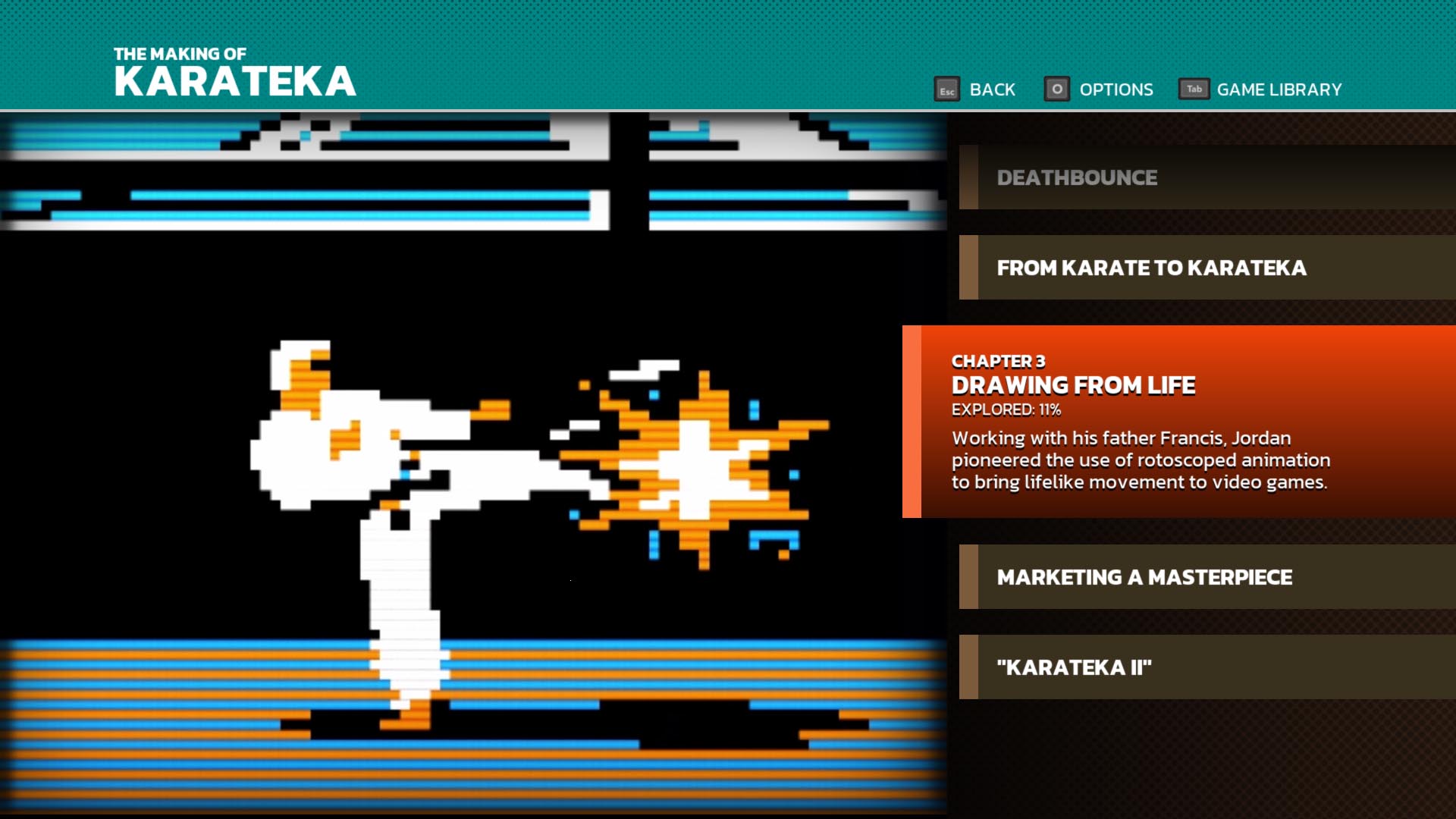
On its website, Digital Eclipse describes The Making of Karateka as a kind of “interactive documentary,” saying, “Through rare archival documents, playable prototypes, video interviews, and much more, The Making of Karateka will delve into the story of this landmark release to a depth that no video game has ever gone before.” But, of course, Karateka is primarily meant to be played, and to that end, The Making of Karateka lets you play multiple versions of the game, as well as watch a playthrough that you can jump into at any time. Perhaps most exciting to me, there’s a commentary track from creator Jordan Mechner and his father Francis, who helped out with various aspects of the game’s development.
Is there a real market for this kind of thing, for classic, important games getting the Criterion Collection treatment? Or is it just me and a few other sickos who are hyped? If you ask me, these types of things are worth doing even if there isn’t a huge market for them, because this is history, and history matters. As it now stands, an overwhelming percentage of classic games are being lost to time, and that’s simply unacceptable.
I do hope The Making of Karateka is a success, and that there’s incentive for Digital Eclipse and other studios to release more games like it. Unsurprisingly, so does Digital Eclipse’s editorial director, Chris Kohler (who, full disclosure, used to work at Kotaku). When someone on Twitter raised the question of whether or not there’s really a market for this sort of thing, Kohler responded, “You know what? We don’t know. We really don’t. Maybe this is a crazy idea. It’s a self-published indie project. The risk is all on us. We just share this dream about how classic games should be treated, and how games themselves are the best way to tell stories about games.” Amen to that.
The Making of Karateka is due out later this year for Xbox Series X|S, Xbox One, PlayStation 5, PlayStation 4, Nintendo Switch, and Windows PC.