Outcast (PC, 1999)
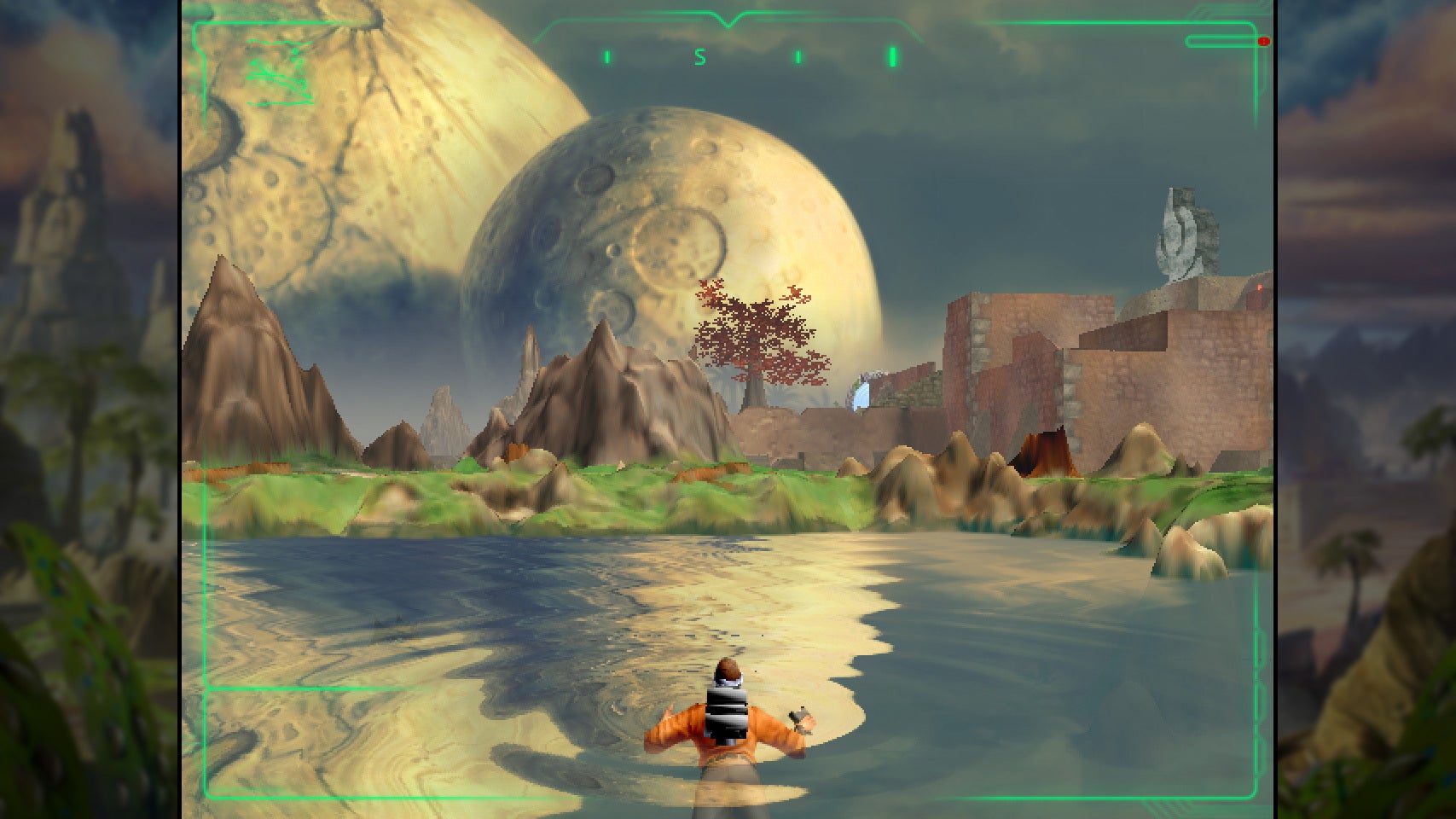
By 1999 the PC GPU revolution was in full swing, though we called them “3D accelerators” at the time. But while PC graphics were rapidly improving, not many 3D games could muster lush, convincing landscapes. To accomplish that, a few games turned away from the accelerated triangle zeitgeist to embrace a completely different technology: “3D pixels” called voxels. But 3D cards didn’t accelerate voxels—all that work fell to the CPU—so voxels could be unpopular among players who really wanted to flex their expensive new GPUs, and their CPU-only nature also meant lower game resolutions. Yet the trade-offs could be worthwhile.
Case in point was Appeal’s Outcast, a terrific third-person action-adventure starring a goofily loveable mercenary messiah-ing his way across an uncommonly detailed alien world. In 1999 a fast PC had to work hard to render the game’s voxel-powered landscapes at a mere 512×384, but goodness, those scant pixels were beautiful. (The screenshot above was taken in 640×480.) Outcast’s wide-open, gently undulating terrains made for a stark contrast to the crude, blocky landscapes of Quake II, EverQuest, and contemporary console games, and its water? Gosh, a good decade passed before GPU-powered shader schemes began to regularly outclass Outcast’s gorgeously simulated reflections and real-time ripples. Each region’s painterly, 2D backdrops were a treat, too.
Outcast probably suffered commercially for its technical choices, but Appeal clearly chose the optimal technology for the game it envisioned. I’m sure the many Ulukaï who fell in love with the world of Adelpha and its quirky inhabitants, myself included, would agree. — Alexandra Hall