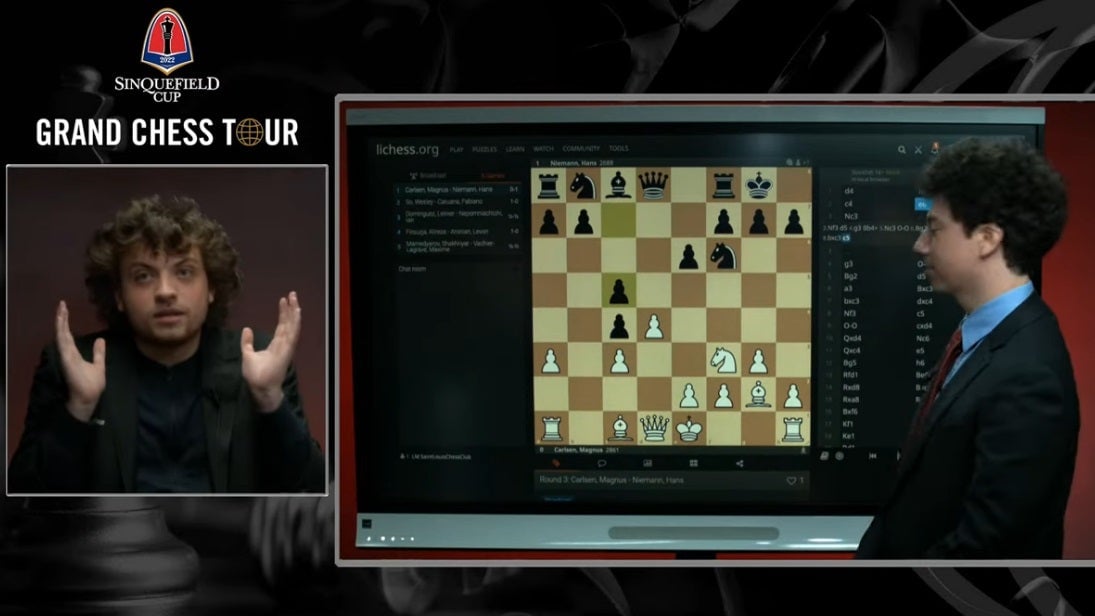
Hans Niemann, who sparked the internet’s favorite anal bead meme last month after beating chess world champion Magnus Carlsen in a stunning upset, is now accused of cheating in over 100 online matches, according to a new unprecedented 72-page report by Chess.com. The world’s most popular website for online chess shared it with The Wall Street Journal, and is calling on some in-person matches, including Niemann’s victory over Carlsen, to be investigated further as well.
Niemann had previously admitted to cheating in online matches twice, including once when he was 14 and once when he was 16. However, The Wall Street Journal now reports that based on Chess.com’s findings, the 19-year old grandmaster has actually cheated much more often than that, including in prize tournaments where actual money was on the line. According to Chess.com’s report, Niemann also privately confessed to the allegations back in 2020.
“Looking purely at rating, Hans should be classified as a member of this group of top young players,” The Wall Street Journal quotes from the report. “While we don’t doubt that Hans is a talented player, we note that his results are statistically extraordinary.”
Chess.com’s cheat detection uses an algorithm to calculate how likely it is someone is cheating based on things like how quickly they move, how highly ranked the move is by a computer, how often they “toggle” between screens on their computer, and their past history as a player on the site. It’s all aimed at trying to figure out whether someone is using a chess engine to feed them the best moves in any given situation.
Read More: Chess Players Are Convinced The Anal Bead Scandal Is Causing More Online Cheating
What its algorithm isn’t designed to do is determine how likely it is that Niemann cheated in over-the-board matches, like the now infamous one in early September against Carlsen. Even so, the report calls for further investigation into that match, as well as some others, especially because of what it calls Niemann’s “uncharacteristically erratic growth” in his player ratings at various points in his career.
While this all explains Niemann’s recent ban from Chess.com, it will only fuel speculation about his over-the-board win against Carlsen. It didn’t help that the world champion resigned from a tournament after just one move, leading many to see it as a protest against cheating methods. The evidence for the accusations at the time was so thin that Twitch chess pundits and Reddit posters joked that it must be anal bead super computers that vibrate in specific patterns based on what the best move is.
When Carlsen finally broke his silence on the matter, his only real contention was that he had a bad feeling about Niemann while the two played. The 19-year old didn’t seem “tense” or like he was concentrating” enough, the world champion argued in a written statement. If this seems like a strange statement that rides too much on an amorphous feeling, it’s worth knowing that chess players can burn thousands of calories simply sitting there. At high levels, pro players can even lose pounds during matches. And so it seemed suspect for a competitor to seem so at ease while playing against the world’s best, is the basic argument.
While others have criticized Niemann’s post-match analysis of his victory for sounding shallow and unconvincing, no one has yet discovered a smoking gun like a rogue ear piece discovered in the bathroom or a mole who claimed to have leaked Carlen’s strategy going into the match. No anal beads either, but also no more convincing explanation of how Niemann may have cheated in person.
FIDE, chess’ world governing body is still in the midst of its own investigation, but while Chess.com’s findings only related to prior online cheating, it’s sure to send the chess world into another tailspin. While there’s no reason to doubt Chess.com’s report, many in the community are now calling on the organization to make its findings public so that they can review the games in question as well. It’s also worth noting that the online chess company is currently set to buy Carlsen’s chess app for $83 million, though Chess.com told The Wall Street Journal that Carlsen was not involved in the report and did not in anyway influence it’s release.
A spokesperson for Chess.com told Kotaku the full 72-page report will be published online Tuesday night, but declined to answer any additional questions. Niemann and Carlsen did not immediately respond to a request for comment.