
It’s 2016. Bearing this in mind, go play a shooter from 2010. Or a sports game. Or, well, anything else from 2010. Look how (relatively) basic it is! Notice how advances in game design and technology have rendered so many of these former classics obsolete. Now go and play Civilization V. I’ll see you in six months. If we’re lucky.
I reviewed Civilization V for this website in 2010. At the time, I thought it was a very good, very ambitious re-tooling of one of the all-time great video game series, albeit one with a few key issues, teething problems related to said re-tooling.
The thing is, that was back in 2010. In the almost six years since the game’s release, Civ V is still around. It’s still a thing, having seen a myriad of changes, from improvements made through patches to fundamental upgrades that came with two official expansions.
And in those six years, despite advances, despite competition, Civilization V remains one of the best PC games you can buy today! Yes, it helps there hasn’t been a Civilization VI—and that the 4X genre itself is sadly stagnant—but it also helps that Civilization V’s razor-sharp user interface, timeless art-deco style and gorgeous character animation means that despite its age, it still looks as good (and plays as well) as many of its more contemporary peers.
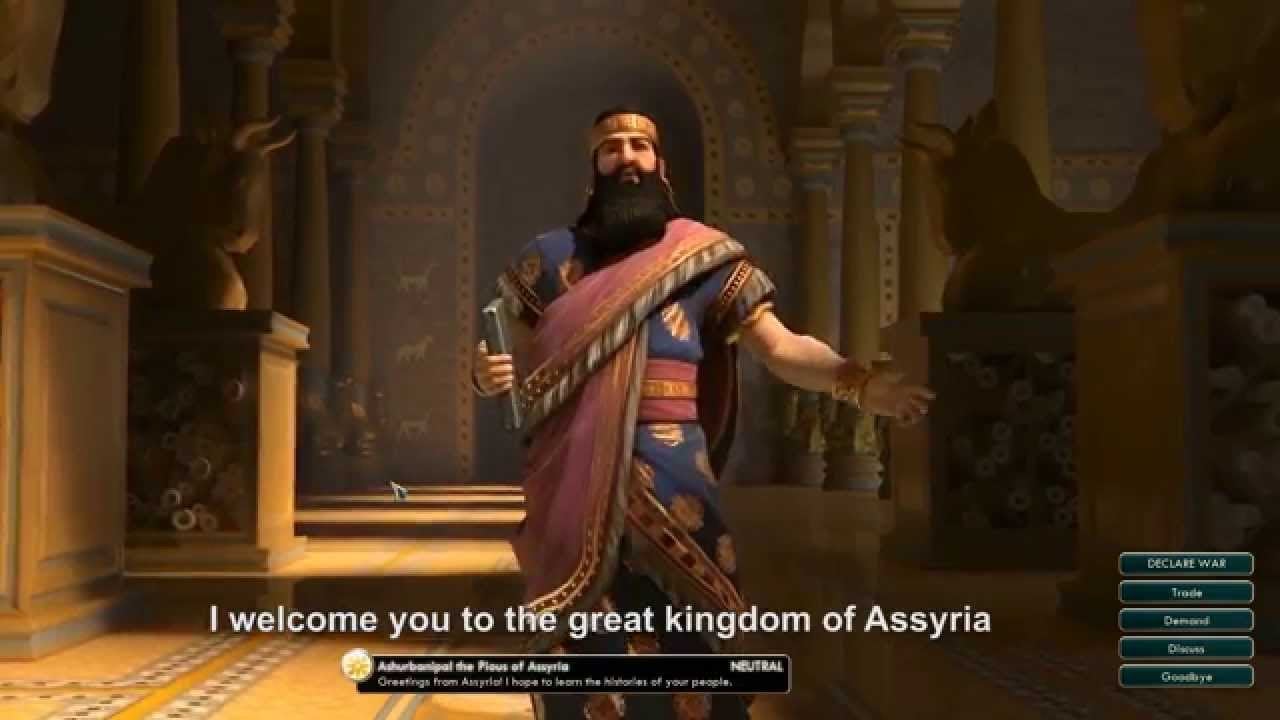
The first thing that hits you about Civ V in 2016 is that the only way you’d know this game is so “old” (in game/dog years) is if somebody reminded you. Its menus, with their art deco inspiration, are almost timeless. Its cinematic intro still looks slick. And its character portraits…well, we’ll get to those later.
It’s tough talking about Civilization V without talking about the Civilization series itself. Being the fifth game in the series, it’s built on decades of development and refinement, as much a product of the games that came before as the men and women who worked on this one.
But what made Civilization V unique, and what’s kept it more relevant than it perhaps might have been had it not made this decision, was the breaks it made from that legacy. The first four Civilization games are, when viewed through the lens of history, very similar. Sure, the visuals changed, and occasionally stuff like borders would come along and shake things up, but for the most part, the way you moved, built and fought—the nuts and bolts of the Civ experience—changed very little from 1990-2006.
It was all about square tiles. You built your cities on them. You moved your explorers and combat units around on them. You fought over them. And most importantly of all, you could put as many units as you liked in them. It made practical sense back in the day, I’m sure, but the unintended result of this was that the game was never really about the entire world around you so much as it was a handful of flashpoint tiles.
Ironically, given this is a strategy series, that design decision robbed the game of much of its, well, strategy. The deployment of armies—one of the great determining factors in shaping human history—became less a matter of skill and terrain and more an exercise in dogpiling, a battle of which player could stack more firepower in a single piece of land and grind out a victory.
From Civilization to Civilization IV, this remained the same, so much so that it became accepted, part of the series’ furniture. Then Civilization V came around and decided to throw it all out in favour of a new, hex-based system, one which didn’t just do away with squares, but also with the practice of stacking units.
In Civilization V, only one military unit could occupy a hex at any time. It was, within the confines of this conservative series, a revolution.
I remember at the time this was met with equal parts relief and outrage. Relief that such a backwards way of conducting warfare had been sorted out, but also outrage at the absurdity of forcing small-scale tactical restrictions on continent-sized maps.
Yes, it was dumb that two spearmen, a horseman and a catapult could block an entire archipelago, but then, this is a series where Gandhi drops nukes and Alexander can survive to the space age, so who gives a shit about “realism”. If one small weirdness could improve the game’s military and exploration phases so much, then it was a weirdness worth tolerating.
Speaking of those hexes, to think, at launch people were worried about them being Civ V’s big change! In hindsight, the introduction of little six-sided tiles seems almost trivial next to the influence that culture, religion and ideologies would eventually have (courtesy of expansions) on the way you play Civilization
Civ would always try and boast that its culture and diplomacy allowed people to pursue non-military paths to success, but in practice those claims always rung a little hollow. The game’s systems were skewed so heavily towards the production of units and the capture of territory that simply talking your way out of things felt like you weren’t doing something different, you were just doing something lesser.
Those trials ended with Civilization V. This game’s non-military aspects are also its great legacies.
Culture, long a hot mess, has in Civ V been refined into something genuinely useful. You can build more buildings that generate it. You get more units which can spread it. Later, archaeologists can improve your current culture by diggin up the bones of your vanquished foes. It finally feels like a worthwhile way to try and win a game of Civ, something that can be specifically targeted, and developed, and used almost as its own bloodless weapon.
Religion also winds itself into the bones the game. You can’t research it, you can’t buy it, you can’t trade for it, but once unlocked it’s always there, always offering you interesting things to play with, always influencing the cities and cultures around you. It permeates the very fabric of a Civilization while remaining largely outside your direct control.
Just like an actual religion. Smoothly done, Firaxis.
Ideologies are Civ V’s third masterstroke. As you explore the globe and meet your opponents, your Civ world gets smaller. The more you learn, the more you stop fearing the unknown. To both maintain that sense of division, and to replicate the modern world’s penchant for building warring camps, Civ V introduced ideologies, which are adopted during the industrial age.
They become your Civilization’s brand. Your uniform. Given a choice between democracy, fascism and communism (and you have to make a choice), the decision you make has a massive effect on the later stages of the game, granting you a series of unique abilities and bonuses.
Even more importantly, though, they define your place in the world. Out go long-standing feuds over land and religion, replaced in importance by clashes over ideologies. Democracies will band together with democracies. Communist states will party together. Fascists will high five before goose-stepping off into the sunset. And every group will despise the other, setting the stage for the endgame’s planet-wide clashes, which don’t just accurately reflect those of the actual modern era, but also present a different side of the game’s diplomatic and military challenges.
That’s why these three systems have become Civ V’s great legacy: more than any other game since the original, they’ve provided new, challenging and fresh ways to enjoy the bones of a decades-old series with none of the repetition. It’s been promised for years, but in Civilization V, you really can play the game in very different ways and have just as much fun as you would have dropping nukes and building tanks.
There’s no doubt that there’s a timelessness to the fundamentals of the Civilization series. Every single game, even 1991’s original, remains eminently playable today, both in terms of how it plays but even how it looks. Remember, as crude as Civilization’s world view may look today, its city and character screens remain some of the series’ best!
But there’s something especially timeless about Civilization V. Evidenced by how long it’s been since we got a new one.
We’ve never gone this long between Civilizations. The longest we had to wait was five years between Civ II(1996) and Civ III (2001). At the time of posting it’s been well over five years since Civ V, and given modern marketing and development timeframes, even were Civ VI to be announced tomorrow we’d be looking at a 6-7 year gap in the series.
But is that such a big deal?
I’ve long believed that the thing that sets Civ apart from its competitors isn’t necessarily its scope or the near-perfection of its systems (though these obviously play a part), but the way each game has injected its complex set of progression and strategy with a heavy dose of humanity.
Firaxis have quite the knack for this stuff. Each leader you encounter in Civilization is someone with personality, emotions, agendas. They’ve been masterfully constructed to take advantage of our inner bias and tendencies; Pedro II’s grace, Dido’s smarm, Theodora’s smug grin, Bismarck’s arrogance…all designed to not just bring life to each opponent but to get a rise out of us, prompt the player to treat each rival like an actual rival, not some random piece of code.
This is achieved the same way it is in XCOM; with animation. There’s something about Firaxis’ character animation that, despite each leader’s slant towards a cartoon appearance, makes them look and behave so naturally. Everything about them has been considered and honed to perfection, from their pose to their background to their little quirks, little things that other studios may overlook or not deem worth the effort, but which here make one of the most under-appreciated differences to the player’s entire experience with the game.
Would you grow to hate Napoleon with every fibre of your being if he was a static character portrait generating text in a bubble? Probably not. But stick him on a horse, have him scowl at everything you say and have him reply in a rude little French voice? Yeah, fuck that guy.
The leader sequences look as good in 2016 as they did in 2010, but they’re not working in isolation. The adoption of an art deco UI seemed a little strange at the time, but has since been proven to be a smart move. If it had gone for “modern” in 2010 it’d look dated by now, but base it on something that’s almost 100 years old and what difference does 5-6 years make?
Rounding out the game’s visual immortality is the map/world itself. One of the big reasons I soured on Civilization: Beyond Earth was because it looked so drab and dreary. Civilization V’s map, on the other hand, is gorgeous. Crisp blue seas, rolling green plains, bright purple and orange and white units, it’s a delight to just sit back and behold. Which, given this game’s tendency to make you sit back a lot, is handy.
The mod scene has also contributed to Civ V’s longevity and appeal. The game’s Steam Workshop integration means there’s an almost endless supply of mods and tweaks, some cosmetic, some historical, some just for shits and giggles.
https://lastchance.cc/make-your-civ-v-game-a-little-more-realistic-1598323504%3C/a%3E%3C/p%3E
The fact I can write about a painstaking recreation of the world in 1900 and an almost apocalyptic Donald Trump mod—and be talking about the same game—is testament to how well mods have complemented the core design of Civ V
They’re also one of the reasons that this game endures not just critically, but socially as well. Civilization V doesn’t exist in 2016 in a vacuum, or as some vintage game; it remains immensely popular, with an active subreddit, strong Steam sales and even stuff likethe attempt at a 61-player “Battle Royale”…
https://lastchance.cc/civilizations-huge-61-player-war-is-just-nuts-1731248232%3C/a%3E%3C/p%3E
Time may have been kind to many of Civ V’s best aspects, but while expansions and updates have bolstered the game in some areas, others are in need of a helping hand. Combat AI, especially at lower difficulties, can still be maddeningly simple and ineffective, while on harder ones it still feels like you’re being cheated.
Likewise, the diplomatic AI still hasn’t managed to match the personality of its visuals. Opponents will still make repeated and unnecessary demands of you, anda lot of the time erratic declarations of war come across as, well, more erratic than unpredictable.
Advances in CPU power seem to have had little effect on turn times for larger maps either, requiring big/late game players to have the patience of a saint as turns process.
In 2014, we made public our declaration that we were as interested in the games of the present as we were of the future. And just because it’s from 2010 doesn’t exclude Civilization V from that coverage. Thanks to some big improvements and classic design decisions, the game remains as relevant and important in 2016 as it did at launch.
I loved it then, and I love it even more now.