AfterClimate, a research and consultancy business “on a mission to decarbonise the games industry,” have this week published the results of their “game industry net zero 2022 snapshot.” It’s a report that takes a detailed look at how most of the world’s biggest video game companies are responding to the impending climate crisis. The good news is that some are doing a lot of work! The bad news is that some are doing nothing, while others won’t even release their numbers.
The report was penned by AfterClimate’s Dr Ben Abraham, author of the book, Digital Games After Climate Change. It basically takes a bunch of “net zero targets, Environment, Social & Governance (ESG) disclosures and other sustainability programs and achievements,” released by video game companies—and tech giants with video game interests—and grades them. They’re assigned into one of four categories based on how committed they are to limiting global warming to a rise of 1.5 degrees celcius above pre-industrial levels.
The first group, the ones doing the most work, are labelled as “Ambitious”. These are described by the report as:
Each of these companies (or their parent) have set strong targets, and present compelling evidence of having taken steps to actively reduce emissions. There is still much work to be done to achieve these targets, but they are moving in the right direction.
These industry leaders are setting the pace, and showing what sort of ambition and action is possible in the games industry.
Some of the companies earning this praise are Microsoft, Ubisoft, Apple, Google, The Embracer Group, Tencent, and Riot.
After that comes the “Baseline” group, described as:
This group of companies are already taking action, however without the same speed and urgency as those in the ambitious group. This is the minimum acceptable standard, and can still be improved upon.
Among the companies in this grade are Sony, Activision Blizzard, Konami, Sega, and Bandai Namco. As you can probably guess by the fact we’re already at the “minimum acceptable standard” and we’re only halfway through, what follows is not fun reading.
The third group are companies that need to “Catch-Up”.
These companies are increasingly aware of their environmental footprint, with some even taking tentative steps to reduce it, but have yet to set a date for corporate net zero emissions.
With decisive leadership and careful planning, these companies could quickly leap-frog the baseline and join the ambitious group.
Companies needing to catch up are Nintendo, EA, Take-Two, Zynga, and NetEase. The fourth and final group are in the “Non-Compliance” bucket, the bottom tier and companies that absolutely need to do better
These are the under-performers of the games industry. These business are exposing themselves to significant risk (physical and transition risk) from climate impacts as well as threatening their brand integrity and social license to operate in an increasingly environmentally conscious world.
Disappointingly, some of these companies appear not to have considered the environmental impact of their operations at all. There is simply no excuse in 2022 for neglecting ESG disclosures. Stakeholders, investors, and even players themselves are already beginning to expect more than this.
Companies earning this failing grade include Square Enix (whose ESG contains no mention of the environment), Roblox, and Nexon. It’s important to note when naming, shaming (and praising!) all these folks, that two of the biggest video game players in the market—Valve and Epic—couldn’t even be graded, since they release absolutely no data or information about their climate impact, nor have they made promises to address it in the future.
It’s this bottom group (and the two major absentees) that are by far the biggest concern, because there’s a such a gulf between their actions (or lack thereof) and those above them. “My approach has always been, ‘what actually needs to happen?’ not ‘what is possible?’ because I think the situation is so urgent that we almost need to work backwards from what needs to happen—which is immediate, deep decarbonization,” Dr. Abraham tells Kotaku. He continues,
The groupings themselves sort of emerged organically from the net zero dates that everyone had set, and really the difference between the first three groups (ambitious, baseline and catch-up) is primarily down to their net zero targets. The bigger gulf is between those companies in the non-compliance group, because most of them have yet to even start to think about ESG. Taking a corporate culture on the journey towards net zero and sustainability is a mammoth task, and it can’t be done overnight. It requires building buy-in from the top to the bottom of the organization.
Dr. Abraham thinks the margins are so close that many of the companies in the second and third groups could be up top by next year, including Sony, who just brought their date for achieving net zero emissions forward by a decade. Which is a lot harder for a company like Sony—which also makes millions of physical products—to achieve than some of the software-only games companies mentioned elsewhere in the report.
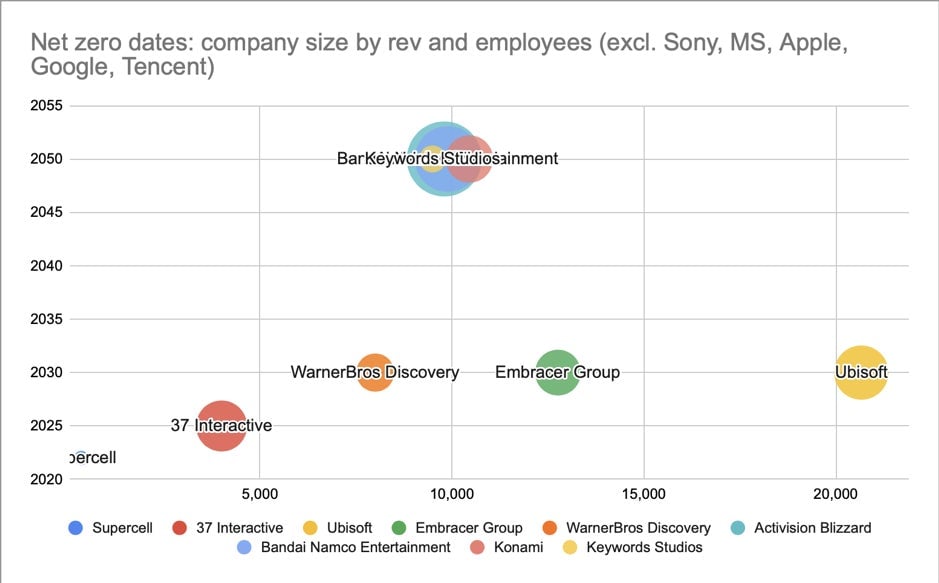
It’s important to note that what’s contained in this report is just a general, over-arching picture, one that is already out of date (since it’s based on 2021 figures), and which can’t take into account advances some companies have made since.
An example of this are changes that Microsoft and Nintendo have made to their supply chain, which previously had been outside the margins of most company’s environmental pledges. “Some positive news can be found in the agreements that big companies make any supplier sign (usually a slightly smaller company) that does work for them,” Dr. Abraham says. “Think of like Foxconn making iPhones, or game developers who make (or work on) games for another developer—huge amounts of work in the Triple A gamedev space is done on a contract basis.”
“You might get some 3D environmental art made by a team in China, for example,” Abraham explains. “So these supply chain policies set the expectations for standards of behaviour of those companies—usually they cover basics like ‘don’t break the law,’ ‘treat employees fairly,’ but increasingly we’re seeing them also be used to make these companies measure and act to reduce their greenhouse gas emissions.”
The researcher continues, “So Sony has one that now does this, Nintendo has one with an environmental focus (probably for the companies that make the Switch), Microsoft has a really strong one I just heard about the other day which doesn’t let companies use purchased offsets to reach net zero. All good stuff.”
Dr. Abraham says that the exciting news is that such actions can have a “trickle-down” impact on the rest of the industry. “For example, Sony’s supplier code of conduct requests that the companies it works with also ask their suppliers to agree to and abide by Sony’s supply chain code of conduct. So you can imagine how far that sort of thing could spread. Who in the games industry is more than two degrees of separation from Sony? Not many, I would imagine! It’s the space to watch in the coming year, I think, and it’s where game developers are likely to be caught out. Because at some point if you want to sell games on PS or Xbox you’re going to need to be carbon neutral or there may well be consequences.”
While there is much to praise here, especially from bigger companies like Microsoft, I was also curious about the possibility for corporate blowback, with a report like this—specifically highlighting someone’s performance in one specific, deeply important subject—potentially damaging a company’s reputation.
“I do think there is some insecurity around these issues at some of the companies included in the Snapshot, and not from just the ones who are currently treating ESG like a joke,” Dr. Abraham says. He adds,
The explanation that I’ve heard is that many companies are just not sure what to do – they are all on a learning process and on this journey to net zero, figuring out what it really means. I try to be fair but firm in my assessments, so I expect not everyone will agree with them, or say that I’m not considering everything I could, but at the end of the day my allegiance is to the planet first. I’ll keep saying it because it’s true: we have to become partisans for the necessary, not just the possible. I hope the snapshot tells the industry some things that it didn’t know before, encourages those who need encouraging, and points out the laggards who maybe need the point reinforced for them that business sustainability is not an optional extra on a planet that is rapidly warming. Investors, game industry workers, players and the press are going to demand more. There are real consequences to ignoring this stuff.
To that end AfterClimate is encouraging more employees and companies to help shape next year’s report. And if you’d like to read this year’s report, it can be found here, along with links to a spreadsheet containing the full set of data used to generate it.