Death Stranding is undeniably an odd game. It has floating spirits, rain that makes you older, ghost-detecting babies, and pee bombs. That’s not to say that the weirdness makes it bad, though. Even its harshest critics, who deride it as a “massive failure” or (gasp!) a “walking simulator” will admit that the game adds a totally unique experience to the AAA market. Rather, most critics argue over whether the game is distilled genius, or whether Hideo Kojima has gone too far into his own particular brand of the bizarre, particularly in the matter of the game’s plot.
The plot, one could argue, comes across as hopelessly convoluted, and Kojima himself has said he doesn’t know what the narrative “means.” At a basic level, it’s about a post-apocalyptic Amazon delivery man uniting bunker-dwelling citizens into a new nation that can meet the floating-ghost threat. A little deeper, and it has to do with rescuing the delivery man’s sister, stopping an impending ghost-armaggedon, and maybe figuring out what’s up with that soldier guy who keeps pulling you into undead war scenarios. Any deeper, and even fans struggle to clearly articulate the full plot.
But in fact, the clearest way to explain the story—an explanation which actually renders the convoluted plot surprisingly simple—is that it is a modern re-imagination of the old Japanese legend of the sorceress-queen Himiko and the Yamatai kingdom.
The Yamatai kingdom is one of the earliest known Japanese civilizations. Scholars hotly dispute its actual location, but Chinese histories record that emissaries from the Yamatai kingdom first arrived in the East Han court in 238 AD. According to the classic Chinese historical text The Book of Wei, the Yamatai kingdom formed from 29 different tribal communities that came together voluntarily under a common government to end decades of warfare on the island.
While there are 36 different shelters protagonist Sam Porter Bridges can connect to in the game, seven of those are attached to your own group, the United Cities of America, as stations or distribution centers. Kojima, a noted stickler for details, created exactly 29 different groups to form the new “America” that Sam is supposedly building. But it’s an America with no Constitution, no Congress, no elections, no rhetoric paid toward the individual rights of man. It’s simply a union of, again, 29 different communities under a common government with a common ruler—a “president, Amelie Strand,” who inherited her position from her mother, Bridget Strand. Like a queen.
The connection between Death Stranding’s Amelie and Queen Himiko
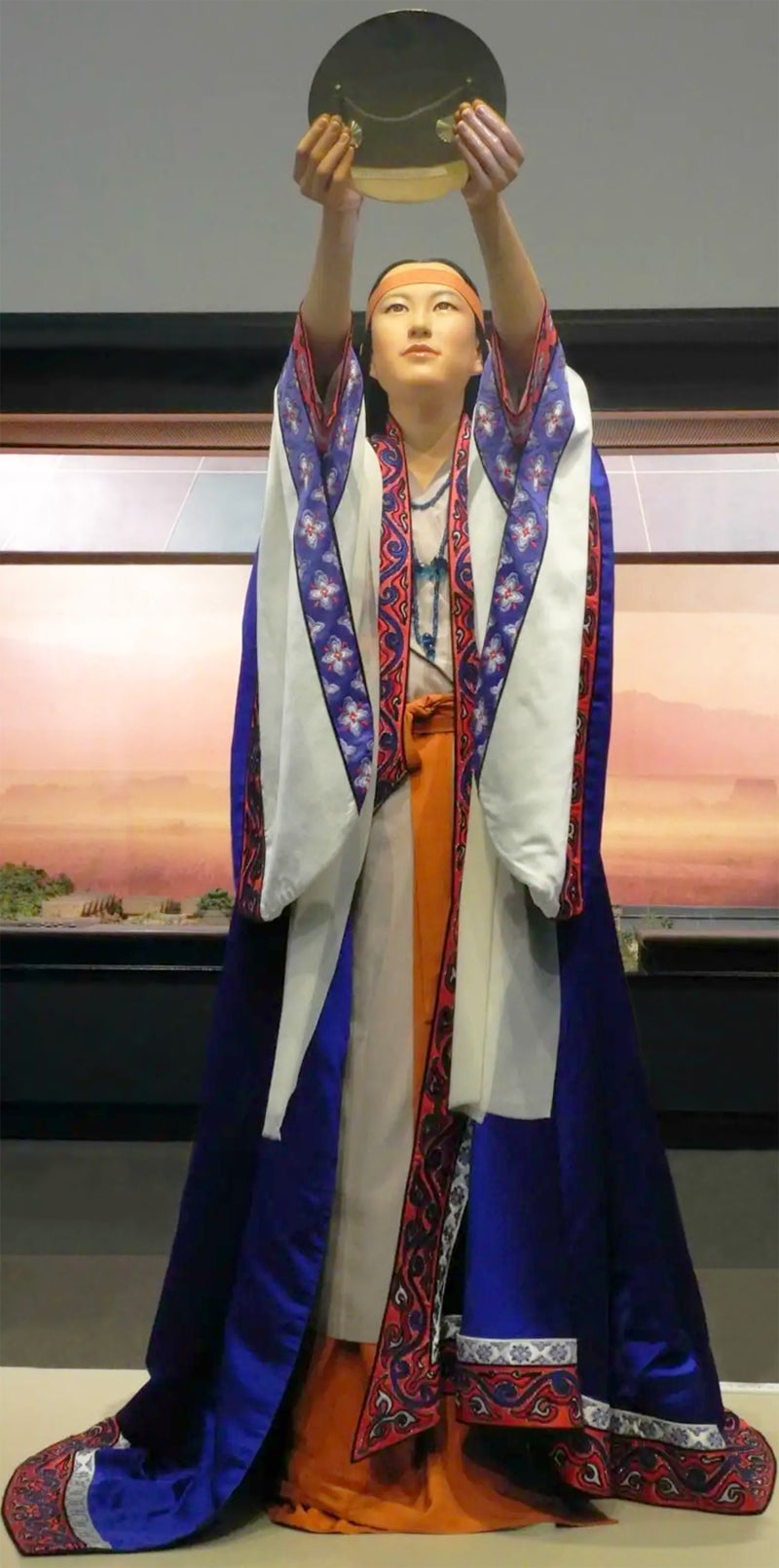
Queen Himiko ruled the Yamatai kingdom from roughly 180-247 AD.. Despite a somewhat complicated reputation, she remains a popular figure in Japan to this day. She pops up in anime and manga, and even functions as the mascot for a few Japanese villages. Depicted as everything from a conniving old hag to a young sexy seductress, Queen Himiko also showed up in the most recent Tomb Raider reboot as an ancient witch-queen who transfers her spirit from an old woman into a young lady.
That’s because, according to legend, the historical Queen Himiko was indeed a sorceress.
Tomb Raider here is following the tradition of Gishi no Wajinden, a Chinese account of the Japanese people, which claims that Queen Himiko “occupied herself with magic and sorcery, bewitching the people.” Despite that, Wajinden also describes the kingdom as prosperous, happy, and peace-loving. This is why depictions of Queen Himiko vary so strongly; no one is quite sure whether to present her as good or bad, especially since supposedly she was barely glimpsed outside her own compound.
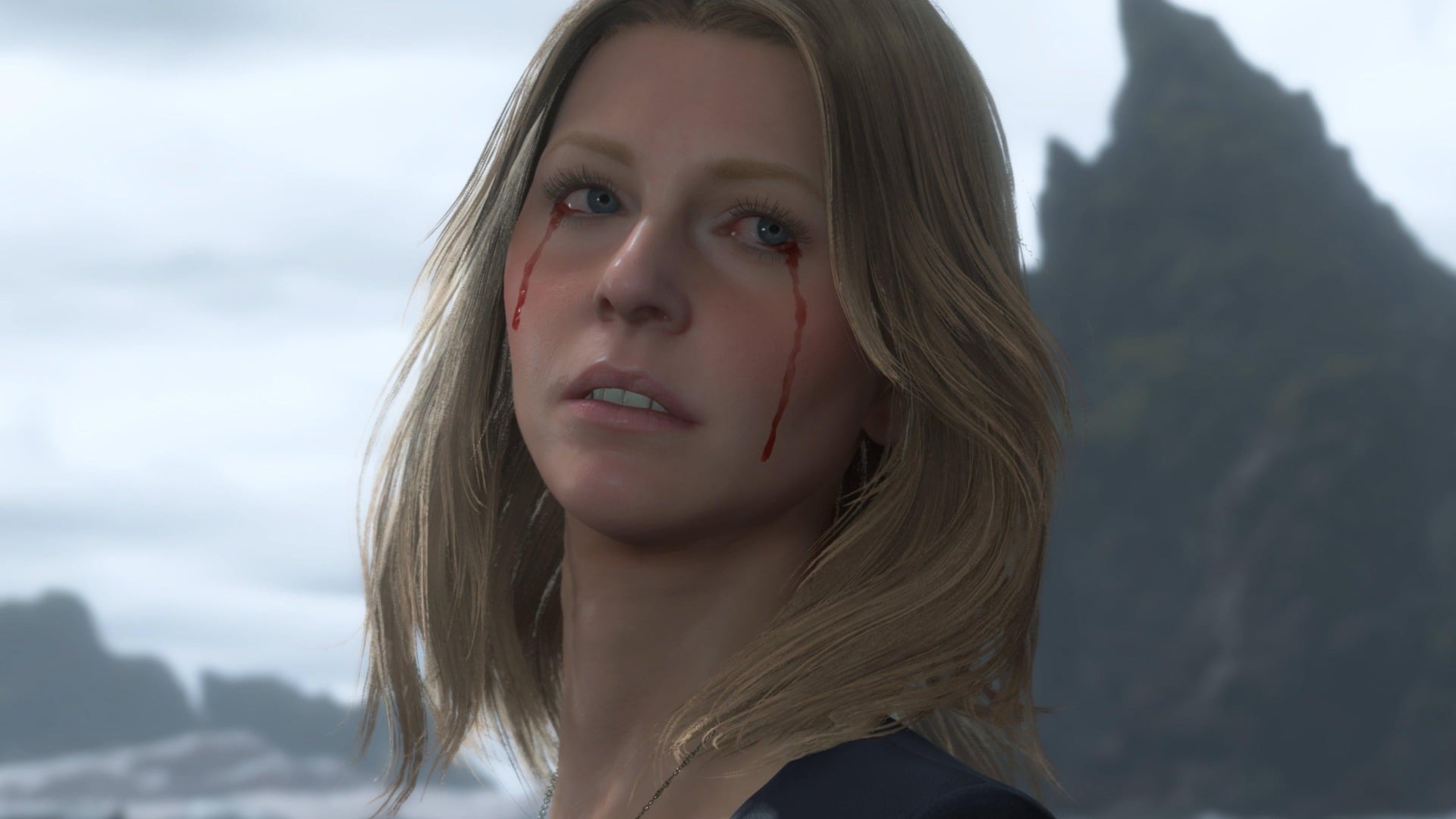
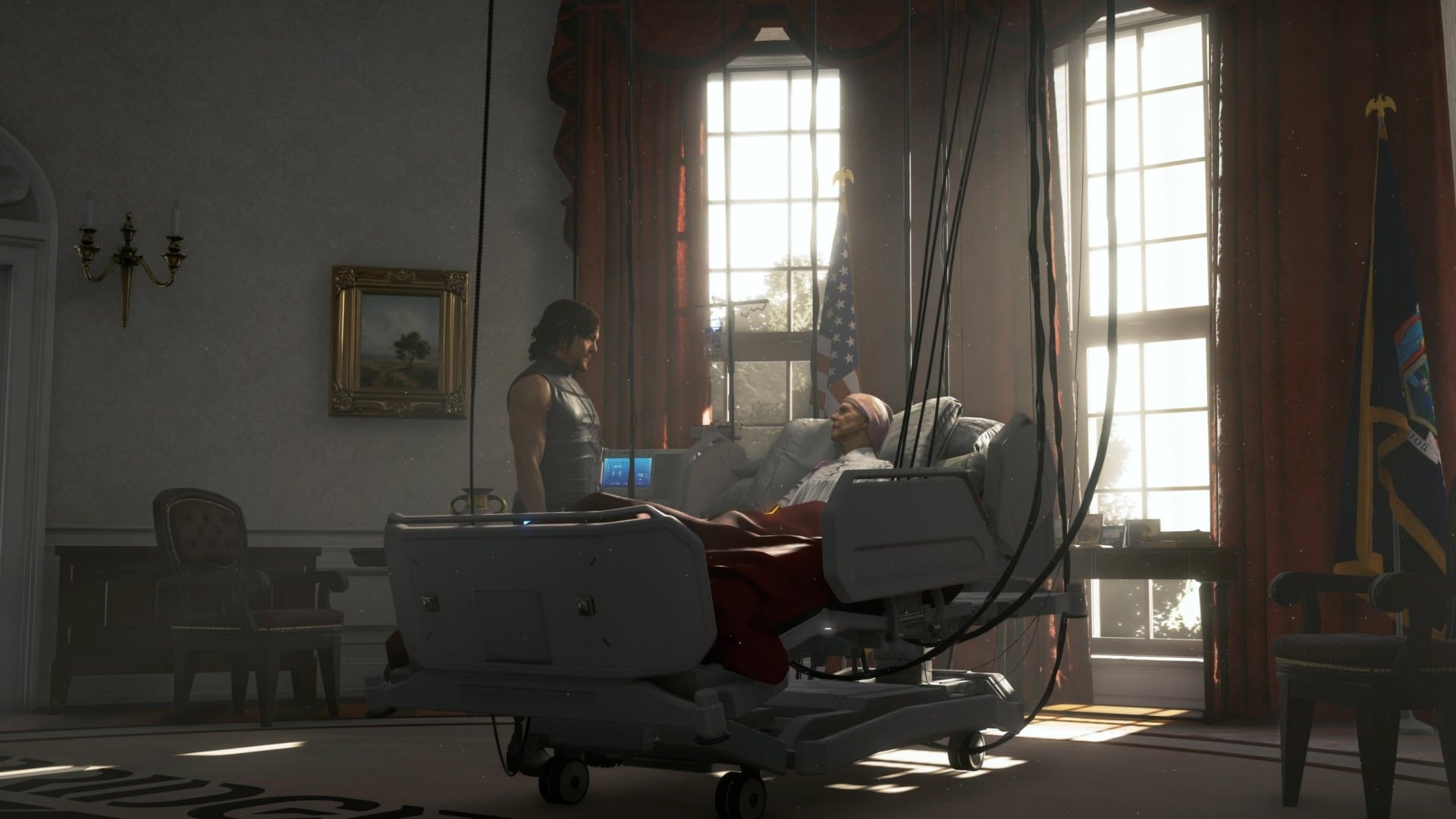
This may be starting to sound familiar to players of Death Stranding. Amelie, the “president” in the game, is rarely ever actually seen by anyone, supposedly remaining a prisoner in an isolated compound where she can only communicate via hologram. It’s worth noting that her “mother,” Bridget, also was isolated to hide her cancer. But even when Amelie is limited to holograms, anyone who speaks with her becomes notably infatuated with her—especially because her presence brings stability and prosperity through the “chiral network,” a sort of magical wi-fi that Sam uses to link up the shelters. And just like Queen Himiko, Amelie has a special connection to the spirit realm, to the point where she can summon and control the demonic BTs that haunt the post-apocalyptic America.
Of course it’s hardly possible for a president to handle everything through a hologram. Most of Amelie’s wider duties are handled by a masked man named Die-Hardman, just as the historical Queen Himiko supposedly communicated through a single male attendant. And like Amelie, Queen Himiko had one more crucial helper, one man who is recorded as handling all the “affairs of state,” who likely would have been responsible for handling the demands of all 29 communities and getting together what they needed.
Her younger brother.
The key to Hideo Kojima’s story
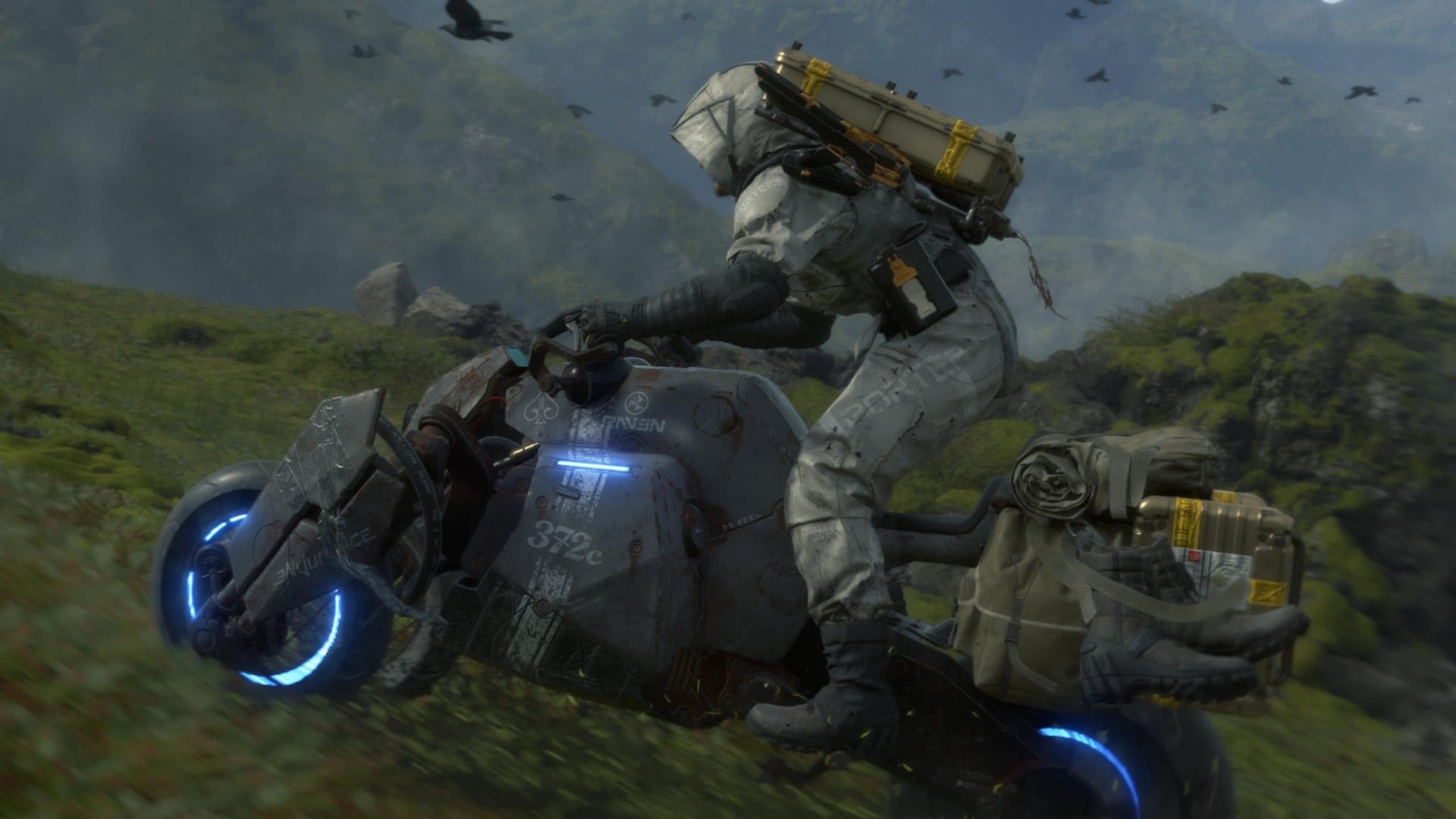
Sam Porter Bridges, protagonist of Death Stranding, is the younger step-brother of Amelie. With the help of a baby he takes to calling Lou, he journeys personally to all 29 different shelters, learning what they need, fielding requests, building up infrastructure like roads and recharge stations. Everything he does, he does out of love for his older sister, the ruler, the sorceress.
Hideo Kojima’s story for Death Stranding is not, in the proper context, confusing at all. It is a futuristic re-imagining, perhaps even a reincarnation, of a very old story. I believe that is why Hideo Kojima admitted he didn’t know what the story “means.” It wasn’t written to make a point, it was written to adapt a legend. In this context, it’s quite clever how Kojima has managed to marry the conflicting images of Himiko as sensitive and sinister; old and young; human and, truly, divine.
It’s not merely a turn of phrase to call Himiko divine. “Himiko” means “daughter of the sun.” Queen Himiko, like the Japanese royal family today, likely claimed direct descent from the sun goddess Amaterasu—who also, in some traditions, serves as a nameless goddess of the sea and the afterlife. Though her counterpart, Amelie, never voices any such claim, the eccentric scientist Heartman describes her as an “extinction entity,” an evolutionary next step destined to kill all life, as with every extinction before. He describes her particular afterlife, her “Beach,” as a realm that encompasses all other “Beaches,” on a higher level entirely from other humans.
And when Sam meets Amelie on this higher spiritual plane, he meets her against the backdrop of a blazing sun.
Amelie tells Sam that Bridget and Amelie are just names, labels for what she truly is: an incarnation of the spiritual plane—the Beach—itself.
Amelie is not merely a soul gone astray, not simply some bizarre evolutionary mandate. Amelie is the sun goddess Amaterasu; bound by fate; an unshakeable part of the cosmos. That is the “Extinction Entity” that Heartman is hunting for: a literal god. A god who suffers visions of the future, but cannot interfere in human affairs. A god who can be punished by “the universe” for disrupting the balance of things. A god who, in the end, stands in her realm, sacrificing herself to hold off the predestined Armageddon.
It’s really quite a beautiful story. Perhaps it would be a less confusing one, if Hideo Kojima had framed it in a world of shoguns and castles instead of “Directors” and “Knot Cities.” But then, that might have made the gameplay more limited and less interesting. Perhaps not. It’s hard to say. Kojima is Kojima, after all, and in the end he told the story of Queen Himiko the way he wanted to, in his own inimitable style. But this does give us hints about the future of the franchise.
What it might mean for Death Stranding 2
There are no historical details regarding Queen Himiko’s death itself. We know that her people built a massive key-shaped tomb, a kofun, for her, and that one thousand male and female servants “followed her to the grave,” meaning they were offered as burial sacrifices. This, likely, is the meaning of the scene in the Death Stranding 2 trailer of the red-robed figures carrying a red coffin toward a bizarre structure—though what “followed to the grave” means, in the Death Stranding universe, is harder to say.
The outlook for Die-Hardman, Amelie’s successor in the role of president, isn’t great. Queen Himiko was indeed followed by a male ruler, but his rule swiftly collapsed into bloodshed and chaos, until Iyo, a very young female relative of Himiko, was appointed. Perhaps this is the “pivotal role” that Elle Fanning has been attached to the new game to play.
Or perhaps we’ve already met the future Iyo. After all, we never did find out what was so special about baby Lou.