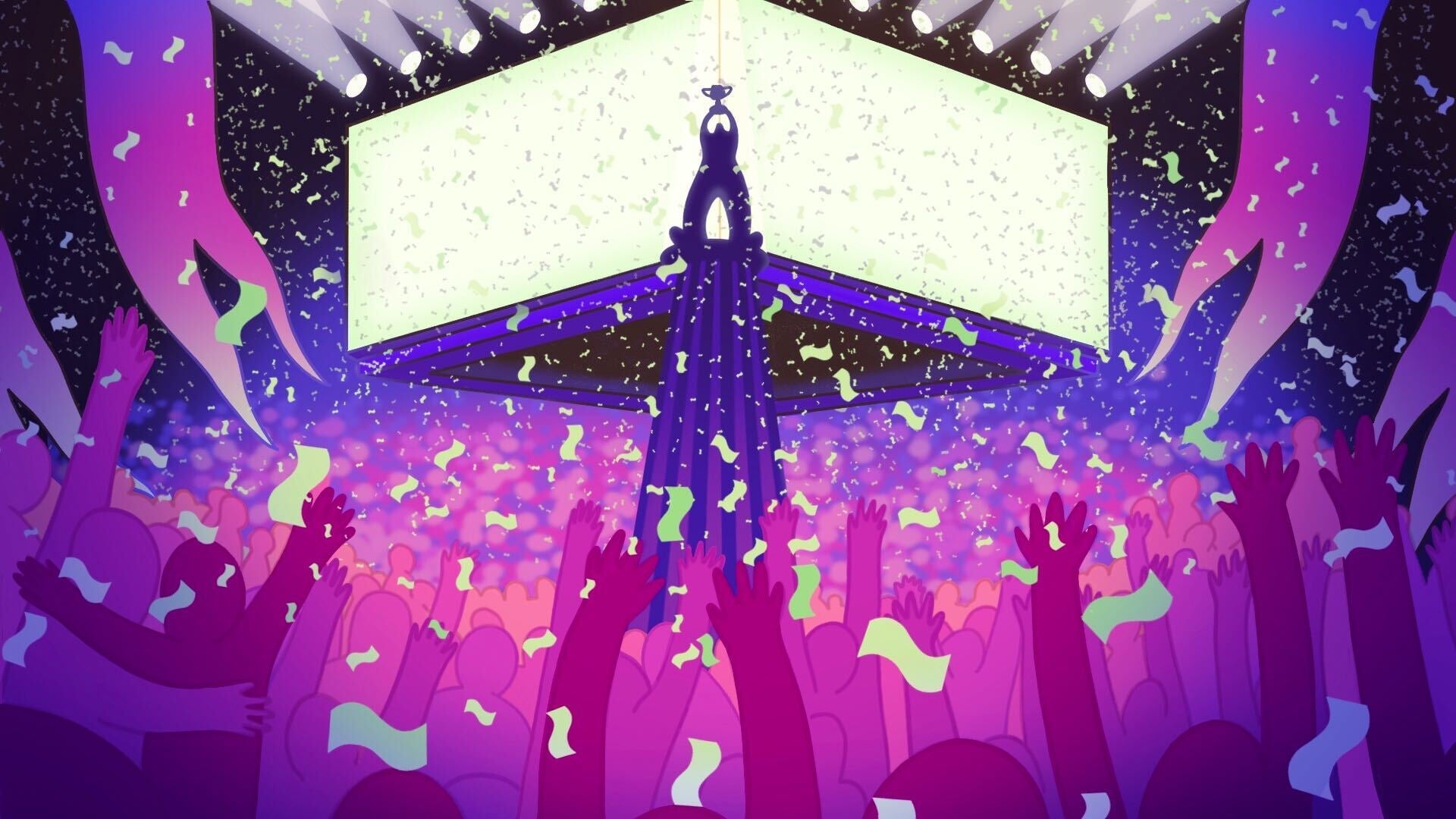
The crowd roars. It’s thrilling. So are the gasps of disbelief, the sudden outbursts of raucous applause whenever someone does something extraordinary. Even when I can’t tell why they’re on their feet, I want to join in. The energy is infectious.
This sort of high-octane atmosphere makes sense: the stakes are enormous. The players on stage are battling over one of the biggest prize pools in the history of competitive video gaming. And whoever wins will go home with a cool million dollars.
It’s Sunday, September 2, and I’m sitting in the corner of Benaroya Hall in downtown Seattle. Usually reserved for concerts and speeches, this weekend the theater has been occupied by a video game studio called Valve. Next week these seats will be lectured by Ira Glass; next month there will be classical bands performing the works of Mozart and Bach. This is a place usually populated with the type of people who’d still call video games “playing Nintendo.”
Today’s crowd is a bit different. Today, Benaroya Hall is hosting day three of a video game tournament. This is the Dota 2 International.
***
To the uninitiated, Dota 2 might seem embarrassingly simple. It’s a strategy game, but you only control one character. You don’t have to gather resources or train troops. You don’t manage a large battlefield or an empire of towns. Instead you control a single hero with his or her own set of skills and abilities, guiding him or her around a two-sided map as you try to destroy an opposing team’s units and buildings. Each of the two sides comprises five-player controlled-heroes. So every game requires ten people. Five on five.
This is what makes the game fun to play, and, by extension, fun to watch. It’s what’s led to this event: the Dota 2 International, which Valve has set up to promote Dota 2 as an eSport—or electronic sport—a game that people can play professionally. It’s what’s led to a total prize pool of $1.6 million—first place gets a mil, second gets $250,000, third gets $150,000, and the rest is divided among ranks four through eight—one of the largest prize pools in competitive gaming today.
It’s what’s filled the 2,500-seat theater to capacity with fans, mostly 20- to 30-somethings, mostly males. Some hold up signs for their favorite players. Others brandish big rubber axes and other nerdy paraphernalia—silly, I think to myself, but no sillier than the giant foam fingers or helmets you might get at a baseball game.
The whole thing is quite the spectacle, even without the crowd. On stage is a large Dota symbol flanked by two glass, soundproof boxes, where the two teams sit and click away at PCs that have been optimized just for them. Above these cages is a giant projector screen that shows live in-game action, and on top of each glass team box is a close-up camera view of the players, their faces intensely honed in on the heroes and spells at their command.
Right now I’m watching the team Na’vi—a fan favorite from the Ukraine—take on the Chinese squad LGD. Heroes are attacking one another on screen, shooting fireballs, summoning monsters, hurling around large balls of energy. Occasionally the crowd will burst into applause. It’s hard to tell why.
Watching Dota 2, I found out this weekend, while fun, is pretty damn difficult if you don’t understand Dota 2. Even though I’ve played the game a few times and I know how it works, I don’t know the names and abilities of all 80-something current heroes. I don’t know the lingo. I can tell when someone is about to die, but I can’t recognize big plays or displays of skill like I might be able to recognize in, say, StarCraft. Or football.
It occurs to me, while sitting in the crowd at the Dota 2 International, that Dota 2 has an accessibility problem.
***
“We’ve got a lot of work to do,” Valve’s Erik Johnson says. We’re sitting in a room downstairs, watching Na’vi and LGD battle as we chat about the tournament and Dota 2, which Johnson manages and helped create.
He’s just given me a brief tour of the facilities they’ve set up below the theater: broadcasters, Valve employees, and other technical staff are bouncing around a grid of small rooms, everyone doing their parts to ensure that the tournament will run smoothly. And I’ve asked him how to make Dota 2 easier for new players to observe.
“I was just watching [Dota 2] with a very casual observer,” Johnson says, “and one thing that jumps out is, other sports have a really clear scoreboard as to who’s winning. And Dota does not have that. There’s a bunch of different statistics that you can, kind of, as a whole paint a picture of which team’s ahead or not… but it’s not deterministic.”
“Other sports have a really clear scoreboard as to who’s winning. And Dota does not have that.”
It’s based on opinion. Basketball has points. Fighting games have health. StarCraft has unit and base counts. But everything in Dota 2 is an abstraction. Even professional players will sit in front of a screen and argue over who’s winning a match at any given point, Johnson tells me.
So what’s the solution?
“I don’t know,” Johnson says. Dota 2 is a game more about finesse, teamwork, and intelligence than physical strength or speed. It’s tough to see those traits transfer to the big screen.
Still, I’m enjoying the match in front of me. Johnson will occasionally pause the conversation to get excited about what’s happening on screen, interjecting commentary like “this could go poorly for Na’vi” or “didn’t realize how many items that Faceless has—he’s gonna be tough to beat.”
We’re not the only ones. A whopping 500,000 viewers are watching this match, Johnson says. And these are just the semi-finals: that number should go even higher when we move to the next round. If Na’vi, who won the whole tournament last year, makes this year’s finals, fans will go crazy.
“Our audience is pretty sophisticated about watching this online,” Johnson says when I ask if they’d ever partner with television networks like ESPN to take Dota matches to a national stage. “If our fans thought it would be cooler, and that’s the way they want to watch it,” then Valve would consider it, Johnson says. But there are no talks in progress.
It’s almost hard to believe, looking at the sheer number of fans and competitive players out there, that Dota 2 still isn’t even out yet. The game entered beta last September. And it’s still in development, as polished as it might look on the screen.
Yes: $1.6 million is on the table for people playing a video game that isn’t even out yet.
Valve is hoping to ship Dota 2 as a free-to-play game by the end of 2012. They’ve got three things left on the checklist: more heroes (boosting up the number from around 89 to around 108), server infrastructure that can support more people, and some sort of solution to make the “brand new player experience” more accommodating, Johnson says.
https://lastchance.cc/dota-2-will-be-free-but-you-can-buy-hats-5914769%3C/a%3E%3C/p%3E
“If you’ve never played any game like Dota and you’re by yourself, it’s not a good experience.”
It’s confusing, overwhelming for beginners. At the beginning of every match, you’re presented with a hero screen in which you have to select which character you’re going to use for the entirety of that game. You have limited time to select, and choosing the right hero can be quite intimidating. (Remember, there are 89.)
“You don’t want a new player to feel like we dropped a piano on their head,” Johnson says. So they’re going to limit hero selection for newbies. They also plan to add some sort of Left 4 Dead-like hint system that “recognizes if you’re doing something you shouldn’t do as a new player,” then helps you out accordingly.
As Johnson and I continue to chat, Na’vi takes the victory, moving on to the finals. The crowd goes crazy.
***
The most surreal thing about this tournament, I think to myself as I watch the people around me, is that everybody is rooting for the same team. They’re all about Na’vi. Any time the Ukrainian team gets so much as a minor victory—takes down an enemy hero, successfully holds off an attack, or even just buys a cool item—the crowd goes wild. They’re standing in the aisles, shouting at the top of their lungs. There are no rivalries here: just unified passion for a single team.
While in the theater, I ask a few fans why they like Na’vi so much. Here are four of their responses:
“They’re the only ones who speak English.”
“They’re the underdogs.”
“They’re the best.”
“They’re not Chinese.”
***
The players’ room, an upstairs section of the theater packed with a bar, food, and a private balcony, feels a little bit like computer camp. Some 45 geeky, bearded teenagers and 20-somethings are sitting on couches and roaming around the lounge, their eyes either glued to the screen or fixated on one another. Sitting in silence. Occasionally talking Dota 2. Ways to win.
It’s hard to tell the difference between the players and the fans: unlike, say, 7′ centers or charismatic quarterbacks, most of these guys don’t stand out that much. But when I see the Na’vi team huddling on the balcony, I can tell why they’re so popular. As Johnson describes it, they’re “larger than life.” They’ve got swagger. Their leader, Clement “Puppey” Ivanov, is by all accounts one of the most amiable guys in the game today. People seem to surround him, gravitate towards him.
But Johnson raves about all of the players there.
“These are some of the most likable people I’ve ever been around,” he tells me. Valve flew them all out here, put them up in hotels, and arranged for drivers to take them around. They’ve hung out at Valve’s office and even gone to big, fancy dinners with the staff—although even during dinner, Johnson notes, they all just wanted to go play more Dota
“These are some of the most likable people I’ve ever been around.”
Johnson introduces me to Theeban “1437” Siva, a Canadian professional Dota 2 player who leads a team named Mousesports. I ask him what it’s like to dedicate his life to a video game.
“I did decide to pause my school and whatnot to try and play Dota,” Siva tells me. “I really enjoy this game. Maybe in the future I will continue to do it, but we’ll see—only time can tell.”
Siva says he’ll play Dota 2 anywhere from two to 12 hours a day. He’s been playing the game for five or six years now, starting with the first Dota—or Defense of the Ancients—a map for the Blizzard game Warcraft III that was first released almost a decade ago.
The story of Dota is long and full of drama, and several games have sprung from it: Dota clones like League of Legends and Heroes of Newerth are some of the most popular games around. Back in 2009, Valve scooped up Icefrog, one of the developers behind Dota and an infamously reclusive personality, hiring him to make a sequel to the Warcraft mod.
In recent months, League of Legends has become part of a resurgent eSports scene revolving around massive tournaments and huge cash prizes. Valve’s Johnson says that the competition doesn’t hurt—”I think there’s an argument that we help each other’s sales,” he told me—but it’s clear the two games are fighting for eSports supremacy. Next month, League of Legends will host its own massive tournament, with a payout of $5 million, the biggest in competitive gaming’s history.
“After watching the Chinese play here at the International, that’s like— we need to step our game a lot,” Siva says. “For them it’s like work.”
Siva and his team have earned a decent chunk of change over the past few months—something close to $20,000, split among five of them—but not enough to live off. They have sponsors who “provide what [they] need,” Siva says, but they don’t make the exorbitant salaries of some other competitive gamers.
Siva, 19, is modest even for his age. He says he doesn’t care about making a large salary or earning big perks—he just wants to get better at the game he loves playing.
But Valve believes that Siva and players like him should be making more money. After all, not everyone can do what they do. Not everyone can bring in the audiences they can.
“The amount of value that these players we’ve invited are creating for this large audience is immense,” Johnson had told me earlier. “And the prize pool doesn’t—the winner gets a million dollars… [but] even that, I don’t think that that equals out for the value they’re creating for so many people.”
Valve has solutions for that, ideas to help compensate players. They imagine that the game will continue to grow and evolve over the next few years, and they hope to bring in more money by selling in-game accessories like team pennants, which fans seem to love.
“This is not the peak of Dota 2 whatsoever. Next year, we’ll have a better understanding of what the future of Dota 2 is.”
“The salaries for any sport with that big an audience and few people [who] are [that] good at it-those guys make a lot of money for a reason, cause no one else can do it,” Johnson said. “We’re thinking a lot about what are the things that we can build into the economy so that these guys— the value they’ve created is getting actually paired with real dollars.”
And indeed, there seems to be a belief among the players that they’re on the ground floor. That Dota‘s potential hasn’t even been close to realized yet.
“This is not the peak of Dota 2 whatsoever,” Siva said. “Next year, we’ll have a better understanding of what the future of Dota 2 is.”
2,500 people at the tournament. 500,000 people watching. $1.6 million in prize money. All for a game that isn’t out yet. And this is just the second Dota 2 International. Next year’s will be even bigger.
Na’vi lost in the finals to a Chinese team called IG, I find out later, while waiting to catch a flight back to New York. It was an upset—people were absolutely stunned—and I feel bad for the Ukrainian squad. They worked so hard to get here. And the scene will just get more and more challenging as more people start to play and master Dota 2. There will be new fads, new fan favorites. Tougher teams to beat.
But Valve, like Na’vi and Mousesports and all the other teams out there, has a hell of a lot of work to do. For Dota 2 to become an international sensation, a game with the scale and scope of something like football or basketball, its creators need to fix the accessibility problem. Erik Johnson says there’s a massive potential fanbase for Dota 2 out there, and I don’t deny that: at its core, this is a fascinating game stuffed with chess-like strategy and some intense, action-packed moments.
I just wish it was easier to watch.
(Photos via Valve)