On a whim a couple of months ago, I decided to start rewatching Lost, a show about people on an island eating fish biscuits for nourishment. Sadly, ABC pulled it from Netflix today, choosing instead to put it all on Hulu. But I got through most of it, and I have a lot of thoughts.
Here are some observations from rewatching most of Lost for the first time since it all aired.
1. Season 1 of LOST is still some of the best television I’ve seen.
From “Walkabout” to “Numbers,” the first season of Lost has some real gems. The pilot is a master-class in gradually introducing the viewer to a very large cast of characters, hinting at some of their quirks just enough to be enticing. And then each subsequent episode brilliantly stitches together the histories of each character—hey, look, they all have daddy issues!—with the mundane realities of trying to survive on a (seemingly) deserted island. Lost would eventually delve into time travel, metaphysics, and convoluted supernatural wars, but in season one, it was just a show about flawed people trying to hunt for boar. And it was really, really great.
2. It’s less frustrating when you’re binging.
There was something special about the experience of watching Lost live, something that I’m glad was such a huge part of my life between 2005 and 2010. I have tons of fond memories of watching key moments and debating them not just with friends but with total strangers. Because Lost unfolded in such a tantalizing way, ending almost every hour with a cliffhanger and often alternating between groups of characters from episode to episode, waiting a week between each show could be brutal. By binge-watching it, you don’t get the same sort of cultural conversation, but at least you don’t have to wait 9 months just to see what happens when they move the island.
3. The Ben/Widmore conflict is a mess.
In season 4 episode 9, “The Shape Of Things To Come,” Ben Linus and Charles Widmore have a delightful exchange in which it’s revealed that the two have been rivals for a very long time. At this point we knew that the show would end in six seasons, and as the title promised, this showdown seemed to be to be setting up the endgame for Lost. At one point, Ben says that it would be “against the rules” for him to kill Widmore now, which was an enticing hint at their bigger-picture conflict. Instead, Ben says, he vows to kill Widmore’s daughter, in revenge for Widmore’s mercenaries murdering his own daughter.
And then… it all went nowhere. Not only were these “rules” never explained, the Ben/Widmore conflict never really materialized. Throughout season 5, neither Ben’s nor Widmore’s motivations were ever made clear. Why does Widmore send a man to guide John Locke across the world to help his friends get back to the island? Why does Ben then kill that man? Why does Widmore send someone to kill Sayid’s wife, Nadya? Who exactly did Ben spend three years sending Sayid around the world to murder? What were their plans?
Lost’s endgame ultimately focused on the Man in Black, aka the smoke monster, aka Fake John Locke, which left the Ben-Widmore conflict unresolved. Which is a bummer, because Ben and Widmore are far more interesting characters than Smokey and Jacob ever were.
4. There are a LOT of plot holes.
Although the creators of Lost had always maintained that they knew the answers to a lot of big questions, there are a few ongoing mysteries that, when looked at holistically, make no sense. The biggest is Christian Shephard, Jack’s dead father, who began appearing on the island as early as season 1. In season 6, it’s revealed that all of Christian’s appearances have in fact been the Man in Black, aka the Smoke Monster, who can take on the form of any dead person. But rewatching the show with that in mind leaves a lot of questions unanswered. How and why did Christian appear on the freighter to say “You can go now” when Michael exploded in the season 4 finale? Why did Christian guide Locke into turning the frozen wheel and ending the time skips in season 5, and why did he tell Locke to say hi to his son? We’ll never know.
5. Some unresolved plot lines are worse than others.
The most glaring and obvious problem with Lost is Walt, who was written out of the show because his actor grew up too quickly. Walt left us with a ton of questions. Perhaps the biggest: How and why did he appear to an injured Locke at the end of season 3 and tell him to go murder Naomi?
I don’t care that much that we never found out why Libby was in a mental institution—a big cliffhanger at the end of season 2 episode 18, “Dave”—or who shot at the outriggers in season 5 episode 4, “The Little Prince.” But it does bother me that Lost bailed on key character storylines, like Ben’s childhood girlfriend, Annie, who was introduced in season 3 as a pivotal part of the Others’ leader’s life, then never seen again. In season 4 episode 6, “The Other Woman,” a character remarks that Juliet reminds Ben of “her”—presumably Annie—and Ben’s relationship with Juliet is also explored in some chilling ways, as we learn that he thinks she belongs to him. But that, too, is never brought up again.
It’s also never made clear why the Others put so much effort into pretending to look primitive, even going as far as to create a fake village, or why they spent so much time making lists. We always knew that Lost wouldn’t give answers to all of its lingering mysteries, but upon a rewatch, some are more blatant than others.
6. The show contains a lot that exists solely to mislead viewers.
In Season 4, episode 7, “Ji Yeon,” we get to see a bunch of off-island scenes involving Sun and Jin. At this point, we know that some of the Losties made it off the island, but we don’t know exactly who. Sun’s scenes are clearly part of a flashforward, as she goes into labor and gives birth to the baby she conceived on the island. Jin’s scenes involve him buying a giant panda bear and delivering it to a hospital as a gift for a newborn baby, which is meant to deceive us into thinking that he also made it off the island. But no, it turns out that his scenes are part of a flashback—“I’ve only been married for two months,” Jin says—and the episode ends with future Sun going to visit Jin’s grave, leading us to conclude that he died before they could escape.
This is frustrating for a few reasons. First of all, Jin’s scenes only exist to be misleading. They don’t tell any sort of story or offer any new information about his character, as every other flashback in Lost had done. The only reason they’re in the show is to make the viewer think that Jin got off the island with Sun, so the episode can then pull a “gotcha” twist by revealing that his scenes were just part of a flashback, and in fact he’s actually dead. But wait! He’s not actually dead, as is made obvious in season five. It’s all just pointless deception.
Lost does this a lot, especially in its later seasons, and on a rewatch it’s even more annoying than it was then. Season 6 is full of these misleading moments—like when Daniel Faraday starts talking about alternate timelines in the flash-sideways universe—and they never fail to frustrate.
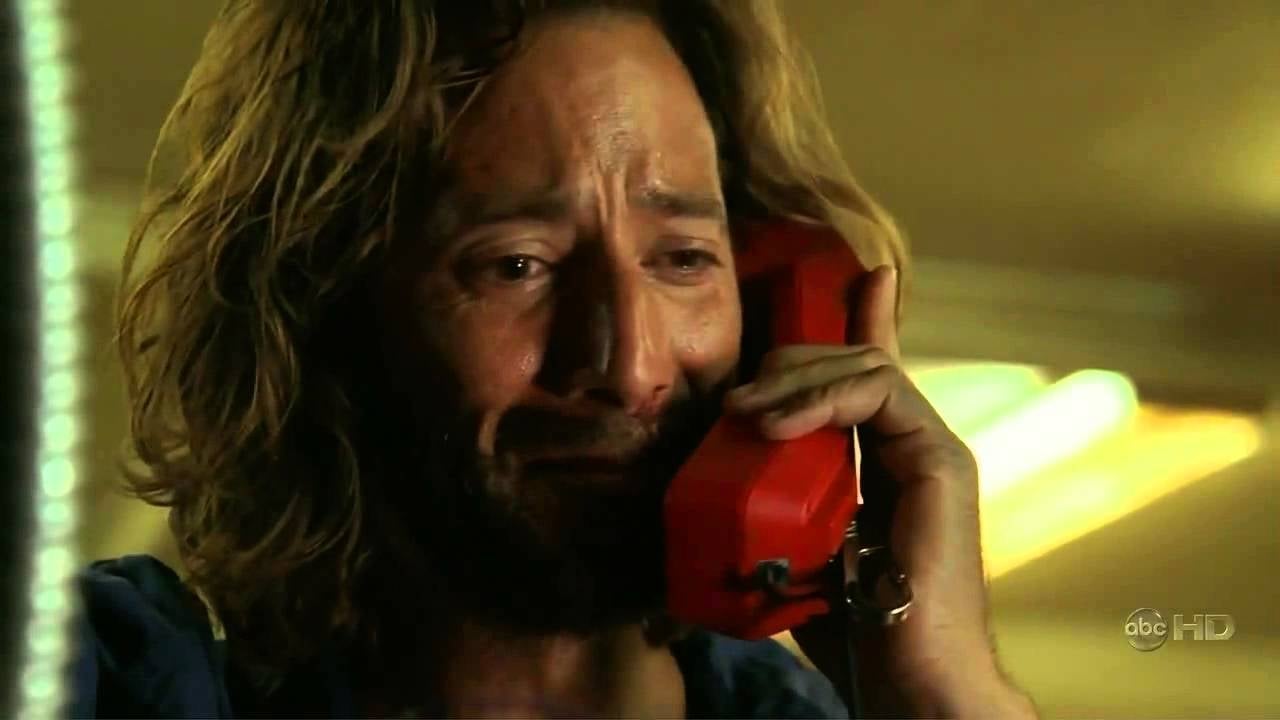
7. “The Constant” is still one of the best hours of television ever made.
Widely considered the greatest episode that Lost ever put out, “The Constant” tells a time-bending story of the love between two fantastic characters, Desmond Hume and Penelope Widmore. If you can watch this final scene without tearing up, you are colder than me:
8. Some of Lost’s plot twists remain brilliant.
Perhaps the best example of Lost’s genius storytelling comes in the season 2 finale, “Live Together, Die Alone.” Giving us our first look at Desmond’s fascinating past, this episode felt like a feature film, offering tense action (where are the Others coming from?), satisfying answers (so THAT’S why Locke saw that beam of light), and interesting mysteries (a four-toed statue??). But my favorite part was the revelation that Desmond failing to push the button—one of season 2’s biggest storylines—is what caused Oceanic flight 815 to crash.
And of course, there’s “We have to go back,” the gut-wrenching ending to season 3. I still remember exactly where I was when we found out that Jack’s dark flashbacks in “Through The Looking Glass” were actually flashforwards. It blew my friggin’ mind.
9. They ruined Sayid.
Sayid Jarrah, the former Iraqi torturer and gadget genius, was always one of my favorite characters in Lost. It’s a shame that season 6 absolutely destroyed him, with a storyline about him losing his mind, dying, and apparently coming back to life only to fail to do much of anything before he died again. And then, in the afterlife, rather than reuniting with his true love Nadya, he winds up with the show’s most insufferable character, Shannon, on whom he had an inexplicable crush. Ugh.
10. It’s best not to think much about season 3.
Much has been written about “Stranger In A Strange Land,” the atrocious episode in which Jack goes to Thailand and gets tattoos, and it’s safe to say that was the worst hour that Lost ever did. But, honestly, the rest of season 3 wasn’t much better. It started off slowly, with a six-episode run that mostly focused on Jack, Kate, and Sawyer being imprisoned by the Others, and then took quite some time before it regained momentum. (It didn’t help that those six episodes aired in November 2006 and then we had to wait until February 2007 for the rest.) Middling, forgettable episodes like “Enter 77″ and “Par Avion” made for a slow, drawn-out season that ultimately helped showrunners Damon Lindelof and Carlton Cuse convince ABC to give them an end date.
11. Lost is great because it’s a show about love.
Forget the smoke monster. Don’t worry about the polar bears. Lost, at its core, has always been a show about people falling in love with one another. It was fun to debate the mythology and mysteries, theorizing about how electromagnetism prevented babies from being born on the island, but Lost was a great television show because it focused on the people making those babies in the first place. Across six seasons, the show’s anchor was never Dharma, or Jacob, or that weird Allison Janney character. It was Desmond and Penny. Jack and Kate. Sawyer and Kate. Sawyer and Ana Lucia. Sawyer and Cassidy. Sawyer and Juliet. Lost was an exploration of screwed-up people falling in love, and that, more than anything, is why it still holds up.