Video game adaptations are en vogue. One of last year’s most critically acclaimed shows—The Last of Us—was one such example, and this year, prestige television has come for another, far more unlikely, property: Fallout. Coming to TV by way of Westworld’s Lisa Joy and Jonathan Nolan, Prime Video’s Fallout, which purports to be a sequel of sorts to the ongoing video game series, has the task of adapting a widely beloved series of role-playing games heralded for its open-endedness and its dark humor in the face of the end of the world.
The Fallout games thrive on agency, this freedom to chart whatever journey a player may desire in the wasteland. Maybe you want to roam post-apocalyptic Washington D.C. or Massachusetts wiping out mutants and solidifying yourself as some wasteland legend. Perhaps what resonates with you most is the lasting consequence of deciding the fate of a town with a dormant nuke at the heart of it. Or maybe you just want to chance upon memorable strangers whose minds and bodies have been warped by radiation and the lawlessness of post-apocalyptic America.
Suffice to say, what works about the Fallout series of games isn’t its ability to tell focused and dramatic stories ripe for television. It is, rather, the strength of its settings and gameplay to facilitate the charting of one’s own narrative. What does a Fallout show look like, then, when your part to play in it is ripped away and it does lean into those aspects the property is capable of, but not renowned for?
Well, it looks like a well-polished facsimile of many of the series’ most iconic and enduring images, phrases, and themes, wrapped into a season-long mystery—not unlike Joy and Nolan’s last show—that skewers the notion of American exceptionalism and the role of capitalism in the downfall of the western empire. For longtime fans of the games, the show’s eight-episode first season will often feel like a retread of well-worn paths. It mostly skirts by on a strong opening and closer, but spins its wheels a bit too much in the middle for my liking. Most importantly, however, it’s another lens through which to view a world I’m intimately familiar with. Though its trappings are certainly no mystery to me, Fallout makes interesting decisions about what it sees as core to the series’ DNA, and about where to differ from the games that have earned so many devoted fan.
Vault-Tec’s finest
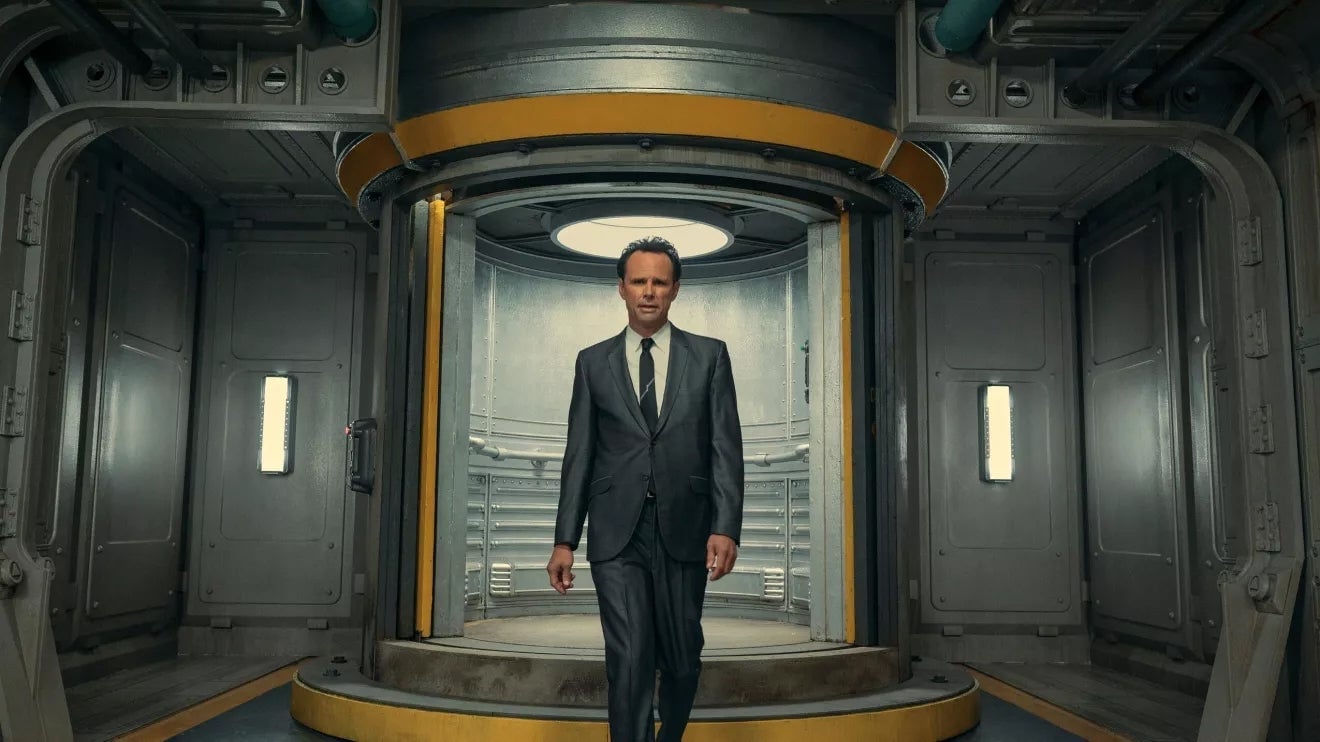
Like certain recent Star Wars shows and other media that set out to fill gaps that didn’t need filling, Fallout sometimes spins its expositional wheels in needless explanation. Walton Goggins effectively pulls double duty as Cooper Howard, a Hollywood movie star before the bombs fell, and The Ghoul, a ruthless, black-hat-style gunslinger in the show’s present more than 200 years later. Much of his time as Howard narrows in on unraveling the mysteries behind Vault-Tec and, annoyingly, preoccupies itself with answering a number of questions that didn’t need explanation. Despite the Cold War feeling of these chapters of the show, it’s also where the writing sometimes feels the most hamfisted and blunt.
At its best, Fallout is outright barbaric. While the games have a reputation for sometimes humorously playing up violence, crassness, and gore (see the “Bloody Mess” perk you can unlock in some entries), the show nevertheless ups the ante. On one occasion, the phrase “ass jerky” is thrown out there as casually as you or I might invoke water. In countless others, members of opposing factions murder one another in depraved ways. Folks get butchered, more than one limb gets mangled, and some extremities are even severed along the way. I winced more than once just trying to get through the show, and you can tell that the showrunners clearly picked up on the violence of the games and decided to spin it into a greater point about how these folks relate to one another (or don’t).
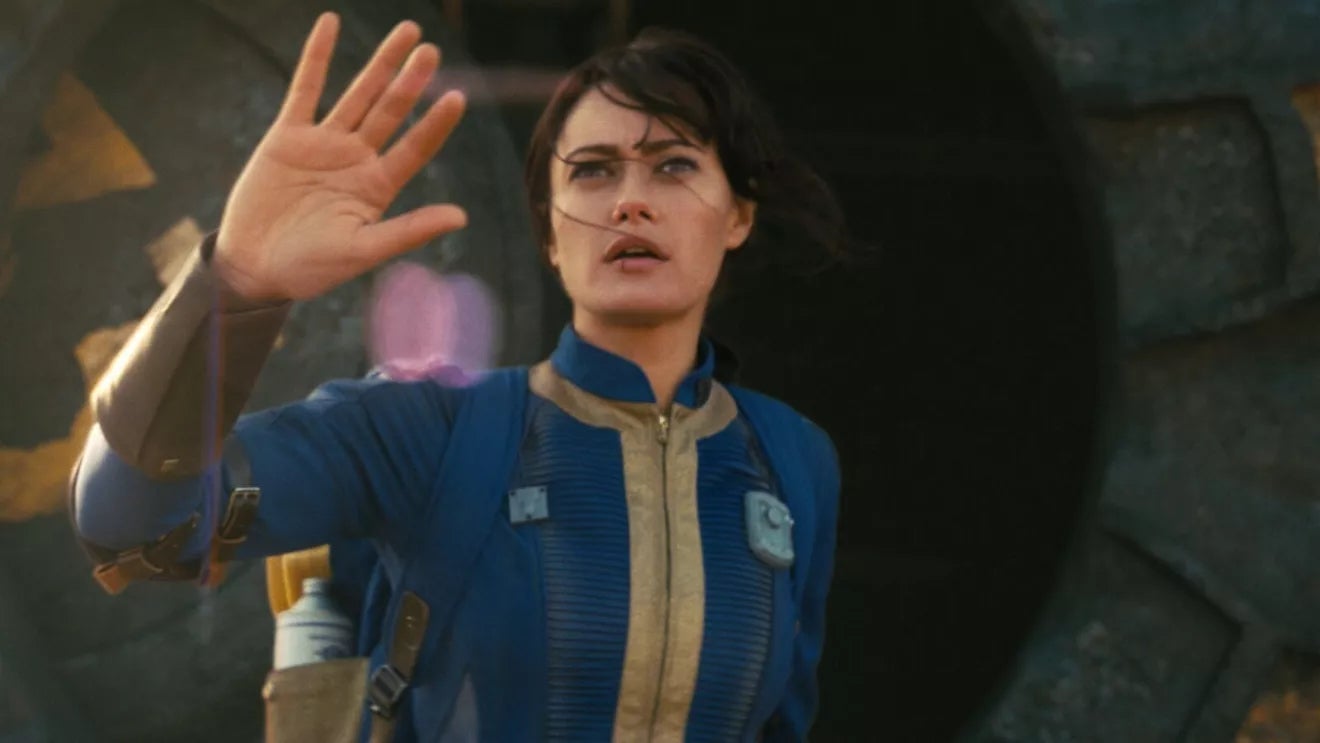
Let’s take Lucy, for example. A Vault Dweller played by Arcane’s Ella Purnell, Lucy tries diplomacy at almost every juncture. She is the player character stand-in who tries to negotiate her way through encounters by passing skill checks. When she inevitably fails these checks, her turn to violence is swift and calculated. Even though she thinks herself better than the inhabitants of the wasteland (it is, after all, the “goal” of the vaults to eventually reclaim the surface and repopulate and rehabilitate America), she starts twisting into one of them with an ease that prompts an inner crisis or two.
Goggins’ Ghoul is a harbinger of wanton destruction and death, but the juxtaposition of his time before and after the bombs paints a vivid picture of how the American way of life was chewing him up and getting ready to spit him out before the world ended. The Ghoul’s cruelty is one born from centuries of this place eroding his very being, and though Goggins is never quite given the room and the material to turn this journey into something greater than its parts, he admirably delivers. Considering the likelihood of a second season of Fallout, I’m interested to see what comes of his character moving forward.
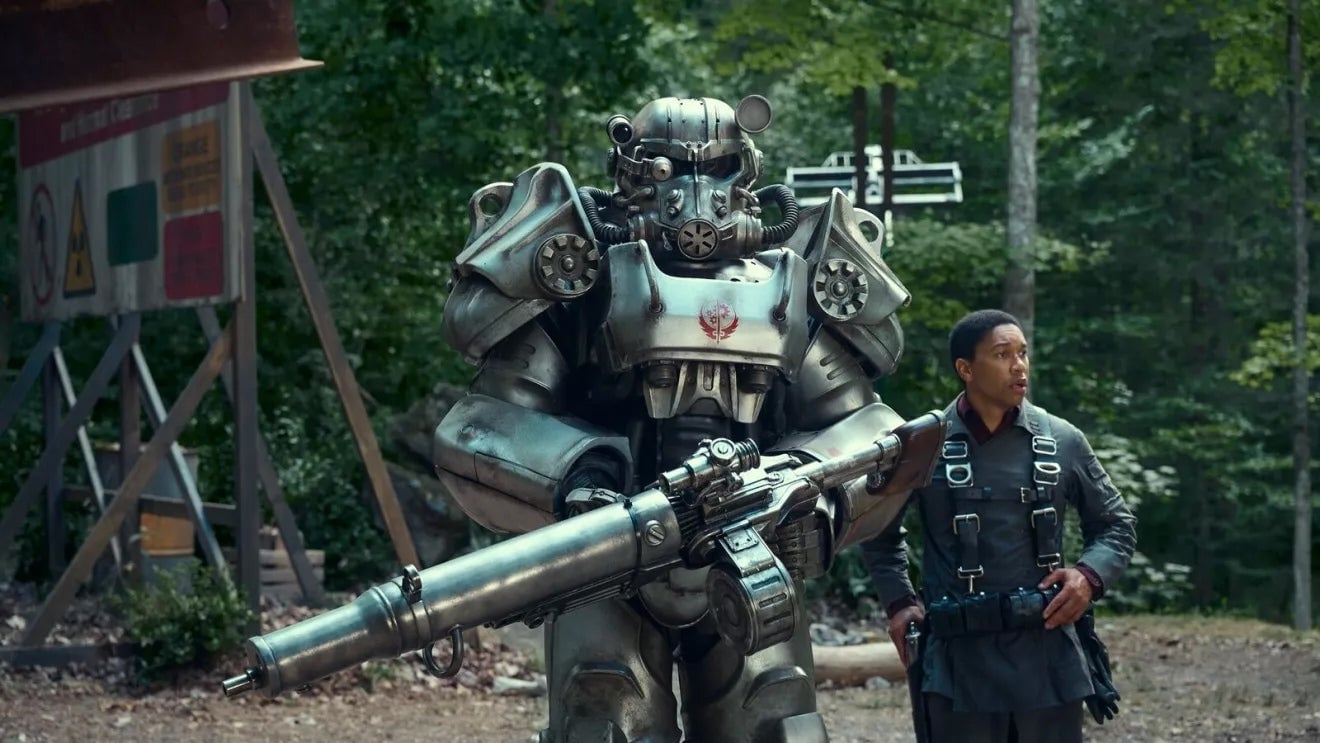
The real star turn in the show, however, is Aaron Moten as Maximus, a squire of the fascistic Brotherhood of Steel, one of the series’ most enduring factions. Maximus’ journey is the best of the three for how well-rounded it is. If Lucy and the Ghoul are representative of the ends of Fallout’s moral spectrum, then Maximus is smack in the middle. He’s the morally dubious heart of the show. Maximus’ naked desire for power, and his willingness to do almost anything to be in proximity to it, makes him a fascinating protagonist because you want to root for him almost as badly as you want him to fail. You want to believe in the goodness Lucy claims is still inside of him, and then you see him lie and cheat his way through the most routine encounters or dialogues. His motivations are always in flux and you almost never know exactly what he’s going to do. One minute he could be baring his soul to a character, and the next he could be trying to crush someone from within a power armor he stole as an act of retribution.
Maximus is also, for what it’s worth, a grade-A dipshit, the clown king of the wasteland and post-America’s favorite stooge. He is the equivalent of dropping all your points into strength and charisma, and not sparing a single one for intelligence. The lights are on, but Maximus isn’t home. He’s the premier himbo of the wasteland and I love him. He’s not only the most interesting character to watch, but the funniest too. Fallout, despite how much of a drama it’s clearly intended to be, is pretty reliably funny and chock full of zingers that got a hearty chuckle out of me. Maximus’ awkwardness and bumbling ineptitude is a particular high point of the show’s humor, especially when he says out-of-pocket things no one in their right minds would say in precisely the manner he does.
Crawl out through the fallout
Because Fallout is a Joy-Nolan joint, these characters’ disparate journeys are all wrapped up in a few core mysteries that the showrunners spend their precious time unraveling. At the very beginning of the show, Lucy’s father (Kyle McLachlan) is curiously taken from their vault, spurring her to track him down and figure out exactly why. Meanwhile, both the Ghoul and Maximus are also tracking down certain people of importance which puts them on a collision course with her, and their time together only adds more mysteries to the heap. And the dwellers of Vault 33, where Lucy hails from, are caught up in their own curious entanglements after they come into contact with people from the outside world and the facade of their misguided practices and ideals begins to crack. Lucy’s brother Norm (played by my longtime fellow in first names, Moises Arias) is the inquisitive thrust of this prong of the story, which begins and ends strongly but spends far too much time in the middle chapters just kind of chugging along.
Fallout is actually pretty slow to deliver many of its payoffs. Though I enjoyed the characters enough to keep watching them interact, the primary motivation of many of the folks in the wasteland is a MacGuffin that only reveals its purpose right at the end, meaning that they’re otherwise going through the motions between the show’s strong opening and close. Lucy spends much of the middle chapters being continuously exposed to the harshness of the wasteland, and while it makes for fun viewing, her story kind of stalls on this point until the finale. Maximus’ journey, which orbits and eventually dovetails with Lucy’s, also feels like it plateaus for a while. Goggins has the benefit of the most material to work with, since the show spends a fair amount of time following him through two distinct eras in the timeline, but its momentum very obviously slows before ramping things up for a very consequential finale to the canon of Fallout
If you’re a fan of the games, Fallout can feel like it’s rehashing points made by them time and time again. At the same time, if you enjoy the games, you’re likely to enjoy the show just based on its production values, how closely it hues to the tenets established by the series, and the fan service. By the time I rolled credits on the show, I felt as if the threads that were left dangling were of more obvious import and interest than the resolutions and revelations offered by the season finale, particularly because they just felt like familiar beats. If you’re looking for an enthralling and entirely fresh Fallout narrative, this isn’t entirely that, but the ending of the show does begin to suggest it could become that.
The story of the show is at its strongest when it’s tackling the failures of the American dream and way of life. These are topics the games often explore, though with a lack of focus that leaves it unclear just what, if anything, is actually being said. This is an area where the show’s narrower vision greatly amplifies the message. Lucy, the all-American vault dweller, learns of the real world and becomes disillusioned with the lies she’s been fed about what her country stands for. At the same time, a sinister story plays out in Vault 33 that lays bare what the actual truth about America is. Meanwhile, everyone above land is reproducing society as they once knew it to be, just like the vault dwellers below, and it’s failing all of them. Fallout’s retro-futuristic aesthetic has been a draw of the series for a long time, but it feels honed to a particular edge here, where characters are so clearly trapped in the past. They want a return to the way things were, but those very structures are the ones dooming them to perpetuate this apocalyptic cycle. It is with that in mind that the show’s ending finally takes the step the last several Fallout games have failed to take, and dares to dream of a different world.
That is the vision of Fallout that I’m excited to see play out. Yes, it is impressive how much this show looks and sounds like the games that many people love, but I could just play those games if I wanted some 1:1 translation. A show that is just the cutscenes of a game sans the gameplay is of little interest to me, which is why I appreciate the lengths Fallout goes to in order to be more than just that. It might stumble and stall a bit while it finds its footing, but it is at least distinct enough to finally stand on its own two feet by the end, and step out from the series’ long shadow.