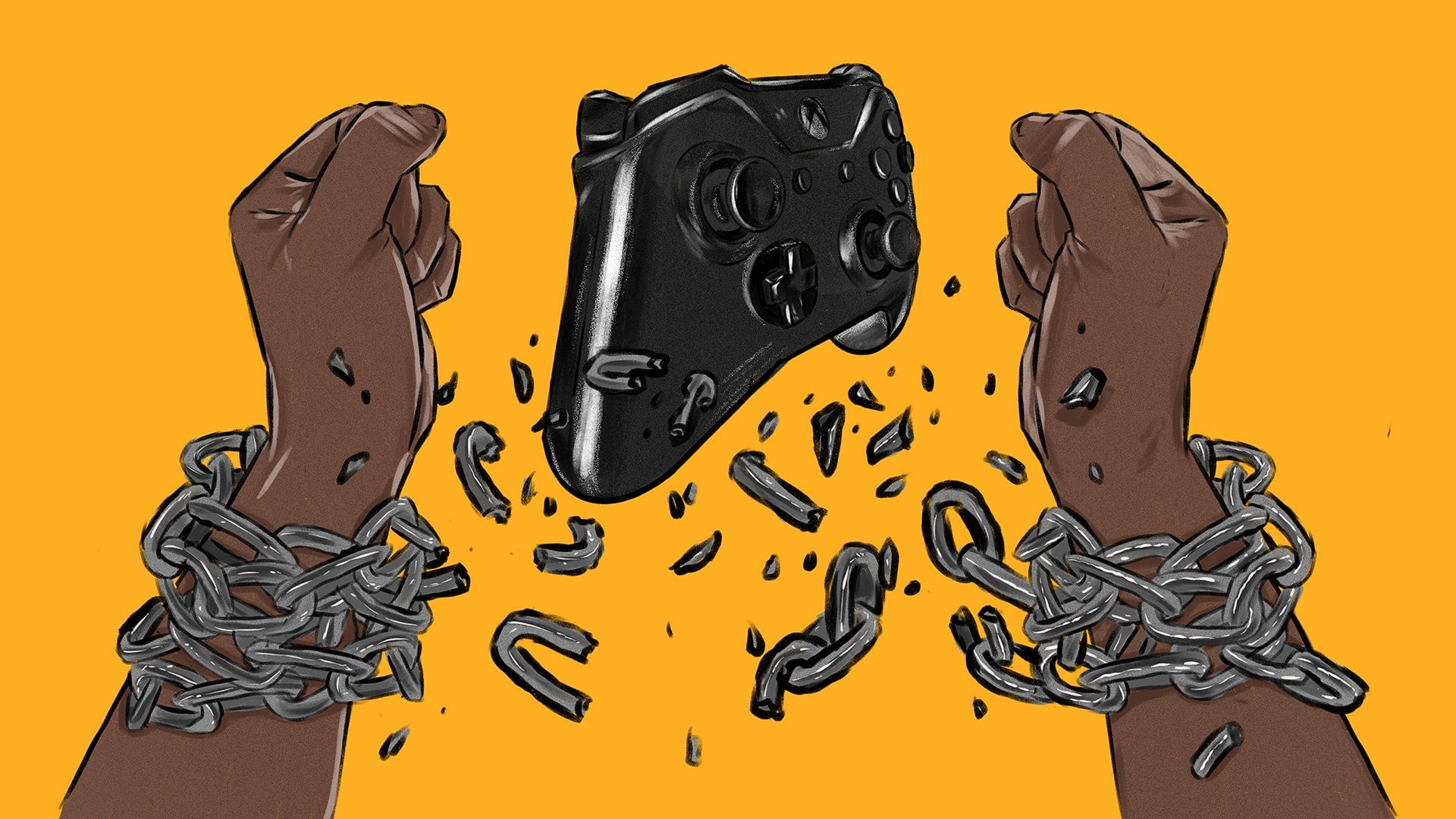
Juneteenth, once an obscure, informal holiday celebrating Black freedom, is now bigger than it’s ever been. It commemorates when the last enslaved people in Texas, the final Confederate state, were set free on June 19th, 1865. Today, on this year’s Juneteenth, countries around the world are reckoning with anti-Black histories, correcting errors they should have addressed long ago. As we toss statues of enslavers into rivers and scour the idols of white supremacy from our courthouses and public spaces—as we reckon with white supremacy and celebrate Black freedom in our offline lives—my thoughts turn to all the ways we can also do so in our digital ones.
This article was originally published June 19, 2020.
To be clear, I didn’t write this in the spirit of “how can I make this current cultural moment about video games?”. I’ve wanted to write a piece celebrating Juneteenth in video games since the moment I got this job. I originally envisioned this as a bloodthirsty take, focused on a list of games that allowed you to kill white supremacists. But as I wrote, I came to realize that a piece about Juneteenth should not in any way center our enemies, even if only by enthusing over all the cathartic ways we can virtually kill them.
Instead this became a piece about freedom: a list of games I think best celebrate the spirit of Juneteenth. That said, I won’t get too upset if a few virtual racists meet bad ends along the way.
Red Dead Redemption 2
I don’t care that Red Dead Redemption 2’s protagonist is a white man, and I don’t care that the game’s main focus has absolutely nothing to do with Black people or racism. The only thing I’m here to do in Red Dead Redemption 2 is kill the Klan and chew bubble gum, and bubble gum won’t be invented until 1928.
I know I said that I didn’t want to focus so much on certain games only because they let you kill racists. But in my defense the violence of John Brown and Nat Turner was just as integral to the fight for freedom as the speeches of Frederick Douglass and Harriet Tubman.
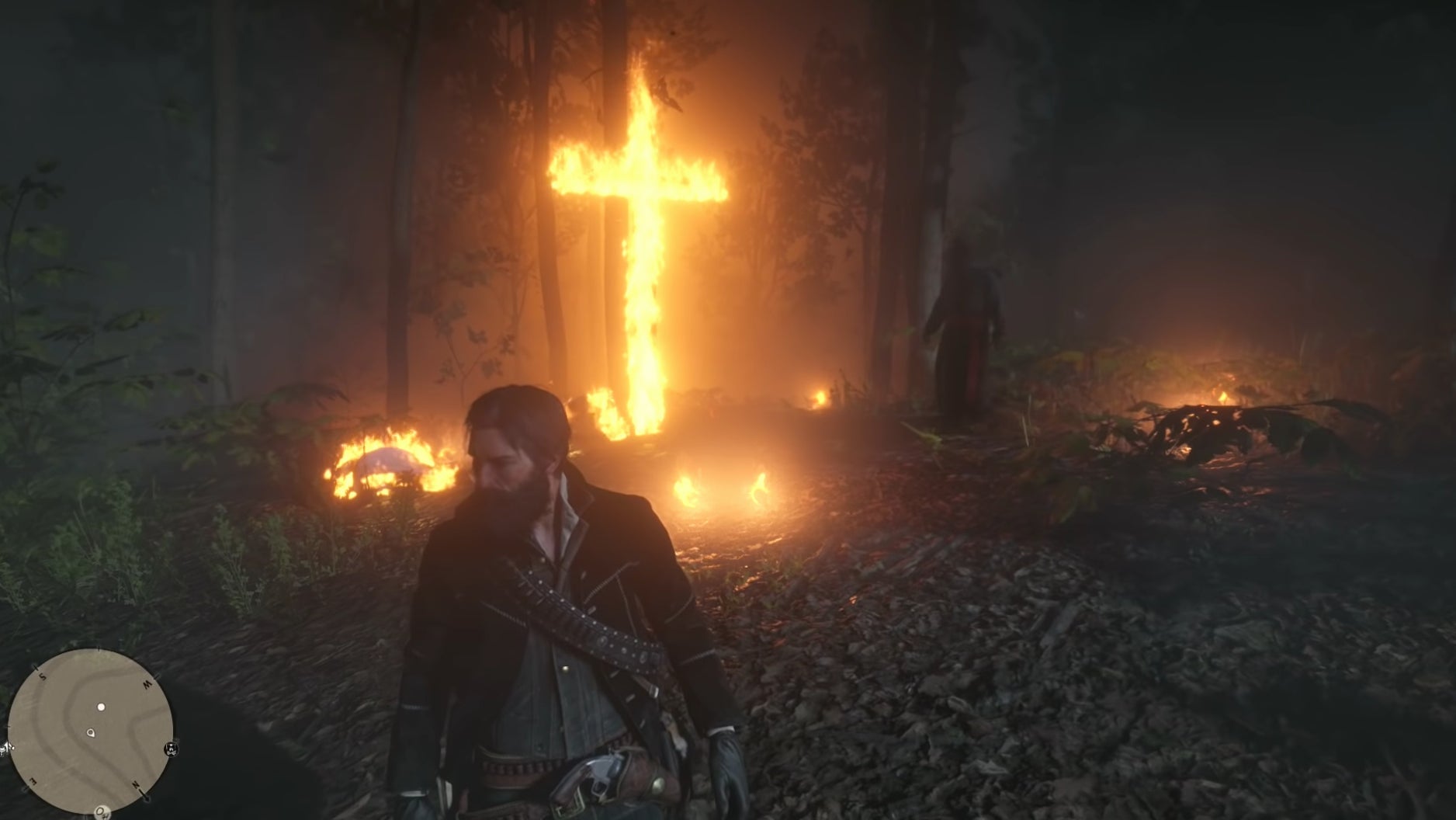
What I appreciate is RDR2’s dedication to ruining a Klan member’s day. No matter what you decide to do when you run into Klansmen, the game kills them. When you discover their gathering, which is a random event, you can choose to fight or let their ceremony continue unimpeded. If you leave them alone—though why you would is beyond me, it’s free honor—their cross-burning ceremony goes wonderfully awry, with their robes catching fire and several members burning to death. This tickles the same schadenfruede-loving center in my brain that lights up whenever people vandalize their own property—or bodies—while blaming Black people, only to get found out later
Assassin’s Creed Freedom Cry
My assassin hides in the thick foliage of Saint-Domingue, whistling to attract a nearby guard. When he draws near, I soundlessly stab him in the chest before letting him drop. Then, with the coast clear, I walk up to a cage, unlock the door, and set an enslaved man free. He thanks me. Then I set aside my controller and sob. When I’m composed, I pick up the controller again, Adéwalé picks up his machete, and together we go slaver hunting.
Assassin’s Creed Freedom Cry is the first game I’ve ever played that lets you set enslaved people free. And It’s not a side-quest, as I would have expected from an Assassin’s Creed game—a task to mindlessly revisit between main missions to grind your memory synchronization up to a satisfying 100%. Setting people free is Freedom Cry’s main conceit.
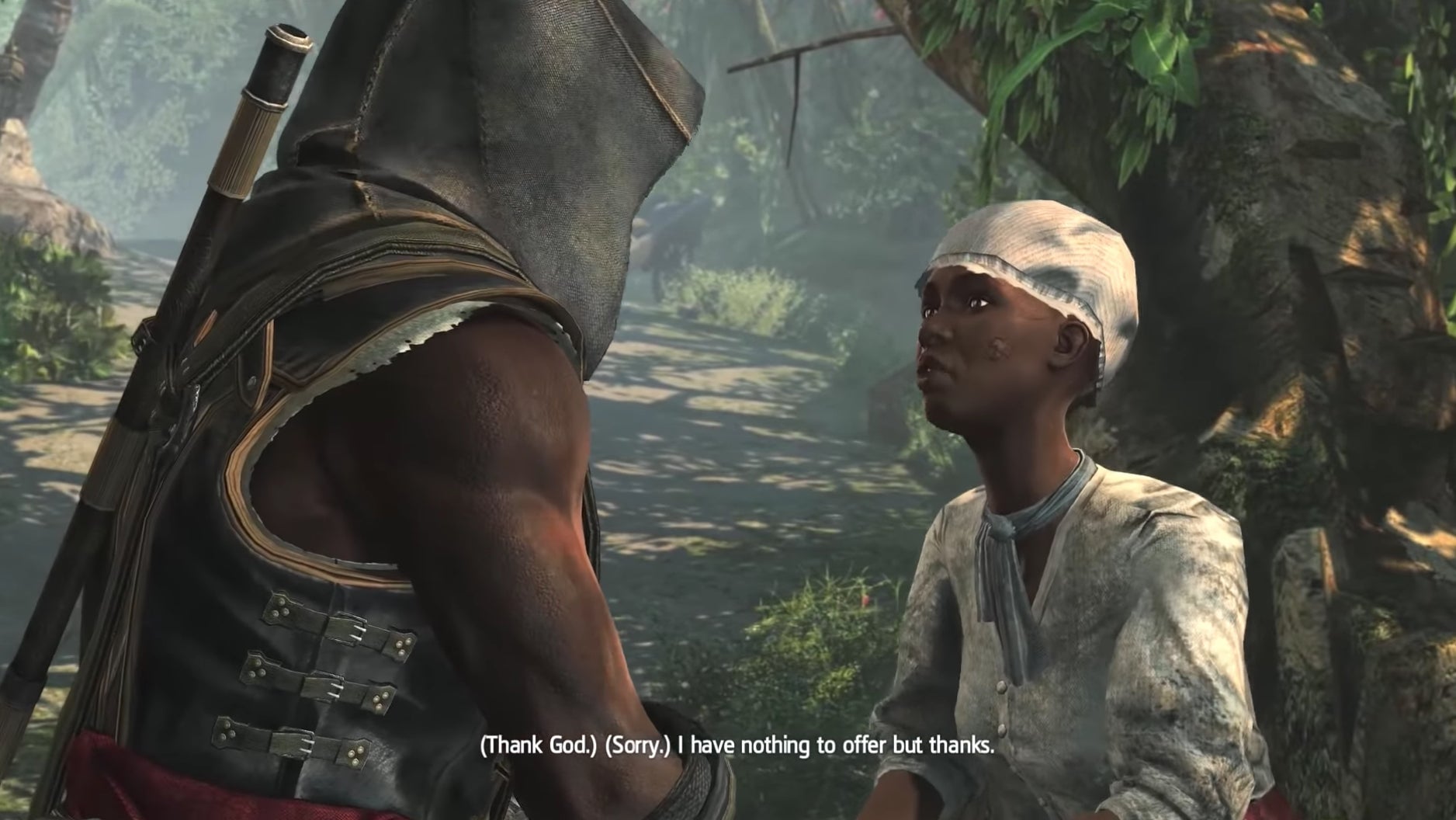
I love Freedom Cry more than I’ve loved any other Assassin’s Creed before or since, but I can’t play it for sustained blocks of time. First, the controls are terrible. Adéwalé hits like wet tissue paper, injures just as easily, and loves to vault off platforms when I don’t want him to. Second, it’s a heavy game. You liberate plantations, sneaking around knifing overseers while workers sing old spiritual hymns to the rhythm of chopping cane—songs I recognize from church. The game punishes you for breaking stealth by killing the people you’re supposed to free. It becomes a personal affront, then, if I fail to save even one person, forcing me to immediately reload the last save lest I feel I’ve failed some digital ancestor.
It’s powerful when a game links its main method of progression to something so intrinsically tied to my identity as a Black woman. I feel like I’m playing history. I know that’s what the series goes for, but it’s more personal here: I feel like I’m playing my history. I don’t mean in a general “I am Black, these people are also Black” kind of way—my paternal family can trace its history to Haitian freedmen in Louisiana. The enslaved people Adéwalé frees represent my direct ancestors.
Watch Dogs 2
Killing Klan members and machete-ing enslavers is fun, cathartic even. But the simple elimination of racists only goes so far. To attain true freedom, it’s not enough that racists die: The systems those racists worked in, played in, paid their taxes in, thrived in have to die with them.
True equality comes when we dismantle the systems in which racism is a feature, not a bug. Watch Dogs 2 very literally allows you to dismantle some of those systems while offering a tongue-in-cheek critique of what it’s like to be Black in tech or Black in…well, anywhere else in corporate America.
While the topic is very baby’s first discussion on microaggressions, I appreciate the candid and authentic way Marcus and Horatio talk about being “the only ones” in tech. I love the way Horatio changes the cadence of his voice as he extolls the virtue of the pomegrapple—a sure sign of code-switching because no Negro I know would ever eat a pomegrapple unless his grandmama gave it to them first. I know that special voice, I often employ it. Code-switching is a survival tool so personal to the Black experience that it’s surprising to see it deployed in a piece of media that’s not specifically made by us. It’s a Black Easter egg, a gift Watch Dogs 2 gives its Black players to say “we see you.”
Honorable Mention: Wolfenstein: The New Colossus
I wanted to keep this list free of alternate histories or fantastical racism allegories—not only would it become far too large, but the depictions therein are often gross simplifications or poorly executed, outright offensive stand-ins (looking at you Detroit: Become Human). Wolfenstein: The New Colossus gets a special recommendation for one reason: Grace Walker.
The New Colossus could have been about Grace Walker. A more ambitious game, one eager to send a message greater than “Nazis are bad,” would have made her its protagonist. Whoever wrote Grace’s character at Bethesda certainly did their homework. From the moment you meet her, you know she’s not with the bullshit. She’s a Foxy Brown-type character, stepping right out of 1970s blaxploitation cinema. Her perfectly moisturized, voluminous afro evokes Angela Davis or Nikki Giovanni, and her backstory recalls the life and times of Assata Shakur. What better way to celebrate Juneteenth than by honoring these Black revolutionaries?
Black women don’t get the best representation in video games for reasons I’m sure I’ll get into as I spend more time at Kotaku. But Grace is a clear, strong image of a Black woman without any of the stereotypes that usually accompany such characters. She’s strong, but shows vulnerability. She’s so angry at what Nazis and racists have done to her and her country that she’s willing to take up arms against them, but so gentle and loving that, in the middle of recounting her horrific story, she whips out a tit to breastfeed her baby.
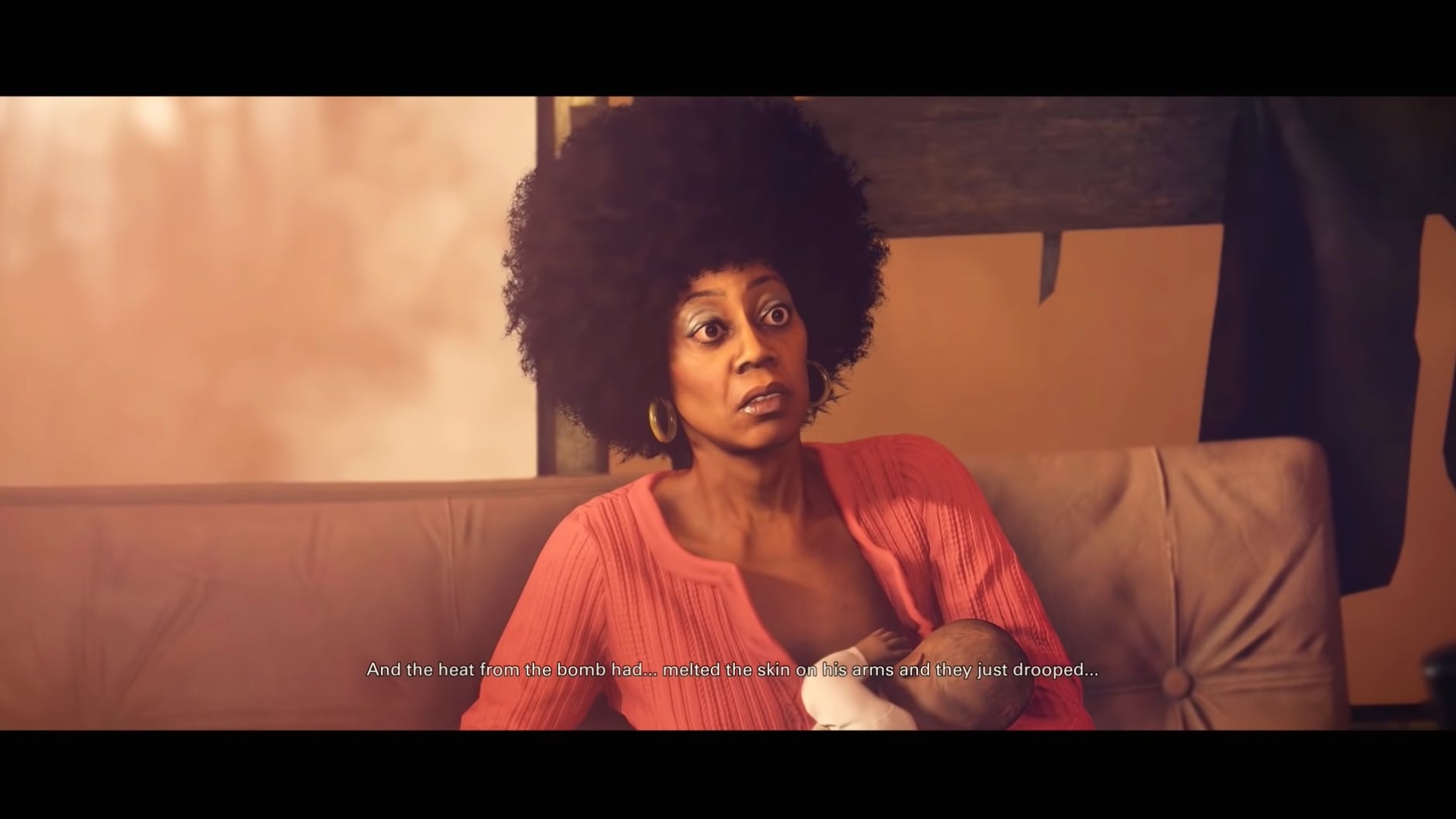
Grace is a phenomenal character who elevates every scene she’s in. She’s like Christoph Waltz in Inglourious Basterds—the movie isn’t about him, but he commands every moment he’s on-screen such that you never want him off it. Shout the hell out to Grace’s voice actress, Debra Wilson.
By the way: Where Wolfenstein fails for me is that even though it has an entire sequence in which folks walk around an American city wearing Klan robes in broad daylight, the game confines your carnage to Nazi submarines and military bunkers.
Nazis are the perennial video game bad guys, an enemy no one tries to humanize—the boogeymen of history. They’re bad and it’s good to kill them. But an enemy just as repugnant and as prolific as Nazis are white supremacists (hell, Nazism took a fair chunk of its antisemetic policies from America’s Jim Crow laws) yet there aren’t many (any?) games devoted to wiping them off the face of the Earth. I would have loved—loved!—the opportunity to mow down the Klan on main street.
Dishonorable Mention: Detroit: Become Human
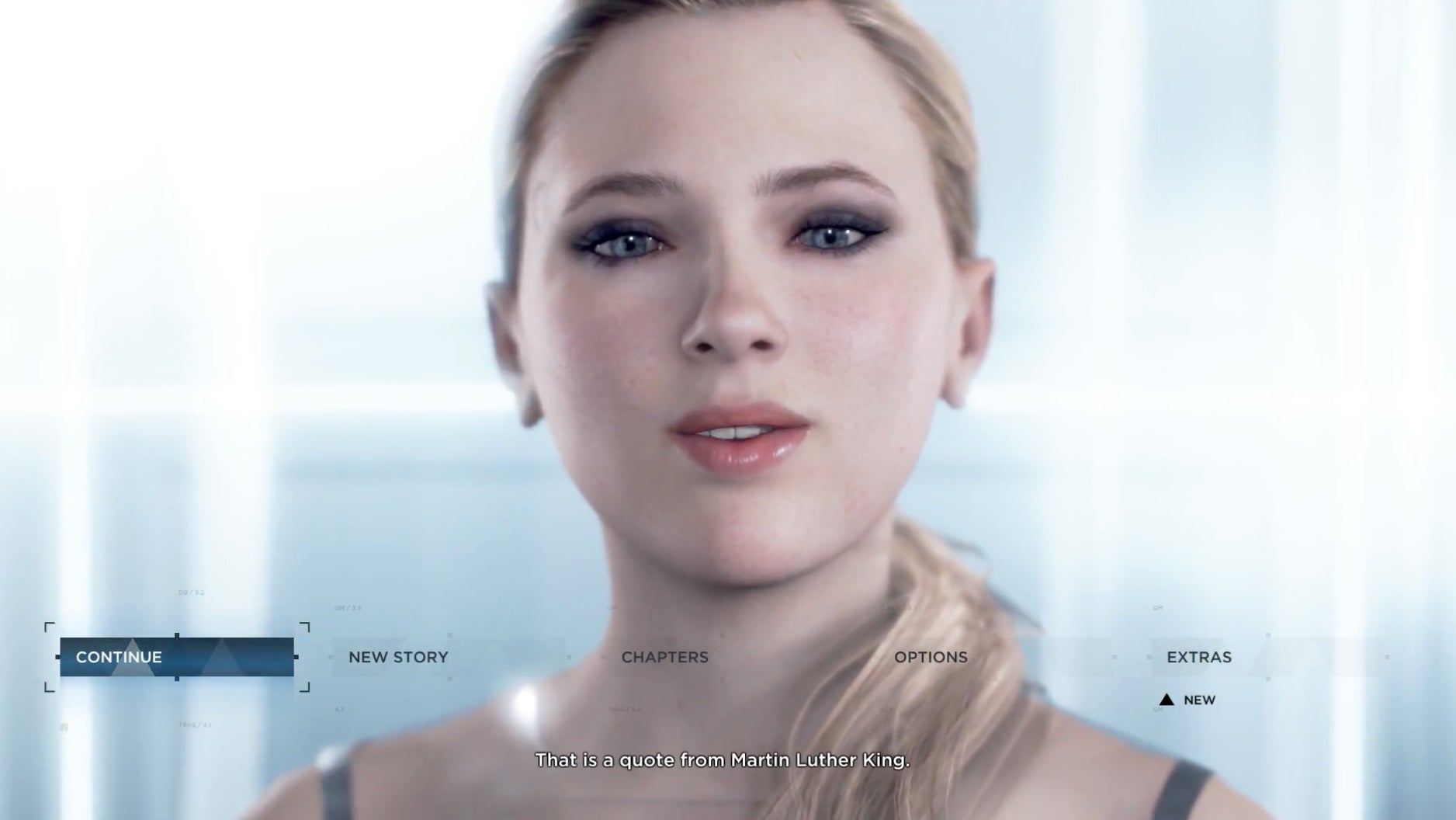
Damn, I hate this game.
Lift Ev’ry Voice And Sing
Juneteenth is our Independence Day, not July 4th, which Black folk generally treat as a day to gather with family, grill, and fight about who made the potato salad. After all, what sense does it make to celebrate America’s independence when our portion of its population wouldn’t be free until almost 100 years later—if you can call living under Jim Crow “free.”
It’s difficult to think about any kind of freedom when Black people are still being hung from trees and shot in the back while fleeing police. The grief and depression is debilitating—like wet snow that doesn’t melt. It settles heavy on the shoulders, calcifies on the bones, until one day you wake up and realize you can’t move. Juneteenth, once ignored, is now on the fast track to national holiday status. And as it grows in the national consciousness, it gives me hope that other long-ignored injustices will finally have their reckoning, too.
Happy Juneteenth y’all.
Looking for ways to advocate for black lives? Check out this list of resources by our sister site Lifehacker for ways to get involved.
More reading:
https://lastchance.cc/i-am-black-and-tired-1843861252%3C/a%3E%3C/p%3E