Gaming tags on Steam are used with wild abandon, to the degree that they’re fairly useless. “Point-and-click” has been reduced to any game with a cursor, and “action” appears to mean any game where you move. In general, rather than draw you toward a game, their main use is to warn you off one. And generally, when I see the words “precision platformer,” I know it’s not for me. I love platforming, but I hate being punished for every imperfection—just let me be. So I’m not sure why I found myself installing Slash/Jump despite its “precision” description. Perhaps it was that it was accompanied by “Short” and wasn’t by “Difficult.” Oh, and also “free.”
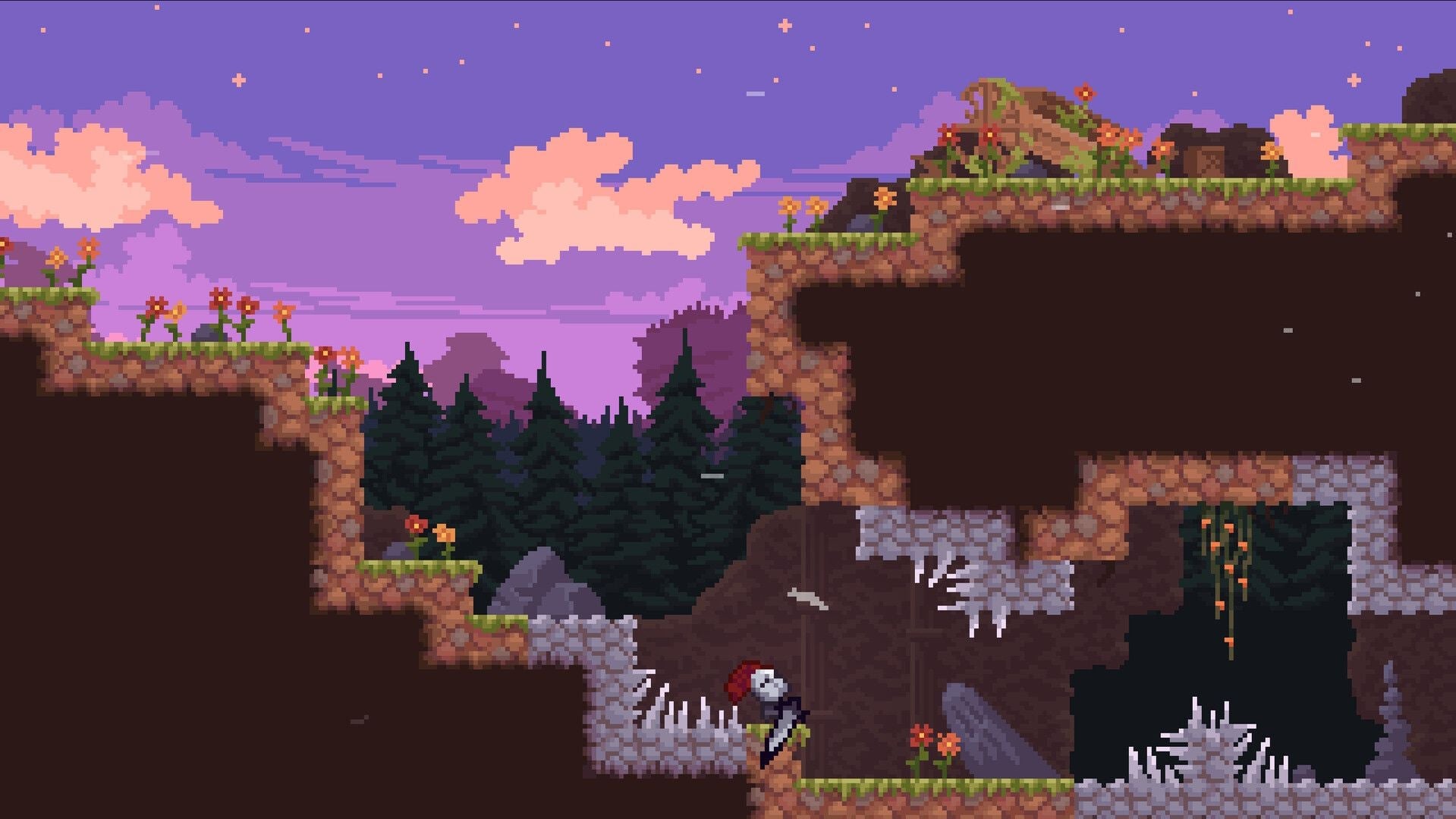
I’m so glad I did. Slash/Jump is unequivocally a “precision platformer,” but one where imprecision makes me laugh out loud. It’s a platform game that’s inherently extremely silly, and embraces that with a series of challenging screens that don’t feel any need to judge or punish when you mess up. This is largely because you’re playing a knight who can only move by swinging his sword.
This means that if you want to move to your right, you need to swipe at the ground to your left. This propels you against the force of your swing, bouncing you in the opposite direction. Using this, with a combination of powerful swings and littler ones, you need to negotiate your way through a world of ledges and platforms, littered with spikes and obstacles that’ll shatter you on contact. Why? Because you’re on your way to a barbecue, of course.
Failure comes often, but a split-second instant restart means you’re not left staring at a “GAME OVER” or frustrated by the game’s gloating. Instead you’re already having another try, then feeling enormously satisfied as you time things just right, so you leap over the gap, whack the spikes with your sword to propel upward, and then give a tiny tap to the right to reach a platform.
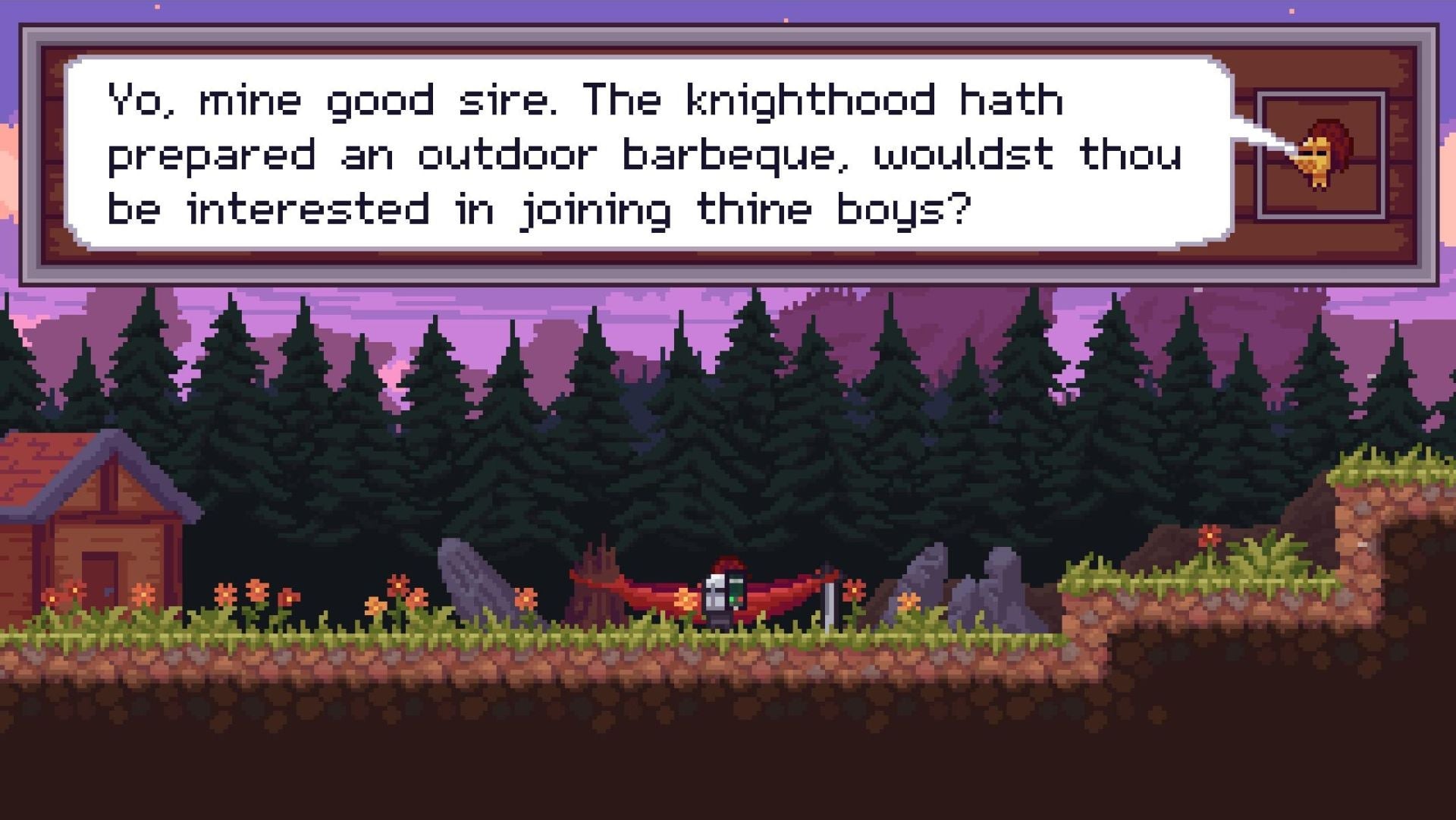
None of this would work if it weren’t precisely programmed, as any little issues or blips would have broken the fun. But developers Brynjar Á and Sindri H, both 19 years old, have absolutely nailed it. Movement is natural and satisfying, no matter how daft it is in conception. The main advice I have to anyone getting frustrated is swing earlier. With that understood, it all begins to flow.
It’s fascinating how hard my brain fought against the game. Pulling the analogue stick in the opposite direction that you want to move is obviously tricky to get used to, and then ever-more-so when you’re trying to wall-bounce up a shaft, before sproinging onto a temporary platform in order to bounce off a spike, and so on. But most bizarre was how any time I landed on a safe, flat piece of ground, I would immediately try to just run left or right, despite this at no point being a game that ever lets you do that. The whole thing is an exercise in rebelling against your instincts.
I’d say there’s a solid hour here if you’re rubbish like me, and probably less than half an hour for people who breeze through games like Celeste. But even though at one point I got a WhatsApp from my wife downstairs asking “Are you ok?” (to which I replied, “Yes, shhhhhhhhh.”), it never crossed from feeling frustrated with myself to feeling frustrated with the game. Oh, and I finished it! I don’t know if that means it’s too easy, or if I’m finally getting better at this sort of thing. I’d assume the former.
Wondering why something quite so good was quite so free of charge, I got in touch with the Icelandic developers. Brynjar and his development partner Sindri made this game in a gap year between finishing high school and starting college. They were already working on their biggest project yet (“I mean more than a month long”), when they were inspired by a side-effect of a mechanic they saw in a Sara Spalding video, and thought it was underused in her game.
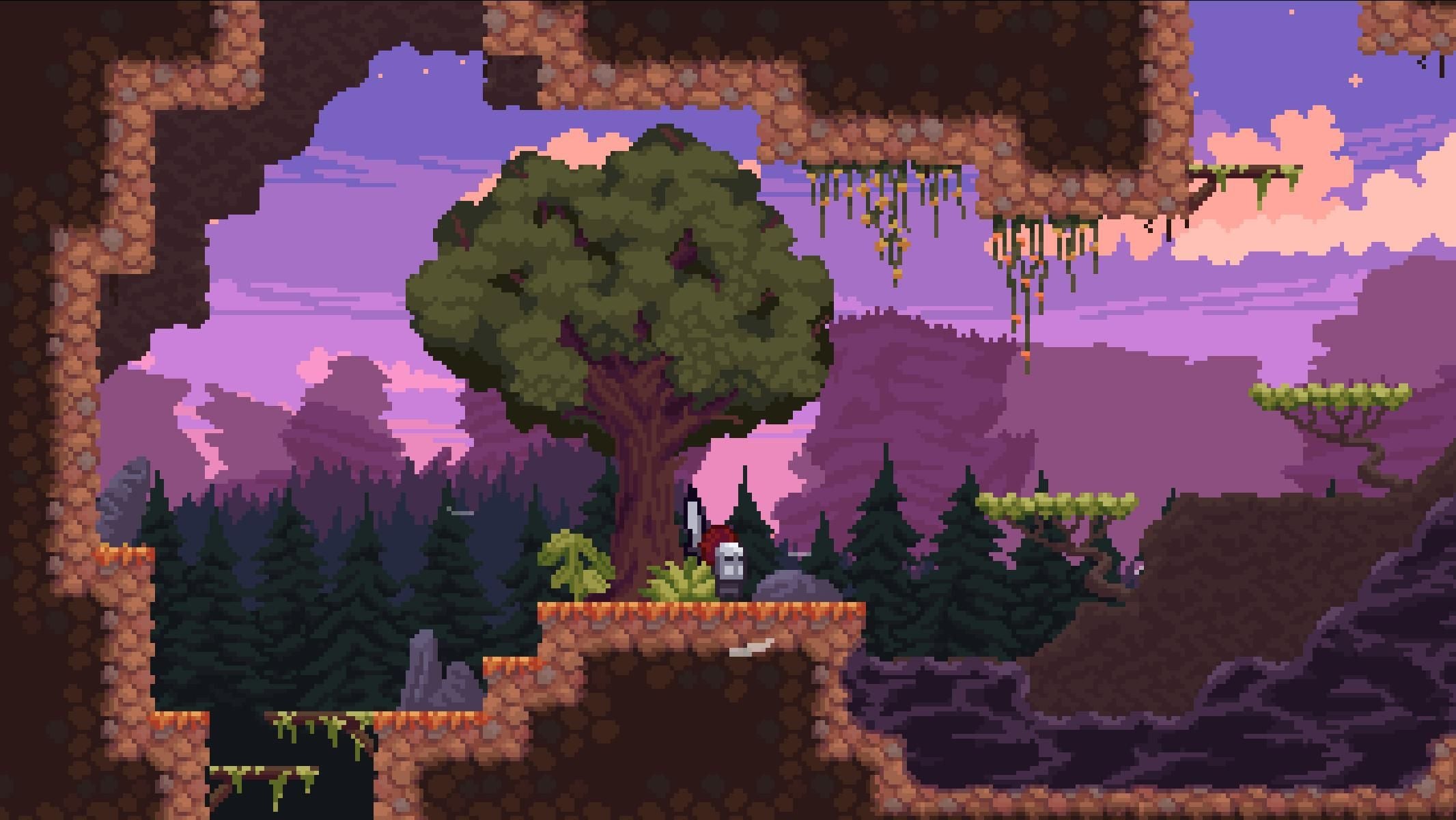
“As soon as I saw it,” Brynjar told me by email, “I thought to myself that you could make an entire game out of just that mechanic alone, you wouldn’t even need to walk! Which was a very interesting and appealing idea to me, a platformer without walking.”
When he realized Spalding’s game wasn’t using the conceit itself, he was inspired to do it himself. “At around 3 a.m., fueled by a spark of inspiration, sleep deprivation and frustration from the underutilisation of the mechanic, I jumped into Godot and prototyped my idea,” Brynjar continues, “making the recoil bounce and adding controller support. And to my surprise it was very fun, even with just an empty level with some blocks scattered around.”
Recognizing that his art skills weren’t up to the project, he teamed up with Sindri, the two teenagers finishing the project before starting college a few weeks ago—where the pair are studying game development and VFX.
Slash/Jump is completely free via Steam and Itch, and well worth your time. If you get it via Itch, you can also choose to pay the pair for their work.
A version of this review originally appeared on Buried Treasure, which you can support on Patreon