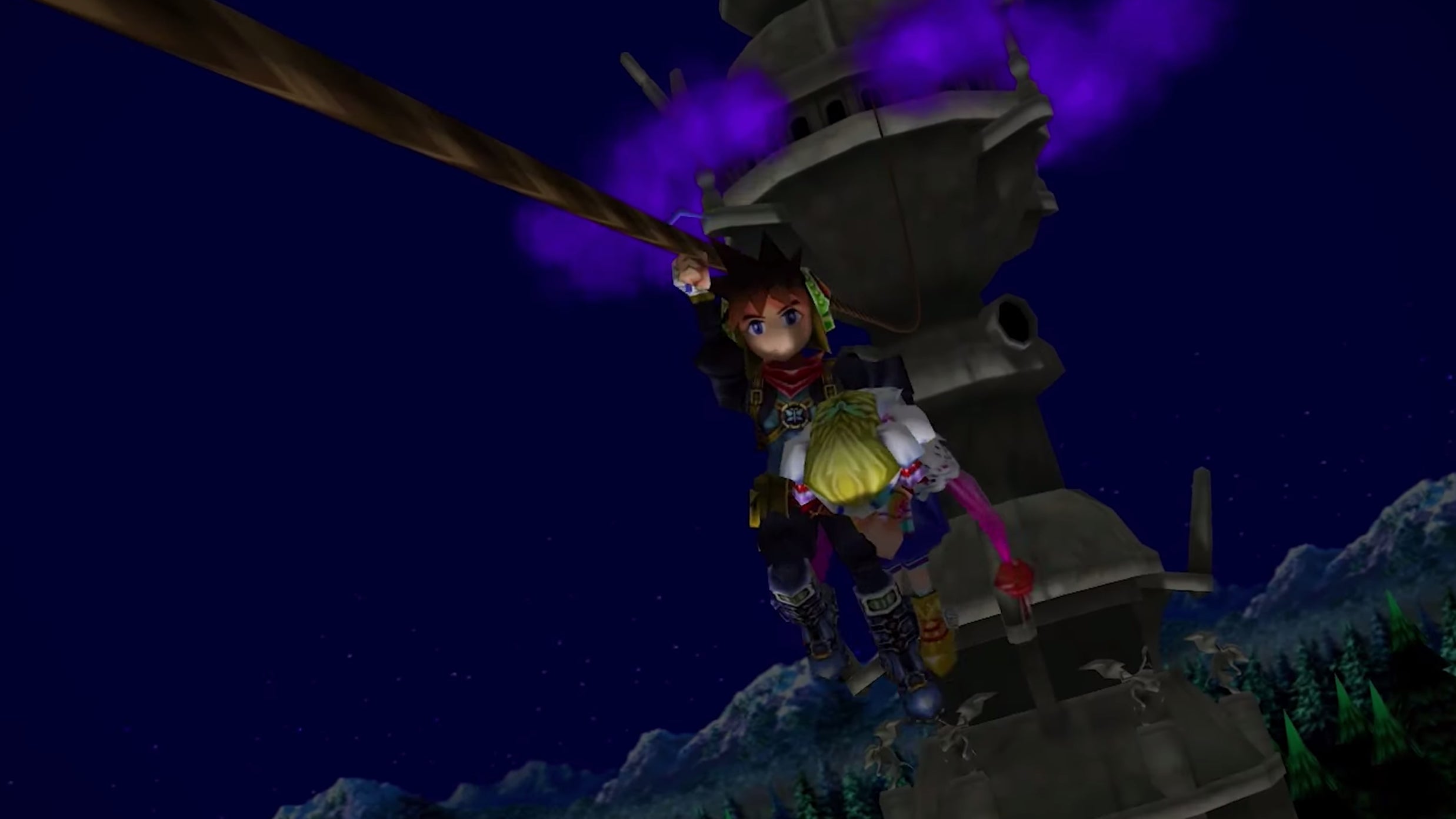
When I was in my impressionable pre-teen years, I spent vast amounts of my summer tucked away in a musty little basement down the street. My closest friends would visit at their grandma’s house near me every year while school was out, and when we weren’t “ripping and running,” playing basketball with the “mannish” little boys next door and riding our bikes back and forth up the bumpy brick streets, we gathered around our consoles for hours and hours of gaming. One summer, they brought with them a Dreamcast—the console that would impact my gaming palate more than any before it with games like Sonic Adventure, Soul Calibur, and Power Stone. One game stood out and ate up those hot summer days: Grandia II. It became one of my favorite games of all time, and playing its predecessor, Grandia, has been a trip in every imaginable way.
Grandia, like its sequel, is a role-playing game with an overhead view and a battle system that takes the best parts of both real-time and turn-based battle systems and squishes them into a neat package. Your characters’ physical positions affect whether they’ll be able to damage or take damage from enemies, and a turn gauge lets you anticipate when each character will move, allowing you to cancel or counter enemy actions. It is by far my favorite battle system in any game, and it’s almost always the first thing I mention about Grandia II, next to the fact that I stubbornly prefer its plot about nefarious churches and crises of faith to Final Fantasy X’s.
What I forgot over years of not revisiting Grandia II was the deep and gripping sense of wonder the game gave me. I forgot what it was like to actually get swept up in a game’s sense of adventure. So playing the first Grandia for the first time, years after I’d played its sequel, gave me an eerie feeling of deja vu and sentimentality. It was nostalgia for a game I’d never played before. I genuinely felt like a kid again, lost for a moment in a feeling of adventure and possibility. I forgot what it was like for excitement to feel this earnest.
Moment by moment, I found myself falling into old RPG habits. Talk to every character in the town, check. Explore every area, check. Look for hints or extra items, check. But instead of the feeling of compulsion that drives me to do those things in a lot of other games, Grandia kept me excited to talk to new NPCs—the woman pacing back and forth and fucking fuming, then bafflingly complaining to a kid about her gambling husband. The little boy hiding by the fountain to avoid being caught by his mom and getting dragged to the dentist. The mom hunting for her truant kid, who you can choose to help out or con into looking elsewhere. The old woman telling stories about her time as a child, when the entire town was forests and woodland creatures, before industrialization happened. The powerful men from the Joule company puffing up their chests about how they brought growth to such a small town with the power of industry. As I talked to each one, multiple times to see all of their dialogue options, I found myself feeling verklempt: Oh, shit. I actually used to like doing this.
It reminded me why I mechanically read through every text box in games nowadays, even when I find the writing banal. This is how video games used to make me feel. This is where I’d learned that behavior—from a series where curiosity actually felt worth it. Exploring the overworld wasn’t just a mad dash to find every item there, a series of actions guided by a long-curated cache of RPG tropes—I wanted to play around with the game’s battle system, figure out where it overlapped and diverged with its sequel, learn about the mysterious ancient cities teased at in the game’s opening and the museum my young protagonists visited.
If there’s a downside to playing Grandia for the first time today, it’s the little annoyances that were fixed in Grandia II. The overworld map feels a little finicky after playing the more polished second game. The monsters’ pixelated visages, while nice-looking in the HD collection, are a little hard to track, making the strategic movement of trying to approach them from behind for a surprise attack tricky. The characters’ movements on the battlefield feel slow and unwieldy, and after playing the sequel, the rudimentary turn gauge in the first Grandia feels more like a test pilot than the innovative and well-tuned system the series is known for. And like news editor Jason Schreier mentioned, the Grandia HD collection lacks the fast-forward button that’s present in emulators and many other retro re-releases, making the tedium of slower gameplay all the more pronounced.
What really struck me, though, was the fact that, as impossible as these things were to ignore, I… did not care. It’s always tough to play a game after you’ve played its sequel, especially in a series that’s been out for decades, but actually wanting to read everything I saw made piles of text boxes and unskippable cutscenes feel like a treat. Imagine that—long cutscenes feeling like a reward. I might feel differently when I play through it a second time, once I’m no longer new to the game and ravenous for story developments, but for now, I’m enjoying my slow stroll down memory lane via a game I’ve never even played.