In just five days of play, Guild Wars 2 has managed to wreak havoc on my usually-sharp ability to make up my damn mind.
Those five days, beginning with Saturday’s head start access, have seen me create one character after another. It’s not because I’m dissatisfied with any of them. Quite the contrary, in fact. While the mage-types still lie outside of my comfort zone, playing my human thief and asura engineer feels like slipping easily into a second skin. Every one of those characters, though, has found herself standing in a part of the world fundamentally different from the others. Each one is in a different city, showing a different culture, a different history, and different priorities.
Five days, five alts, five stories to tell. It appears I will see every low-level area Guild Wars 2 has to offer, even if I despair of ever letting myself get to what comes later.
To understand what Guild Wars 2 has done to me, there is one crucial fact about my general play preferences you must know, and it has nothing to do with my strange history with the MMORPG genre. No, the most important thing to know about me as a player is that I put 100+ hours each into Fallout 3 and Fallout: New Vegas, explicitly because I could see on my compass and map that there were areas of the world I hadn’t explored yet, and I was compelled to explore them all. I can’t help it.
Guild Wars 2 has a very thorough map. On it, you can see not only the local points of interest, but also where quests lie, where skill points sit, and where quick-travel waypoints can take you. And on top of all that, there’s the little red icon that has doomed me.
The little red icon signifies something called a vista point. As you walk around the world, you encounter little flapping banners, usually on the highest point in any given area. Get yourself to the top of the building, or the mountain, or the room, and you can trigger a panoramic cut-scene highlighting the area you’re in. (It’s very similar to the feeling of sending Ezio to the top of the nearest tower for a panoramic view of Rome in an Assassin’s Creed game.)
I have developed a bit of a vista view problem, and I don’t mean my tendency to forget that GW2 doesn’t have Safe Fall. (Yes, I have splatted all five of my characters.) The map tells you exactly how many of these there are not only in each zone, but in the whole world. There’s one just around the corner. Who cares if that area is level 15 and I’m still level 6? Surely, I can climb just one more mountain…
It’s become a new variant Civ “just one more turn” sickness. Guild Wars 2 tracks and quantifies everything I do, so I know just how far I have to go and where the end goals are. 301 heart quests, 507 waypoints, 716 points of interest, 202 skill points, and 266 vistas. Surely the vistas can’t be that challenging to collect. 200 and change, I must be able to manage it, right?
I have as yet completed fewer than 20 of them. And given how particularly tricky the ones in Asura areas are to get to, I think I have a very long road ahead.
Apparently if you build it, I will come.
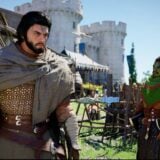
While insatiably exploring the world, I’ve also come to love how different the stories and the environments for each character race feel. The art and architecture, from level one onward, convey the weight of Tyria’s history. And the scale is extraordinary. Norn are half again as big as humans, and Asura barely knee-height, and yet the cities dwarf everyone.
Sure, walking through Divinity’s Reach, it can feel a bit silly being surrounded by doors and ceilings that a giant wouldn’t graze the edge of, when the tallest human around might be six feet on a good day and in heels. But the views are so lovely that I find myself generally not caring. It’s one of many conceits a player learns to accept for the sake of making the game itself work better. Like location-based events: sure, a pack ox may be walking back and forth between a trading post and a town with some regularity, so protecting it makes sense. But must the giant wasp queen always be spawning right when I happen to be running through the forest near it?
The spirit of cooperation that I first noticed in an early beta weekend event still endures, and is what makes participating in overland events worth it. When twenty souls are hacking away at a massive boss, or valiantly surrounding an escort target to defend it from waves of attackers, it feels almost cowardly not to lend a hand. They may not need your help, but surely working together for a common goal, and participating in the world around you, is better than ignoring your fellow man. After all, you may need the help of a stranger yourself sometime soon.
https://lastchance.cc/a-gorgeous-living-world-sets-guild-wars-2-apart-5906933%3C/a%3E%3C/p%3E
Then you discover the next area, and the one after it, and zoom out and look at the full world map, and you realize how small you and your understanding really are.
The last time I was as eager to step off the proscribed path as I am now was back in 2005, when I was a wee newbie EverQuest II scout and realized that I could, with some difficulty, walk from the Commonlands (Freeport’s 10-20 zone) to Antonica (Qeynos’s 10-20 zone) if I wanted to. It meant going through both level 20-30 zones on the way. On foot. Surrounded by creatures that vastly out-leveled both my stealth and my stabbing. I was level eleven, and it took me about two hours of real-time to do.
That was the day I got hooked on a game that I kept playing for close to six years.
Guild Wars 2 isn’t punishing me for stepping off the path and seeing just how much danger I can put myself into. On the contrary: the system of icons and achievements explicitly encourages me to explore the world. And if I’m impatient enough to be doing it while under-leveled, well, that’s on my own head. And I love it.
Eventually (as in, before next week, because I have to share my experiences with Kotaku) I will actually advance in my story, get beyond the starting woods and villages, and get to the serious business of vanquishing my enemies. But for now, I am content to explore the world, from every vantage point it has.
Kotaku’s MMO reviews are a multi-part process. Rather than deliver day one reviews based on beta gameplay, we play the game for four weeks before issuing our final verdict. Once a week, we deliver a log detailing when and how we played the game. We believe this gives readers a frame of reference for the final review. Since MMO titles support many different types of play, readers can compare our experiences to theirs to determine what the review means to them.