March 22, 2014 has been declared Hellboy Day by Dark Horse Comics. That’s because it’s been 20 years since Mike Mignola’s signature creation first appeared in print. It’s been a long, awesome existence for Anung Un Rama. Let’s celebrate it by picking the brain of Hellboy’s daddy.
The iconic creator got on the phone with me to talk about the history of his cantankerous occult adventurer. Over the course of the conversation, Mignola talked about his early career working for Marvel and DC, why the Hellboy video games probably didn’t work and what kind of animation he love to see Hellboy done up in.
Kotaku: Let me start off with a little personal anecdote of mine as it relates to Hellboy. There was a short that I believe you drew. It was one of the little Hellboy vignettes where he eats pancakes for the first time.
That’s one of my favorite moments. But one of the best things about it was I was able to show that to a friend of mine who doesn’t read comics. He’s not into geek culture at all, yet he got it right away and he laughed.
To me, that encapsulates one of the things I like most about Hellboy, which is a mix of plainspoken, everyday workman like tone with this ominous Lovecraftian doom-and gloom-framework. Was that something you set out to do from day one?
Mike Mignola: I had so few conscious thoughts about what I was doing. I just basically swept together everything I liked. I guess I should just be really happy and lucky that I found the right balance between all these things because I really did bring everything to it.
I know guys who are much more compartmentalized with the way they think, and they say, “I’m going to do this book and it’s going to be this plus this. Then this other book over here is going to be my take on this.”
My feeling from day one was I’m only going to create one thing. If Hellboy works, I have no intentions of trying to do that again. I’m just going to pour everything into this one thing. The one conscious thing that went into Hellboy was creating a character that could be a vehicle for all this different stuff.
I do have a book where I’ll do an adaptation of an old Irish folk tale, but at the same time, I’ve got this big Lovecraftian thing going on. I dance around explaining how all these different universes work together.
Mostly I’d rather just keep certain areas mysterious rather than trying to explain some big thing. You start explaining fairy tales turning them into a Lovecraftian thing and you’ve lost the magic of what was in that fairy tale. I did hit on a way to write all of this stuff very vague and mysterious and cryptic, and not step on the magic stuff.
Kotaku: It’s been 20 years. Do you feel like you prefer the writing or the drawing more? You were doing both at the same time for a very long time. But now you’ve handed off some of the artistic duties to Duncan Fegredo, right?
Mignola: Yeah. I did hand it off to Duncan. I’ve now taken it back, and have been drawing the book myself for the last two years or so, something like that. I got to the point because of the movies, especially that second movie.
I was so roped into working on a film that I couldn’t do both. The comic was just never going to be coming out if it had to wait for me. Plus, I’d gotten very hung up on the way I drew, and I was scrapping more pages than I was publishing. It was very frustrating and I was very happy to step away from the art for a while, and almost right away I missed it.
The beauty of writing for Duncan, a) he can draw a lot of stuff I can’t draw, and I was able to write him a gigantic story without saying, “Oh my God, it’s three trade paperbacks worth of material.” It ended up being almost like 20 issues, some ridiculously huge story, and I didn’t have to think about having to draw it myself.
It’s also much nicer to be able to say, “Hellboy fights with a giant army of skeletons,” without the artist part of you going, “Screw you! I’m not going to draw that.” It’s very liberating to write for somebody else, somebody else who’s good. Also, Hellboy was able to have a love interest. Because I’m pretty terrible at drawing women or certainly I get very intimidated at drawing women.
I don’t think it’s my strong suit. To do anything kind of a romance thing, I don’t know if I would have attempted it if I was drawing it. Actually, I know I never would have attempted it if I was drawing it.
Kotaku: That’s the secret of being Hellboy single back then.
Mignola: That’s right. No. I don’t think I even referenced him ever having relationships with characters because I didn’t even want to do a one-panel flashback or anything. But the beauty is because of Duncan, he was able to have a really charming relationship, and some of even the awkward romance dialogue I thought I was going to have to write I didn’t have to write because Duncan’s storytelling was so good that the art told the story.
That is the beauty of working with a really good artist, there are certain things that you just don’t have to write if the guy can give it to you in pictures. Yeah, that was fun. I still do writing for other people, but at the same time, there is a thing I am always going to miss if I’m not drawing.
I can’t imagine a time where I wouldn’t draw at all. There are certainly days where I would be very happy to chuck all the drawing because I’m very critical of my own drawing. But if I swear off drawing, within 24 hours I would be going, “Yeah, you know what I would like to draw? I’d like to draw this.”
Kotaku: My colleague Luke Plunkett is a huge Hellboy fan. Bigger than me. I’m going to read a question from him verbatim just so you can get the full feel of it. He says, “I’ve always found the most distinctive thing about your art, particularly Hellboy, to actually be the colors. They’re like a dungeon full of wet, brown leaves. Where do you get them from? Do you have a special name for any of them?”
Mignola: A special name for my colors? I’ve been very fortunate to work with some very good colorists, but the bulk of Hellboy has been done with Dave Stewart. Once Dave came on board—which was maybe 15 years ago, maybe even longer than that—we clicked very well.
He’s willing to put up with me because I do have very definite ideas about color and using color to tell the story. Working with a colorist for 15 years, you do develop a certain shorthand. He knows the colors I like.
He knows the colors I don’t like. If I tell him that kind of night time sky blue, he knows what I’m talking about. He’s great. He’s just I think the best colorist in the business, but he’s very patient with me. We just did the newest issue of Hellboy in Hell
I don’t know how long we were on the phone, but I talked him through the entire comic one panel at a time, “This is this, and this is that. These three panels need to be the same color because it’s this particular location. For this panel, we jump away to this place.
[colorwork via Alex Petretich]
We need a different palette, something very icy and cold and kind of blue-greenish. But then for this panel, it’s a flashback of Prague. Give me something that’s in grays. But for this panel over here it’s all about the possibility of redemption so give me these nice goldy colors that don’t relate to anything else.” There’s a whole layer of storytelling that is in the color.
I know guys who don’t think about that stuff at all. I just think it’s such an important tool. It’s like the soundtrack on a movie, you can manipulate mood so much. It’s quiet. It’s quiet. Then a little bit warmer. Then boom! Here’s where the big drums come in. You bring that in such a powerful way with the color.
Kotaku: I want to backtrack a little bit. You talked about starting out. One question for me is what would you have done if steering your own ship had not proven financially viable? You’re a guy who started off as a work for hire with various companies, and then you carved out this niche for yourself and a universe for yourself that does exactly what you want it to do. What would you have done if that didn’t work?
Mignola: Well I was certainly prepared for it not to work. At the time, I had a pretty good relationship with DC. I kind of burned my bridges at Marvel, which is unfortunate, because Marvel is what I grew up on. To some extent, I understood those characters, had affection for those characters. Never gave a shit about DC Comics. But it turned out that one of the few characters that people liked to see me draw was Batman.
I had done a Batman book there that I was pretty happy with. I knew a lot of people in editorial and stuff there. I knew I could probably do more of that kind of stuff. At the same time I had done the Alien book for Dark Horse. That worked out pretty well.
I figured I could get other work like that. I went into Hellboy saying, “If it works, it’s great, but chances are it’s not going to work.” I was prepared to go back and do one of these things I’d done before again. I would just bounce around back and forth between these couple different companies and do whatever I could do.
I got to that point in my career where I could go in and say, “I want to do this kind of a book.” I could create my own projects. I’d done that for about a year. Probably before I did Hellboy, I created a plot for a Batman story. DC let me do it. I could have continued doing that I think for a while but God knows where I’d be now. But that was a plan. Certainly Hellboy was not a huge seller.
My first instinct after I did that first Hellboy series was to go back and do another Batman book or something. It was actually my wife who said, and probably people at Dark Horse saying, “It worked well enough. Why don’t you keep doing it.”
I wasn’t ready to throw it away, but I’d bounce it back and forth between other books. But my wife, who had no reason to believe that Hellboy would ever turn into anything, said, “Why don’t you just keep at it for a while.”
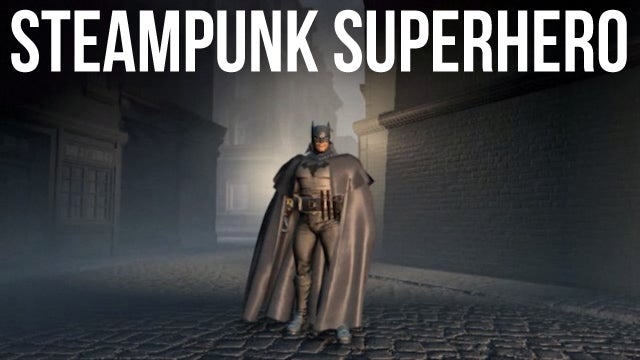
Kotaku: That’s so great. That’s so supportive of her. Was this Gotham by Gaslight?
Mignola: Actually, no. The Batman book I was referring to wasn’t Gotham by Gaslight. It was a one issue Legends of the Dark Knight called “Sanctum.” It was a straight supernatural Batman story that I thought of myself. In a lot of ways, it was the precursor to Hellboy because I plotted this story that was a supernatural story and I really had a good time doing it.
When I came off of that book, I was really in a spot where I thought, “Do I continue to do stories like this where I try to cram existing characters in? Or, if I know I want to do that kind of story, do I make up my own guy?” That one particular Batman comic was very much a springboard to Hellboy, but it came before Gotham by Gaslight.
Kotaku: I was going to mention it in passing was because there was a game in development for a while and then it got canceled. I don’t know if you’ve ever seen it.
Mignola: No. I know nothing about games. I only heard of this thing when it was canceled. That was all over the Internet and Facebook and stuff. I saw a couple of images from it but I never knew anything about it.
Kotaku: It looked pretty cool. Since you mentioned games, let’s talk about the two Hellboy games. Why do you think they didn’t clicked? The consensus is that they didn’t feel right.
Mignola: I had nothing to do at all with the first one. I don’t think I’d ever seen anything from the first one. Again, I’ve never played games. I don’t know anything about them. I’ve heard through channels that the first one was horrible. I assume that would be part of the problem.
https://www.youtube.com/watch?v=Yslmp35z2oI
The second one they brought me into consult one day. [Guillermo] Del Toro and I went in. Del Toro is a game guy. He said certain things and I just looked at it and said, “Yeah, what he said. That sounds fine to me.” Again, I have no idea. I don’t know what they should be. I don’t know what they shouldn’t be. I can comment on story, but games are such a completely different thing that mostly I kept my mouth shut and nodded. I would think it should work, Hellboy as a game. I would think it should work. But my lack of knowledge about games means I can’t try to sell anybody on the idea of a Hellboy game. That’s entirely somebody else’s thing.
Kotaku: Hanging on a little bit to past characters that you’ve done before, obviously Guardians of the Galaxy is coming out this year. People are going crazy for it. And it’s got Rocket Raccoon, a character you drew back in the day.
What do you think the appeal of the character is? I personally hate raccoons in real life. I don’t hate very many animals but they creep me the fuck out. But people like Rocket Raccoon. Why do you think that is?
Mignola: I suspect it comes down to something as simple as the talking raccoon who apparently has an attitude, which he didn’t have, I don’t think, when I drew him. But whatever they’ve done with him since then made him into something different.
Again, I’m totally unfamiliar with all the Rocket Raccoon stuff done since I did that book. I really have no idea. It certainly caught me by surprise when the character showed up again, even in the comics, let alone the fact that he would get turned into a character in a film. I don’t know.
It’s very funny to me. But, to me, Rocket Raccoon will always be just a job I was very lucky to get at the very beginning of my career. To me, it was just a job. I wasn’t cut out to do superheroes, but fortunately the writer I was working with said, “I created this raccoon character, maybe you could draw that?”
I’m thinking, “Yeah, I don’t know how to do anything else. I want to break into comics. I want to stay in comics. You got a story about a talking raccoon? You’re going to pay me to do that? Very happy to have the work.”
Kotaku: That takes me down a side route that I wanted to ask you about, about your art style and the way it evolved. I remember reading your stuff back in the day, there was some early Alpha Flight
Mignola: Yeah.
Kotaku: At times, it feels like the angles have always been there, in so far as how you compose bodies and characters and faces. But, looking back on your work, it becomes apparent that you stripped away more and more detail as your career went on. Was there a tipping point for that? Like, “Oh, this is what’s really working for me?” What informed that kind of change and approach?
Mignola: It is hard also to assess what my stuff looked like the first couple years of my career. I barely had any idea what I was doing. In a lot of cases, I was under really heavy inkers. Gerry Talaoc, the guy who inked Alpha Flight, saved my ass because I didn’t know what I was doing. But you don’t really see my style at all.
I was able to evolve a style probably before anybody knew I was evolving a style. When I did Cosmic Odyssey for DC, I spent a year using a lot of Jack Kirby comics for reference. I was drawing all of these Jack Kirby characters and that was probably the biggest period of transformation. Again, the inker was not terribly sympathetic to the way I drew. I was doing a lot of things…
Kotaku: Who was the inker on that?
Mignola: It was Carlos Garzon. He’s a very good inker, but he’s of the Al Williamson school, which is a lot of extra lines. I had already stripped my stuff down over the process of doing that book. I’d scaled my stuff down into these very geometric shape things very influenced by Jack Kirby. That got softened a lot. That’s one where I really wish I had xerox with the pencils because I do think a lot of what I was doing was starting to click there.
Kotaku: The thing about Hellboy and the Hellboy universe is that it’s grown into these unpredictable ways. Is there a specific aspect of the universe that’s taken a life of its own that’s surprised you?
Mignola: Well I’m still surprised that’s it’s turned into a universe. It was never intended to be. From the beginning I was just happy anyone was buying the comic. The idea of expansion was very slow in coming.
When I realized that this Hellboy character was so much more interesting than I originally thought he was, I saw that he was going to be the focus of the book, and all of these other characters that I had created, there was never going to be any room for them. We had to eventually try to spin them off. Just the fact that the whole thing has taken a life of its own is one of the things I’m most proud of. It’s become a coherent history that’s spread over everything from the Stone Age through World War II, and the Old West up to now.
I’m just surprised I’ve been able to get away with it, and I’m surprised at no point really have we written ourselves into a corner where I’ve gone, “Oh crap, that’s a dead end. We shouldn’t have gone there.” The fact that it’s still organically growing, and at no point has anyone, Dark Horse or anybody else, said, “We need more books, we have to expand this thing for sales or any other reason.”
It’s only grown because I’ve said, “Oh, there’s more story here. There’s more story here.” I can have a character who wasn’t supposed to get a spinoff book, I’ve suddenly got 20 years of this guy’s life that I’ve figured out. I think that’s maybe the secret to the success of this universe, the fact that everything feels organic. All these stories are coming organically of what’s gone before.
Kotaku: Another Luke Plunkett question: whatever happened to the Screw-On Head cartoon?
Mignola: Again, it’s something I had almost no involvement in. I believe, as happens with a pilot, they did it, and the people who were supposed to do it as a show said, “Nope! We don’t like that.” Yeah, that I think comes down to something as simple as that. I had almost no involvement. They sent me a script. It was taking something that was meant to be a one-shot comic in a nonsense world.
The fact that Abraham Lincoln was in it tripped them up so suddenly it had to take place in a particular place in history, and they had to build in relationships for all of these characters. All of it was stuff I understood. They were trying to do a series. It wasn’t my kind of thing. I read it. I gave them some notes. Some they listened to, some they didn’t listen to. Then I essentially just stepped away.
There was nothing for me to do. When David Hyde Pierce and Paul Giamatti did the voices, I went and watched that. That was a great experience. And that was the end. I never watched the show. Can’t watch the show because they were very keen on trying to do my style, which makes it impossible for me to watch, because when somebody is trying to do you, all you can see is what they’re doing wrong.
If it were done in a completely different style, stop-motion would have been the best, or live-action, or anything like that, I could maybe watch it because I’d have a little objectivity. But if I look at it, I would go, “Oh, I would never draw a knee like that.”
Kotaku: You had a little thrill in your voice when you mentioned stop-motion. What are your favorites in that particular type of animation? The old Rankin/Bass Christmas specials?
Mignola: Oh certainly, there’s just a charm to those old homemade things. Coraline and the new Boxtrolls, I just watched a trailer for that the other day, this stuff looks great. It’s just a wonderful art form. Svankmajer is his name. The guy who did Alice and Faust. A guy like that, where it’s disturbing as hell.
The Quay Brothers. Disturbing, disturbing stuff. But I could see the Screw-On Head stuff done like that. There’s a creepiness to that stuff. Even the Hellboy in Hell stuff, and certainly all the Screw-On Head comic stories, I imagine them taking place in a world like that where everything is made of dirty old toys you found in the backyard. There’s a real charm to that.
Kotaku: Last question. It sounds like from the game stuff and the Screw-On Head cartoon, and even the movies a little bit, you’ve grown warier of adaptations now. How do you basically feel if somebody comes and says, “We want to do the Hellboy game right,” or “We want to do the next Hellboy movie and this is what it’s going to be like.” What’s your stance on your vision, your creations migrating to other media right now? How do you feel about that?
Mignola: I’m fine with it. One thing that is nice now is all of those rights other than publishing are held by other people. It’s nice that I’m never going to be in another position again where somebody has to come to me and ask permission. They can just do it, whether I like it or not. It makes your decision making process a lot easier when they don’t have to ask you.
Kotaku: Can I stop you there? That’s super interesting to me that you prefer to have a buffer rather than dealing directly…
Mignola: Because if I say yes to the wrong thing then I’ve got to beat myself up for years to come that I should have said no. The truth is something like a game. Initially with Dark Horse, when Dark Horse did the first game, I had to say yes to it. But I knew I was never going to play a game.
I knew I didn’t care about that, so it was easier to say yes to something that I didn’t care about because they were making it for a different audience. But if we’re dealing with something like the design of a Hellboy book cover, I will wear out the design department saying, “Can we change this? Can we move this? Can we move this?” Because the books are what I care about. The books are what I can control.
Mignola’s first drawing of Hellboy
Anything else, animation, film, whatever, there are so many other people involved in that stuff, my feeling is, hopefully somebody who knows what they’re doing there will do that. I’m not going to sit next to the filmmaker or the game designer and say, “Oh, it should be this or this.”
Because I’m not a game designer. I’m not a toy-maker. I’m not a movie director. If they ask me, I’ll give my opinion, but it’s not my field of expertise. But if we’re talking about story or character designs and stuff in the comic book world, then I got plenty to say.