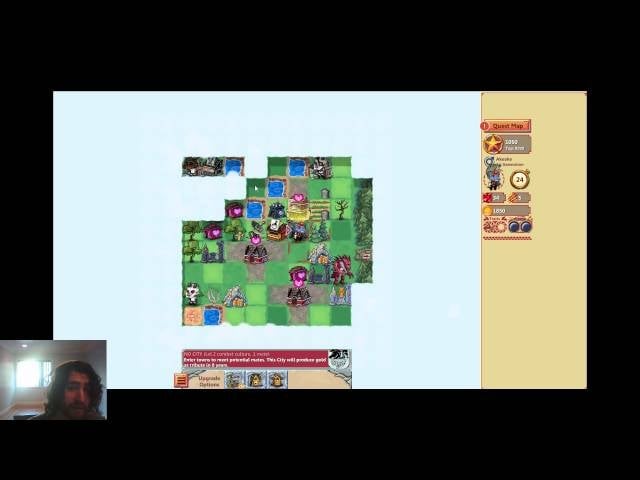
Should I care about Hero Generations? For sure. It’s a turn-based strategy RPG where each turn equates to one year of your hero’s life, and death is permanent. You have to make every move count as the world shifts and ages around you.
What’s it about? The game’s Steam page does a pretty good job of describing it, so here’s that:
“In Hero Generations, each step you take is an entire year of your hero’s life. You explore a procedurally generated world in search of fame and a mate to have a child with before you die. After your life ends, you take control of your child in the world you left behind, in the hope of continuing your family legacy. Each turn becomes a meaningful life decision: you can focus on building and crafting the world around you, or adventuring to far off lands to make a bigger name for yourself.”
As years become decades and centuries, the world changes too. New technologies are discovered, buildings you put in place when one of your characters was a fresh-faced youth wither and crumble. Shacks become towns, towns become metropolises, and metropolises return to nothing. Now is the part where I’d say something profound about the passage of time if I actually had anything to profound to say.
Watch me play a bit of it here:
https://www.youtube.com/watch?v=g4-WPwB7_TE
Why is (or isn’t it) cool? It takes the complexities of massive, centuries-spanning strategy games like Civilization and boils them down into a slick, easy-to-pick-up experience. It’s like one of those games, but individual, personal. You only have to account for one character at a time, but as a result each move counts all the more. Absent-mindedly wasting your years skipping through the woods or bopping rando baddies with a wooden sword won’t get you anywhere. The world is vast. Explore! Expand! Exploit! Exterminate! Find out what the deal is with all the ominous, apocalypse-foretelling letters each character in your lineage receives when they first step out into the searing sunlight of adventure.
Smaller details, however, are what make Hero Generations so cool. Let’s use the aging/procreation system as an example. Each character starts out a scrawny teenage weakling, but every ten years they get a nice, fat stat boost. For a while. Once they get into their 60s, however, they lose strength every decade instead of gaining it. This is the game’s way of saying you should probably find a village and settle down, let your kid take up your sword.
You can, however, wriggle away from the long arm of Father Time (which often looks curiously like a Reaper’s scythe). You can build structures that give you additional strength and life expectancy. You can focus on family traits that boost those stats even more. It’s in those final moments—whether defiantly flipping a middle finger in time’s general direction or hurriedly accomplishing goals in hopes of making every year count—that I felt like I was truly defining each character’s legacy, deciding what they were all about.
Sounds like there’s a lot of room for player-driven stories here. Yeah, I would say that’s one of the central appeals of the game: imagining each character’s motivations and goals, and enacting them on a massive world’s stage. There is, however, something equally intimate about all of it. This is a game about family, after all. It’s hard not to follow in the footsteps of your last character, especially when their child shares their physical features (eyes, noses, hairstyles, etc) and a genetic trait or two. They’re connected by blood, by goals, by love and fear.
We all want to make our parents proud, after all. Or make them curse in their graves as they watch how great we become despite how badly they fucked us up. Whichever.
So the first major goal in the game is to take down a big boss dragon monster thing. Initially, even going near it constitutes suicide. I was wary with my first couple generations, because you know, permadeath. One idiotic blunder and that’s the end of my whole family line. I decided to bide my time, create structures to give each successive generation a bit more of a head-start. Three or four generations in, I was ready. This child, she was a combat machine. She amassed a strength stat of more than 20 (characters usually start with just a few points) before she was even a proper adult, and she inherited her father’s blade. I couldn’t help but imagine the sentiment. “Go slay that motherfucker, honey. Finish what our family started centuries ago.” She, like that blade, was made for this—honed and sharpened since the day she was born.
She finally cornered the beast when she was a bit north of 50. She was stronger, but barely. The first time they fought, she got the better of the dice roll, and she shaved quite a few years off the beast’s lifespan. But the second time—just one turn later—he won the encounter, sending her packing with only a handful of years left and a wicked scar. One more encounter like that, and it would surely be her end. She could’ve run. She could’ve cut her losses, settled down, and passed the family burden onto her child.
But that just wasn’t in her nature. This fight was her everything. Whether she loved her father for giving her this strength or detested him for setting her on this path, she couldn’t decide. All she knew was that fleeing wasn’t actually an option. So she plunged back into battle with this thing, this monster suddenly looming taller than ever before, and swung her sword with all her might.
It wasn’t quite enough. Thus ended that playthrough.
And yeah, I could’ve played smarter, but it didn’t feel true to the character I’d developed. In that moment, I realized just how powerful of a story Hero Generations‘ simplest game mechanics could create. All of that blossomed in my head because of play, because of the game’s structure. That is damn cool.
Is it always that good? Ehhhhhhh. That’s Hero Generations‘ biggest problem: after a while, the rhythm of each lifespan becomes kinda predictable. You’ve got to make sure your structures are intact and then use them to grind up to a point where you’re not totally screwed against powerful enemies, and then you’ve got to use the precious few years you have left to actually accomplish things. The build-up goes from contemplative to tedious. Moreover, the game’s simplicity works against it after a while. I found myself wishing that I had more options for developing my characters, that the world changed more significantly over time, that combat was more than simple dice rolls.
Should I buy it (even though there are a million-billion other Steam games I could spend my money on)? Yeah, I would say so. You can get up to speed and have a life-and-death family-legacy-riding-on-your-shoulders struggle in minutes. The thrill of it all wanes as time goes on, but there are still a lot of interesting choices to be made. At $14.99, it’s definitely worth a look, if nothing else.
Steam’s new release section is chaos. Steam Snapshot is a regular feature in which I post my brief impressions of a new Steam game in hopes of letting you know, as quickly and succinctly as possible, if it’s worth your time/money.
To contact the author of this post, write to [email protected] or find him on Twitter @vahn16