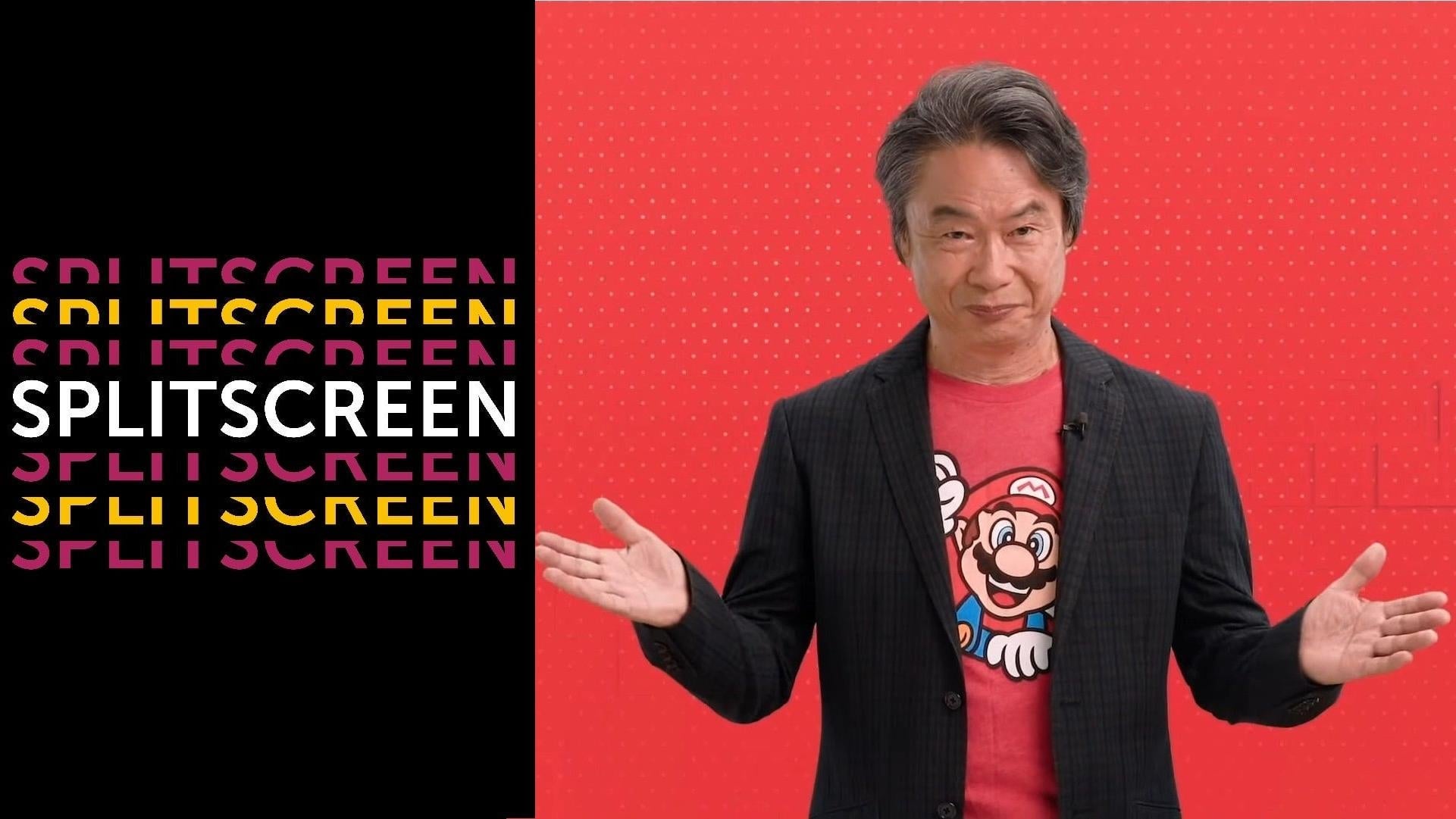
Somehow, miraculously, video game movies and TV shows are suddenly good. The Witcher is fun, Sonic inhaled box office money like so many chili dogs last year, and star-studded renditions of Borderlands and The Last of Us are on the way. Also, the new Mortal Kombat movie looks dumb as hell in the best possible way. On this week’s Splitscreen podcast, we remember a time when things weren’t like this at all.
For the first time in our illustrious several-month history, one of us, Ashley Parrish, was unable to be present for recording, so this week, the part of Ash is played by Brock Wilbur, journalist, comedian, and co-author of a book about Postal, a series of pretty bad games that inspired an incredibly bad movie. To begin the episode, Mike Fahey, Brock, and I discuss the earliest video game movies, including Mortal Kombat, The Wizard, and of course, the completely bonkers 1993 Super Mario Bros film—whose production was hilariously fraught.
Then, for our second segment, we closely examine the crown jewel in this Criterion collection of crap: the filmography of German director Uwe Boll. He gave us magnificently incoherent movies (loosely) based on games like Dungeon Siege, Alone in the Dark, and Postal—the latter of which inspired perhaps the worst video game movie of all time. Brock regales us with tales of how Boll’s movies got made, as well as the time Boll flew online critics out to Spain and Canada for boxing matches in which he, as a former amateur boxer, mercilessly pounded the stuffing out of them.
Lastly, we set our sights on the present for a discussion about the pros and cons of big-budget video games’ slow convergence with Hollywood. On one hand, at least studios finally care about making video game movies and shows, you know, good, but on the other, do we really want to be even more like Hollywood?
Get the MP3 here, and check out an excerpt below.
Brock: If you’re unfamiliar, Dr. Uwe Boll is a German writer, director, producer, star who, in the early aughts, found a German tax loophole akin to that of the movie The Producers, where basically if you lost money, you made money. He’d been around in the ‘90s, and he’d made a bunch of really, really terrible films. He did one about Columbine that was…pro-Columbine, kind of? Everything was just action-packed with slurs and twists, and nothing makes any sense. But in the early aughts, he gained some notoriety because he just started buying up the rights to all these low-level C-list video game properties like House of the Dead and Alone in the Dark and started making movies because he realized he could get, like, B- and C-list stars with a decent day rate to come to Canada for a week and film out a whole movie. These would then go to theaters, do terribly, and he’d have double the money to make the next one.
He became the source of the internet’s ire because he was just picking up all these game properties that people felt very strongly about and then turning them into incomprehensibly bad films. I remember my fascination with him began around the time that Something Awfulreleased an article that was written by two screenwriters who’d been hired to work with him on his Alone in the Dark movie. And what they describe is working with a madman who doesn’t understand how movies are made and is also violent. What he was also best-known for in this period is that he, out of pocket, paid for his five biggest online critics to fight him in a boxing match that was streamed online, and he did not inform anyone ahead of time that he used to be an amateur boxer. So he got some film critics from online into the ring and just obliterated them.
Nathan: Yep, just mercilessly beat the shit out of them. This really happened!
Brock: So that’s sort of how he approaches writing and problem solving and directing. Everything is a nail because he is a hammer. So he keeps going, and this process of doubling the money kind of continues every time, and it reaches the point that we have huge Oscar-winning names in some of these films. Like A Dungeon Siege Tale starred Ben Kingsley, and you’re like “Sir Kingsley, what the fuck are you doing here, man?”
So we finally wind up where he’s got the rights to Postal. And the thing about Uwe Boll is, if he’s not making a video game movie, he’s making some variation on the film Falling Down, where somebody snaps and just shoots a bunch of people. He has four in a single series about it. So he got the rights to Postal, a ‘90s video game where you’re just a guy who snaps one day and starts shooting people because—and imagine this in Spongebob font—“Mental Illness.”
Nathan: Oh god.
Brock: It’s very much reaching for a South Park satire of society, but it…doesn’t do that. Sometimes Postal 2, which the movie is based on, is kinda funny, but it’s still very much “Man snaps and does things.” So Uwe Boll takes this film and turns it into a screwball, over-the-top comedy, pulling actors from, like, The Kids In The Hall. It’s his only chance in his career to be like “I’m gonna go for the jokes, and I’m gonna go for the social commentary.”
And you can really tell that it’s gonna be that in the first five minutes, because the opening of the film—somewhat detached from the rest of the film—is set in one of the planes about to crash into the World Trade Center, and it focuses on the hijackers who are starting to realize “I don’t think this whole ‘virgins’ thing is real.” So they decide not to crash the plane, and that’s when the white people in the plane rush the cabin, and that’s what causes the plane to hit the tower. And you’re like “OK! So there are some thoughts!” And that’s just the opening.
There’s a lot of disconnected segments because it’s an actor at a day rate. They got him to show up, it is what it is, and no one else needs to be there. The production of it was apparently in line with what you’d expect. The creators of Postal, the game, told me that on set, they’d see things like Boll bringing in a bunch of kids and filming a sequence where they were all shot with a machine gun, and everyone was like “But that’s not in the script,” and Boll was like “But isn’t it funny?”
Nathan: Did any of those scenes make it into the movie, or are they just sitting on a tape somewhere?
Brock: I can’t answer that fully because there is a director’s cut of the film that was only released in Germany despite being entirely in English, and I’ve got that sitting on my hard drive to watch someday—to watch someday. Because once you’ve written a book about Postal, you can’t really do…more of this.
Nathan: You’ve got to spend the rest of your life cleansing your palate, and then you can come back to it on your deathbed.
Brock: My wife’s dad bought a copy of the book, and he’s never played a game in his life, and he called to let her know he’d rented a copy of the movie, and I was like “Stop, no! Don’t!” Read my dunks, but don’t do this to yourself.
Fahey: The thing about Uwe Boll was, early on, when he first started making video game movies, I legitimately thought, “Oh, cool! I’m getting an Alone in the Dark movie with Christian Slater! This is gonna be great!” Up until I saw the movie, direct-to-video, I was imagining Christian Slater in an old-timey period piece set in a dark mansion with pirates and…it wasn’t that at all. And then I saw House of the Dead, and then I gave up all hope.
Brock: There’s a line in the Something Awful piece penned by the screenwriters who were fired from Alone in the Dark, which you should absolutely look up, that has always stuck with me as a screenwriter, which is that he kept trying to get them to add more big battles, bigger guns, and more people. He fundamentally misses the point of what would make something scary in Alone in the Dark
Fahey: Alone! It’s called ALONE in the Dark!
Brock: More people with more weapons in increasingly bright situations—when you saw the finished product, that’s what it is. It just gets brighter throughout, and there’s always more people and bigger guns. There’s a real arc there.
Nathan: Brock, for you as somebody who’s worked in film and been around that industry, is there anything you can take away from the works of Uwe Boll and the fact his movies ever got to exist, at all?
Brock: I think that was my introduction to the idea that the licenses to an IP are something video game companies might not give a shit about. It turns out, if it’s not one of their flagship products, you could have it for a buck and a song, and you could go do whatever with it. Clearly, Uwe Boll made a very successful…successful-ish career out of doing this one trick. For better or worse, I think it shows that even out of sheer hatred, people will turn out to see a movie based on a thing they know and like. I say this having watched the Monster Hunter movie last night.
For all that and more, check out the episode. New episodes drop every Friday, and don’t forget to like and subscribe on Apple Podcasts, Spotify, or Stitcher. Also if you feel so inclined, leave a review, and you can always drop us a line at [email protected] if you have questions or suggest a topic. If you want to yell at us directly, you can reach us on Twitter: Ash is @adashtra, Fahey is @UncleFahey, and Nathan is @Vahn16. See you next week!
Recommended Stories
https://lastchance.cc/sordid-tales-of-real-romance-in-online-games-1846255527%3C/a%3E%3C/p%3E