Valve has been in the software business for a long time, and they’ve gotten pretty good at it. In 2014, the PC gaming giant will be launching their first official piece of hardware: The decidedly odd, innovative Steam Controller. What will happen when a company steeped in software releases their first piece of hardware? No one—including the people making the controller—is quite sure.
On Tuesday, I flew in to the Consumer Electronics Show in Las Vegas to attend a brief Valve event dedicated to their new Steam Machines initiative. The event took place at a rooftop bar at the Palms hotel; it was all very purple and generally looked like this:
During a brief presentation, Valve head Gabe Newell unveiled 13 Steam Machines prototypes from various third-party developers. Also on hand were several of the Valve-designed Steam Machine prototypes, complete with prototype controllers, both of which have already been sent out to 300 beta testers.
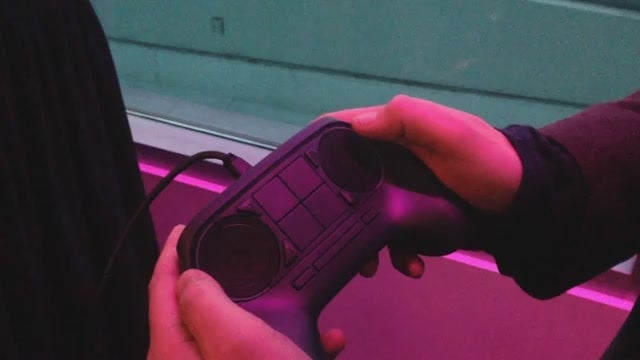
It was my first chance to try out Valve’s interesting, thumbstick-less controller, and I came away intrigued:
It’s a funky piece of tech, and I get the sense that I’d need a few days to get used to it. In place of the expected thumbsticks, the Steam Controller has two touchpads that look like the world’s smallest DJ turntables. The touchpads offer haptic feedback, so you can feel them rumbling and almost rolling under your thumbs. In use, the controller actually feels a bit more like a stationary trackball-mouse, rather than a traditional game controller or even a laptop trackpad.
The Steam Controller doesn’t appear to be designed to replace the traditional Xbox/PS3-style controller for which most current controller-based games are designed; rather, it’s Valve’s attempt to build a device that can play mouse/keyboard PC games on a living room TV. Newell says that Valve is still deciding whether they want to make their own in-house Steam Machine PC, which means that at this point the Steam Controller is the only hardware they’re officially working on with plans to release.
Shortly after Newell’s presentation, I had a chance to chat with Valve industrial designer Claire Gottschalk—who tells me her last name translates literally to “Lamb of God,” awesomely—about the ongoing, challenging process of designing the Steam Controller and the uncertain territory Valve is entering as they make their way toward the controller’s launch later this year.
Kotaku: As Valve set about making the Steam Machine prototype and controller prototype that you recently sent out to beta users, what have you learned about making hardware?
Claire Gottschalk: It’s definitely a very organic process. At Valve, it really all comes back to the user, and the user’s needs. So, we do a ton of experimentation and we iterate very rapidly. I’d say the core hardware team is probably about six people. So it’s like a black ops team. Everybody’s very good at what they do, very good at communicating and respectful of each other, to make sure we don’t step on each other’s toes.
We’ve found that’s really the best way to be able to iterate really quickly, that that interpersonal component is just as important as your skills. And so for a long time, with a controller especially, in my personal opinion the controller is much more difficult to develop than the console, because you’re working with human interaction and ergonomics and human factors and input.
What’s your process like, in terms of iteration and redesign?
We build stuff very quickly; we have working prototypes in a couple of days. Pretty much every other morning we just sit and chat and talk about all the stuff on our minds and how we think we can push it forward. We don’t like [job] titles, but we have mechanical engineers, we have electrical engineers, we have machinists, we have UI experts, and we have industrial designers. Those are probably the people working on [the controller]. And you’re talking to the industrial designer. So I’m probably the least technical, but more attuned towards user interaction and usability.
(Photo of unreleased controller prototypes via Seattle Times)
This will be the first time Valve has shipped hardware. So far it seems like you’re taking a very iterative, software-like approach to it, doing constant revisions and getting a lot of user feedback. But when it comes down to it, you’re going to have to ship a physical object that you can’t just update by pushing out a new software revision. Does that make you feel pressure to get it perfect?
Well, not pressure. I find… it’s probably just my personality, but I’m more fascinated by how this is really gonna play out. Because it is absolutely as you say, a very software-centric approach to iteration. And it’s like, yeah, we can’t hit an update button.
…and just push a fix out and give everybody a new controller
Yes. But we can absolutely hit a button and produce three hundred of them, or a thousand, or a couple of thousand. However, the market doesn’t like waiting for that. Especially when you involve partners, and they have their own schedules and their own deadlines, and they want to ship with a controller that works.
It’s tricky for consumers, because when people buy something, and they own it… and then you issue a new version of it and suddenly they have the inferior version. That can make people mad. And you can’t just issue a mass-recall or freely update the controller people already own.
Yeah. So just, I find just from a product development and business standpoint, it’s a really interesting story in itself, how is this going to play out? I’m curious myself. I don’t have the answers. Because it is a big experiment, to see how this really plays out. We will see.
But it sounds like you’re generally feeling good.
All of this has happened in the past year. I’ve been at Valve a year and a half, and when I joined we just started working on controller prototypes. And so it’s amazing see that we’re developing this totally different type of input device that is still recognizable as a controller and is still reasonably usable. And launching it to a test group and getting feedback. I’m more curious on how the ecosystem will evolve, or if it will evolve. That I’m very curious about. Like, how we’re gonna balance the needs of other [third party Steam Machine] partners with the development of this, and how it’s a software approach to hardware. Atoms and bits are very different things.
Related to beta feedback: Earlier this evening during his presentation, Gabe Newell was saying that you guys are pushing the beta testers to give tougher feedback. [Full quote from Newell: “The beta users have been super happy, we kind of want them to tell us what’s wrong. So we’re kind of poking at them a little harder. Right now they’re just saying this is the best thing since, you know, the beginning of time or something. So we’re trying to get them to give us more, how can we iterate on this, what are the steps that we need to solve next.”] How has it been, trying to get more constructive criticism from beta users?
Claire Gottschalk: It is interesting. If you look at a company like… well, I won’t name any names. But there are some companies that people criticize very heavily, and they go, “This can’t possibly be any good.” And then with Valve, it’s a strange place because there’s a bit of a halo around some of this stuff, because we’ve always tried to produce things that we believe are the best that they can be, and that resonates on a lot of different levels.
https://lastchance.cc/the-internet-reacts-to-valves-steam-controller-1412340389%3C/a%3E%3C/p%3E
Though you know that when you release it to the public, people won’t hesitate to tell you what sucks about it.
[Nods] And part of it is also, it’s a weird experiment because none of our beta users paid for the system. It’s like, “Here’s this awesome Christmas present!” So, I think, from a psychological standpoint, maybe users feel like they can’t be critical because they’ve been given this gift, in a way. We kind of have to look at how that’s affecting our users.
Though on the flip side, it’s not as though when people buy stuff, they’re unbiased, either. If people buy it, they might have a separate thing where they’re going to be more critical of it because they’ll want it to justify the price they paid for it.
Yeah. Though it’s not like all the [beta] feedback’s been positive; it hasn’t. We have gotten some constructive criticism on it, which is what we want. Things like it’s too light, it’s too difficult to learn—we realize there’s a really steep learning curve with it.
I noticed the lightness when I used it.
Yeah, because it’s hollow.
Are you guys thinking about changing the weight?
Claire Gottschalk: Oh, yeah. Totally. I mean right now, it’s just a shell built around the average size of most male hands. So it’s built around fiftieth percentile male hands.
Are you thinking about doing different sizes?
We’ve talked about that. It’s kind of a trade off because as soon as you involve tooling in cost, you have to try to think, well, is the market really big enough for small hands? We don’t collect demographic information about any of our users, so we really don’t know how big or how old most of our gamers are.
So you just sent them out, you don’t really have any idea of men, women, old, young…
Well, yeah, in a way, we don’t have that information. With the beta test, people supplied, “Hi, my name is Jack blahbahblah,” so you’re like, this is most likely a male…
But if it was “Adrien” or something, you wouldn’t be as sure.
Yeah, because we don’t collect that information. But what we do collect and what we are paying attention to is is this person an active gamer, are they part of the community, do they provide feedback? That’s the type of stuff we’re interested in. But yeah, it’s kinda hard designing blindly, in a way. So you try to meet as many of your users as possible, and get feedback, and then to take from that.
I’d assume that if you aim for fiftieth percentile-sized male hands, you’re probably hitting a large percentage of your users.
That is absolutely the assumption we’ve made; we have no hard data. It’s our policy that we don’t collect user data. So… [laughs]
That must make your job harder!
It is harder. So the whole thing is trial and error. So far, we’re like, oh, it turns out that yes, everybody at this event [looks around] is you know, male, above 30.
And it’s self selecting, too. Like, everyone here is games press, games press is largely male, because lots of guys play video games, because lots of games are marketed to guys, and so on.
And then if you actually look at it, what is the flip side to it? Does [the controller] actually have to be designed for a woman? If you look at the actual differences in hand size it’s much smaller, you know, my hands are fiftieth percentile female hands, and a male hand is a centimeter longer for an average male hand. So that, when it comes to playing a game controller, is actually not that big.
Have you gotten any feedback from any women or people with small hands saying the controller is too big?
In the early stages, yeah, we had some crazy-sized prototypes. We have one guy in our office who’s 6’7, ex-NBA, and a lady, she’s probably 4’10? And so [laughs] I would kind of go to them as extremes. But the population falls right between that fortieth to sixtieth percentile. It was kind of funny because Eric, the huge guy, would hold the controller, and it’s this tiny little thing in his hands. So we made him a giant controller for fun and put it on his desk. [Laughing more] It’s like a lunch tray, it’s like a bento box. It’s pretty hilarious.
Ha, that sounds pretty great.
So back to your earlier question, in the whole development process, the controller is very fast-paced, organic, we kind of try to pursue one or two avenues at the same time and test them as much as we can. Most of the initial testing has been internal.
Kotaku: So most of the people in the office just use the controller and let you know how it’s going?
Claire Gottschalk: Yes. And then if there are things that we feel we can’t find out from that core group, we try to open up. It’s like most companies: You expand your test base to friends and family, and right now we’re expanding to the public.
Do you guys have any plan to do a broader test of the controller outside of the Steam Machines beta? Send them out to more people to plug them into their regular computers and test them out?
Yes. We’re doing another build right now to build more controllers, and the controller is easier to build than the steam boxes.
And cheaper, I’d imagine.
Yeah, I don’t want to say that, but you can do the math of the components. It is actually logistically a lot easier to create a couple thousand controllers, so we’re trying to build those and send them out to a group of the community including a lot of developers. Because the 300 beta users are not developers.
So we’re going to be having Steam Dev Days this year I’m not sure the details or if the big game developers are coming out this year, I think it’s mostly indie developers. I think that’ll be our next big outreach to get the more really educated community involved in testing these and trying them out. Because those indie devs, they’re part of the industry but they’re also the most in-tune customers. This is what they eat and breathe, they love games.
https://lastchance.cc/watch-the-steam-controller-play-a-bunch-of-pc-games-1488594877%3C/a%3E%3C/p%3E
And they’re generally the game-makers doing the most interesting things, especially with input.
Yes. So that’s kind of the next big big/small batch that we plan on shipping out.
[Note: I checked in with Valve to confirm that they’re going to be sending out more controllers to the public, and a Valve spokesperson said they are indeed planning on continuing to make and distribute controllers to both developers and testers, though they don’t have any specific timelines at the moment. Which means that sometime this year, you could get your own prototype controller to mess with. Good times!]
There are going to be third-party companies designing Steam controllers too, right? That’s kind of weird… how can someone else design a Steam controller?
It is a free-for-all, it’s open. If you are any one of X amount of hardware companies, you can develop a controller.
What’s the baseline? Does it have to have two trackpads, or… what makes it a Steam controller?
I think the main thing that makes a Steam controller a Steam controller is that it works in Big Picture mode.
But a regular Xbox-style controller does that, too.
Also that it allows you to easily play and enjoy games that are built for a mouse and keyboard-type setup, that’s the tricky one. The [games] that are built for XInput, you can use your Xbox controller, your Logitech controller. That’s less of a challenge.
So having it register as a mouse and keyboard, that’s the thing.
Yes, exactly. So that’s kind of the technical workaround. But the hard part is how do you make it as intuitive, and as easy as possible to use. So we still have a couple of little hiccups and glitches and things, you know, if a game pops up with a certain command, “press M” or something…
How do you work around that?
The temporary fix is that you’d have to become familiar with your controller and what the configurations are bound to. And that takes some work. And nobody likes work.
I would imagine a game that has that kind of QTE kind of thing, it’s not going to be selecting from a pool of too many keys, so it’d be pretty easy to learn. But more complex PC games would be another story.
Yeah. The hardest way is probably memorization, which I’m not a fan of, I don’t think anybody is a fan of. The other way that we were exploring was the integrated screen. And that would show you some of the most common commands. So there is that feedback, if you do need to actually look down. You’re still learning it, you haven’t memorized it, that’s an option. And then the third path is also the other side of the experience, which is the game itself and how that’s written.
Right now, a lot of these games—well, all of these games—were created before this controller came out. And so we’re trying to get our developer community more involved, to create games that are more friendly for this type of device.
And if you do come up with a solution, you can make it work with old games. Because developers are probably not going to go back and change whatever game from two years ago to make it work better with the Steam controller.
Those two first methods that I mentioned, that’s more kind of backward compatibility mode. And in an ideal world, the games are designed around the input device. [For] Xbox, the games are designed around XInput. Every developer knows exactly the layout, and you have things that flash green, red, blue, yellow on your screen, and everybody knows what that means. And that’s a very integrated experience.
https://www.youtube.com/watch?v=bXqjTCDjUJU
So, we will see how things develop, but it really takes not just the hardware side, but it takes the software and the games side to be able to complete that. Right now we’re just in the very baby stages of talking to the community, gauging interest, getting people on board, just even getting people to port their games to linux.
That’s a whole other battle, convincing developers to port to linux.
Yes.
So are you guys still considering putting a screen on the controller?
We’ve talked about it. I think we have a different method that we think is a bit easier, which is more of a… we don’t know. One method is the screen, another could be that it’s just a heads-up, or the equivalent of a screen, that information is displayed on your TV. So it’s on your primary screen, and maybe… there’s a lot of different ways of doing it.
So that’s actually one of the things we’re exploring as we speak. To figure out what makes the most sense. To try to solve that issue of knowing all these commands. Worst-case nightmare is trying to take an entire keyboard and map that many commands.
So the current face buttons, and the plastic Steam logo in between the two trackpads…
That’s kind of a placeholder for the screen. And so it could be a number of inputs if it was a screen and you could swipe through. Because of ergonomics and the size of your thumb, we could cut it into four quadrants so that you could emulate four different zones. And then if you need more than that you have to go to a configuration setup and go and add more commands to it. So that’s kind of the band-aid that we have right now.
And regardless of how you do it, people can make and share their own presets or download the best presets, so each player doesn’t have to make his or her own. Since that’d be a lot to ask of people.
Exactly. And the whole configuration thing, we really want the community to vote up the most popular presets for a game.
Which I imagine will probably tell you guys a thing or two about how people are using it, too.
Oh yeah, absolutely. Maybe there’s a whole lefty community, or I don’t know. [laughs] Or there’re superstars in the gaming world and you can follow them. The whole ecosystem really is in its fledgling days, and it’s going to take some time. It needs to develop in so many different avenues, from the input, to the game development, to the hardware, to the systems that they’re running on being more friendly of an environment. The people in the business space just being able to wrap their heads around “where can this actually go,” because my general feeling is that a lot of people are like, [Makes skeptical face] “Okay…”
Ha, that’s definitely how a lot of people feel. Which is largely probably because it seems like this is a very fluid time for the Steam controller, and for Valve’s hardware plans in general.
This week right now, at CES, a lot of what’s happening right now is talking to partners, and figuring out what their needs are. If they want us to provide the controllers, so we’re looking at going into mass production, what needs to happen to fix as many of the user complaints or concerns as possible. Because we want to ship the best product that we can. Everybody wants that. And so, it all comes down to timing. We’re trying to see, can we achieve that initial goal of making a good, solid experience shippable by the end of this year. So that’s kind of what we’re looking at.
Thanks for taking the time to talk with me.
Happy to.
To contact the author of this post, write to [email protected] or find him on Twitter @kirkhamilton