Final Fantasy VII‘s Wikipedia entry is 6,596 words.The Wikipedia entry for William Shakespeare is 5,999 words. Let’s apply One-Hundred-Point Scale Internet Video Game Web Site Score Logic to these two word counts: if we were giving Final Fantasy VII a 10, Shakespeare’s collected works would score a 9.7.
Hello. My name is tim rogers. The above paragraph was only an introduction. I am here today to jump ahead of the curve: September 2012 will mark the fifteenth anniversary of the release of Final Fantasy VII, a game that was many gamers’ first electronic love. I am here to celebrate this anniversary of what continues to be a sacred artifact of a golden era of interactive electronic entertainment.
I will not lie and I will not pose: I like Final Fantasy VII a whole lot. It’s taken me many years to say that. The introverted month I spent beating that game until it was a horse’s tombstone was one I spent aged eighteen and not having a minute of sex, and I still look back upon it as one of the best wastes of time I have yet to painlessly endure.
I decided to replay the game, recently, for what seemed like a particularly good reason. It’s definitely not as fantastic an experience fifteen years later. I still don’t take back what I said in the previous paragraph. I can never renounce Final Fantasy VII‘s eternal niftiness, because it did things, it went places, and its boss battle theme remains One Of The Coolest Things Ever In Videogames. Having said that, I will proceed to be a nitpicking jerk and publicly “roast” the game here on Kotaku. Why? Why the heck not?
1. It’s hard as heck to move around.
Final Fantasy VII is not a three-dimensional video game. Like Resident Evil before it, it’s only pretending. And like Resident Evil before it, it doesn’t do a fantastic job of pretending.
A friend who is a genius computer programmer once explained to me how Resident Evil was built upon the source code of Capcom’s Goof Troop—which was a 2D game for the Super Nintendo. This blew my mind—and then it blew my mind even harder when he showed me proof and walked me through the details.
I can’t begin to get into it without having to Make Stuff Up, so you’ll have to bear with me while I fudge it: the two-dimensional ground plane is distorted in some tricky way to make it so the impression of characters moving farther away from and/or closer to the camera appears “natural”, if not realistic (we’ll get to the “if not realistic” part in a bit).
What this boils down to is the bold statement that Final Fantasy VII Is Not A 3D Game. When I first saw this sentence emboldened above a paragraph in Die Hard Game Fan, I called the magazine a “buzz-kill” and threw it at the wall.
Fifteen years later, it’s me who is the buzz-kill, talking about Resident Evil being the same codebase as Goof Troop
What’s with the run button? This is the developers acknowledging that the character’s default movement speed is too slow.
So: here’s how the not-3Dness affects Final Fantasy VII in a manner that a thirty-three-year-old with four jobs and no health care is capable of acknowledging and groaning about: the sometimes low-angle perspective tilt of the two-dimensional ground plane necessitates that Final Fantasy VII include a direction-approximation component on the controls.
Keep in mind that Final Fantasy VII was released before the advent of the Dual Shock. Players had to play this thing with just the original PlayStation controller’s directional buttons. So sometimes chaos happens: you press down and left and your guy sort of flumps over to the upper-left.
Good thing this wasn’t an action game! You’d be running into spikes all of the darn time—especially with the way the character leaps forward when you press a directional button from a standing start while holding the “run” button.
Speaking of which: what’s with the run button? This is the developers acknowledging that the character’s default movement speed is too slow and that players might want to move a little more quickly. That seems like a fundamental flaw, right there.
Resident Evil dealt with character movement in fake 3D much more elegantly: tank controls. They sure didn’t have to keep the tank controls even after the game was Actually 3D, though it was a good solution at the time: the camera angle changes and, as long as you’re holding up, your character is still moving forward.
2. It’s sort of hard to tell where your character is.
Oh no! I’m still talking about the field map graphics.
Like Myst before it, Final Fantasy VII chose “interactive postcard collection” as its primary graphics delivery format.
In Myst this worked a lot better—both because we were four years younger and didn’t know any better and because the player experienced the game from a first-person perspective. And the whole game was about looking at stuff and figuring out what was important about the stuff you were looking at.
Playing Final Fantasy VII now, it just looks like a muddy mess. You can’t tell where the path is, half the time.
Moreover, all the stuff looked like stuff you’ve seen in your real life.
In Final Fantasy VII, the postcards’ themes range from future urban slum to dilapidated train graveyard to craggy mountain to glowy cavern at the core of the earth. The key trick of the graphics is “overwhelm them with noise”, and it blew our hats right off our heads back in 1997.
Playing Final Fantasy VII now, it just looks like a muddy mess. You can’t tell where the path is, half the time. You can’t see where your guy is, most of the time. And a heck of a lot of the time, you’re going to have to pore over some noisy, glowy, fancy, labyrinthine mish-mash abandoned construction site and wonder where the exit even is before you can decide if you’re supposed to get there by climbing over the ball of yarn or the stack of broken cinder blocks or the fallen girder or what
I once (okay, twice (okay, thrice)) said, of The Elder Scrolls series, that “if your game has fast travel, maybe it’s time to consider the possibility that your slow travel sucks”. Of Final Fantasy VII, I’d just like to point out the fact that, when you press the SELECT button, a handy little glowing red arrow appears over the exits of an area.
I know, I know: they’d settled on this art direction on purpose. They’d settled on it because it Looked New, and Looking New was the key to make the money magnet work.
Then they had to stand nervously by as play-testers got lost, stuck, and frustrated. So they put in the Little Red Arrows to make the experience work.
This is a theme we find all over Final Fantasy VII
3. The Cubical Fists
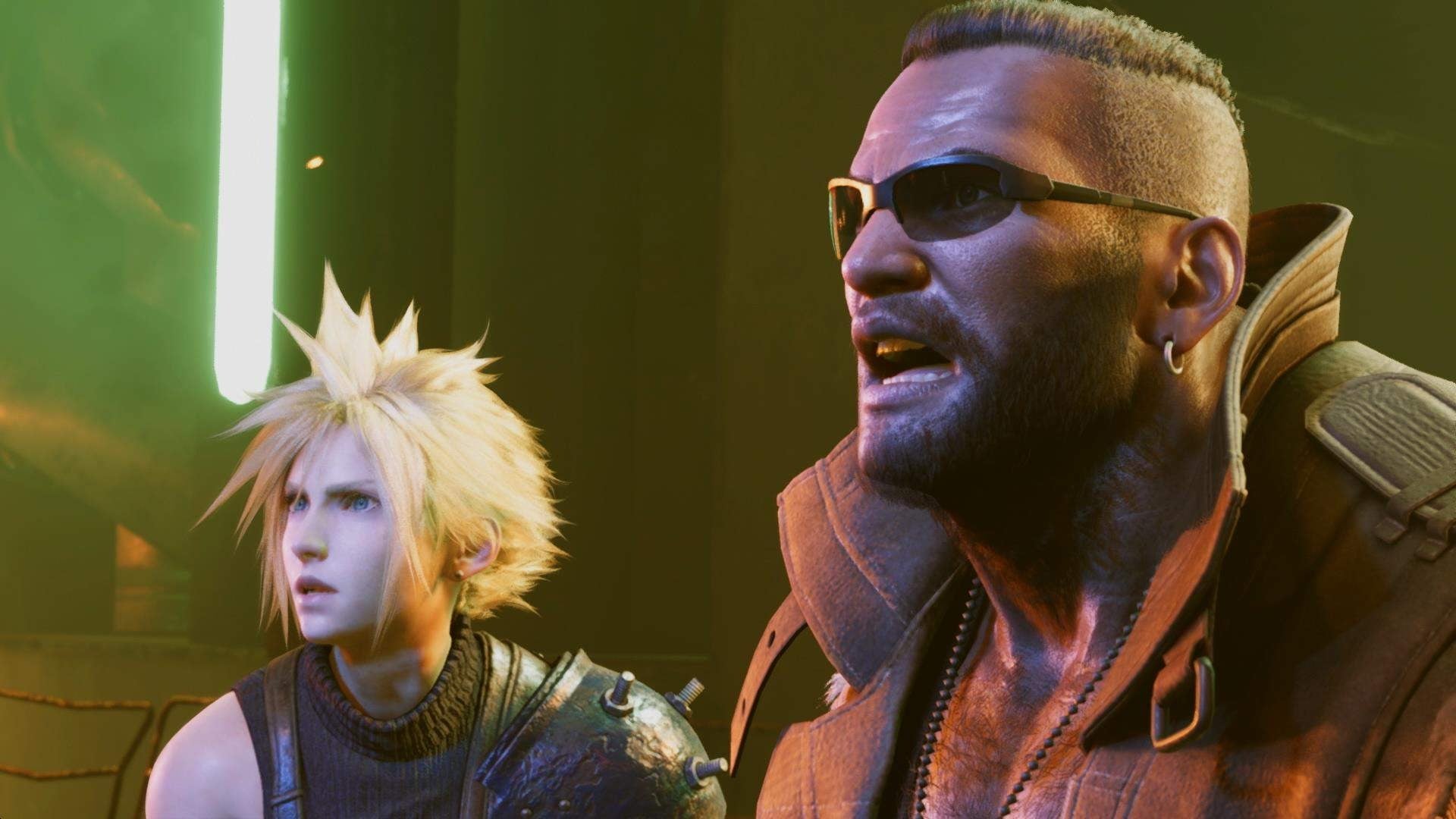
Seriously: these peoples’ hands look like lunchboxes. It’s hard to tell the difference between Barret’s regular fist and the hand that is supposed to be a gun—unless he’s doing that little emote animation in which he fires his gun all over the place.
Maybe an “HD Remake” of Final Fantasy VII isn’t what we need. Yeah, dude: I’d take a de-make.
Speaking of which—man oh man does Barret sure fire his gun at the ceiling in friendly buildings a whole lot when he gets upset…during dialogues between friendly characters. That’s a little bit jarring.
Um, anyway: Final Fantasy VII has a bit of a graphical identity crisis. We have a different set of models on the field—the little tiny double-digit-polygon ones with the cubes for hands, the more detailed ones during battle scenes, light-source-shaded versions of the blocky ones for use in less-detailed cut scenes, and the super-elaborate plastic-like action-figurey ones for the marquee cut-scenes.
It’s worth noting that the marquee cut-scenes were the only parts they showed on the television commercials.
I was a college student at Indiana University in Bloomington, “Kirk Hamilton’s Hometown” Indiana when Final Fantasy VII was released, and I distinctly remember a super-jocky dude—not that I’m dissing him for being jocky: he had a heart of gold—borrowing disc one of the game from me based on the TV commercials. I had already whistled my way through the game by this point, though hey—here I am owning up to my idiosyncrasies: sometimes I just loved starting up a new game on disc 1 and watching the introduction. So I watched him fire up the game in his dorm room.
I tell you what: when Cloud jumped out of that train, this guy snapped: “What the fuck? It was all badass and now it looks like some bullshit.”
To be perfectly honest, I had played through the entire game without a single complaint. So here was this guy who only played Madden on the Genesis (even though he had Madden on the PlayStation), immediately pulling the rug out from under my unadulterated appreciation of the game.
We’ll get back to that guy in a later segment. Spoiler: we’ll get back to that guy right at the very end of this piece. (Foreshadowing!)
To close this one off, I just want to say that Final Fantasy VI looks phenomenal even today. It looks amazing. It sounds incredible. Its narrative is arranged with a stupidly-powerful virtuoso. And it uses the same character models for the field, cut scenes, and battles. Just saying. Maybe an “HD Remake” of Final Fantasy VII isn’t what we need. Yeah, dude: I’d take a de-make that gives it Final Fantasy VI‘s graphical style any day. (Serious as a hotel full of heart attacks.)
4. Multiple characters are always using one character as a container.
Fifteen years after its initial release, I decided to play Final Fantasy VII start to finish for only the third time in my life. This was a couple weeks ago. Well, I sure freaked out a tiny bit right at the beginning when Barret (“Jackson”) walked right inside of Cloud (“Billy”) and then vanished. I yelped like a stomped chihuahua.
It’s like: the more photo-aspirational the backgrounds are, the harder it weirds me out when the narrative has a little fit of narcolepsy and says “Oh yeah, you’re playing this video game and this is the guy you move around.”
The game does this over and over and over—you’ll enter, like, a house, and the floor-wood looks sort of real, and there’s a table and chairs, and then whoa—-a bunch of dudes nonchalantly spill out of your dude and are like “Alright here we are”.
I understand that the plot here hinges on Cloud having a couple of emotional issues and being a bit of a pathological liar who has displaced someone else’s experiences on top of his own, and I respect that, though if you try to tell me this thing here is some kind of a metaphor, I will kick you really hard on the side of your shoe. (Then I’ll apologize.)
If you try to tell me this thing here is some kind of a metaphor, I will kick you really hard on the side of your shoe.
If I may use another Japanese role-playing game as an example, Dragon Quest II had characters following you around the world map all the way back in 1987. That’s 25 years ago! (Happy 25th Birthday, Dragon Quest II.) Why Final Fantasy never had your party members following you on the field map is anyone’s guess (my guess: graphical limitations), though by Final Fantasy VII, with its drastic shift toward futuristic sci-fi visuals, it must have started to seem like a missing element to . . . somebody, because Final Fantasy VIII sure did have all your party members on the screen at all times. And they were taller! They all looked like actual humans.
5. The menu cursor sounds are certainly not optimized for high-volume enjoyment.
Final Fantasy VII‘s music is mixed to audiophile specifications. You can throw a truckload of bass at it and it never crackles or distorts. It is, quite frankly, one of the greatest sound-design achievements in video games. I would know, because I am a jerk, and I enjoy expensive headphones more than I enjoy eating or breathing.
https://www.youtube.com/watch?v=XcsEfkNeRm0
With my Astro A40 headphones on my comically large head and turned up to the maximum, the boss battle theme of Final Fantasy VII is loud enough and perfect enough to cure impotence.
It’s a shame that the menu cursor sounds are so bad.
They are weirdly compressed. They clip. They distort. They squeeze off right at the tip of the sound wave, and there’s this popping momentary silence, a razor’s edge before a popping momentary eardrum-stab. The sounds are lame and awful.
I played Final Fantasy VII for the first time in a dorm room, and also in my parents’ house. Nearly my entire experience with the game was with a pair of headphones. So, no, I’m not talking about just the version available on the PlayStation Network.
Lord, it is an awful cacophony. You sure have to scroll through a lot of menus in that darn game. And you sure have to scroll through a lot of menus while fighting important battles. The more important the battle, the more rocking the music, the louder you turn the game up . . . the more menus you have to scroll through, the more times you have to hear those horribly compressed squeaks and dings, the deafer you become.
I’m sure there’s a technical reason the menu sounds are so badly mixed. Still, I can’t excuse it.
My neighbor here in Oakland, California is a Reverse Vampire, so I have to stay quiet during my gaming hours. That’s why the Astro A40 (fantastic product, by the way). I figure, with surround sound headphones, I might as well turn the game up and get pumped.
The boss battle theme of Final Fantasy VII is loud enough and perfect enough to cure impotence. It’s a shame that the menu cursor sounds are so bad. .
And there’s that perfect music, and those awful cursor sounds. I am cry. And then Cloud’s sword rips through a guy, and—gah! For a few milliseconds too many, it sounds like The Incredible Hulk running his too-long fingernails down a dusty chalkboard.
Call me a nitpicker if you want, though I double-dog dare you to put Final Fantasy VII in, turn your surround system up loud enough for the neighbors to call the cops, and not go so deaf you can’t hear the cops pounding the door down.
And for the record—I have played Final Fantasy VI at just as high a volume, and the cursor sounds are sublime.
6. The thing with Cloud cross-dressing. (And the other stuff like it.)
First of all, I think we’d be best off if we stopped calling it “cross-dressing” and just called it “wearing a dress”, the way we call wearing a shirt “wearing a shirt” or wearing jeans “wearing jeans”.
Now that that’s out of the way, here’s what I don’t like about the “Cloud Cross-Dresses” scene: it’s a sudden, silly tonal shift. Those can be cool sometimes, though in Final Fantasy VII it comes as a shoehorned-in tangential distraction at a point where the story was just starting to pick up mountains of steam.
I genuinely love the idea of a story taking a sharp detour into a colorful, weird place. I love the idea of Final Fantasy VII, a game that from this particular plot point will barrel forward into dark territory, chilling out and being funny for a while. It just doesn’t mesh thematically. It’s jarring and dumb. Why does Cloud have to dress up like a woman to infiltrate a lowly slum brothel? This is a guy who blew up a (not-)nuclear power plant with a bomb. Why can’t he just run into the place and rough the dude up to get his girl back?
Because the game is trying to fill time, I guess.
Most of the time, when Final Fantasy VII is killing time, it’s doing it so painlessly. The characters are written with personality (and translated into English with a little too much personality, sometimes), and they have occasional funny lines which yield moments of levity. It’s not all a funeral (except during that funeral scene).
My biggest gripes with the story are the moments when the game tries to be funny.
You spend the first eight to 10 hours of the game in the city of Midgar, a science-fiction metropolis that, once you leave, you will not be able to re-enter for the rest of the game. For the greater part of The Midgar Segment, the game holds your hand and yanks your arm toward the next great action-packed melodramatic set piece. And it’s fantastic. The game’s self-confidence is enormous.
Then you’re dressing up like a woman for cheap “laughs”. Then you have to participate in a squats contest with some cartoonishly homosexual bodybuilders in order to win a wig with which to complete your outfit. Now, I’m not a homosexual, though by age eighteen I’d been called one so many times by kids at school that I was truly sympathetic, and this whole segment just felt near-indescribably gross and stupid.
The atmosphere of the “Wall Market” area in which the cross-dressing-item scavenger hunt takes place is so wonderfully realized, with little neo-Tokyo-ish noodle shops in which you can order food and everything. Maybe they could have done something neater here? Oh, well.
From this point in the story on out, my biggest gripes with the story are the moments when the game tries to be funny. It spends so much time deliciously wallowing in hokey melodrama—and it’s genuinely entertaining in that—and then it’s like, “Oh hey, you have to get a whistle to call a dolphin to give you a boost to get up into this door”. Or “Oh, hey, your talking tiger character has to dress up as a human and walk on two legs”. Again: I’m all for sudden comedic tonal shifts, though these are “comedic” tonal shifts that feel written by a chain-smoker who took his wife to the bank the day after their wedding and called it a “honeymoon”.
7. The character designs are sort of lame.
Seriously, look at these guys. This looks like the sort of thing kids in my seventh-grade art class were doing with their colored pencils.
Now you know what an “executive producer” does: he runs his finger down the Yellow Pages of Modern Culture, and says, “put a sassy little girl in there, somewhere.”
Imagine, if you will, a five-year-old speaking the following words, full of the fire of kindergarten creativity:
“This is CLOUD STRIFE. He has a sword and it’s SEVEN FEET LONG and it weighs EIGHTY POUNDS.”
Now try, if you will, to focus your eyes on the part of this illustration that does not include an adult human. Look at those goofs. What did they throw those goofs into this game for? “Fan-service”. In case you didn’t already, now you know what an “executive producer” does: he runs his finger down the Yellow Pages of Modern Culture, and says, “put a sassy little girl in there, somewhere”. And then there’s the one character who’s a red tiger-thing who can speak using human words. And then there’s the character who’s a little cat with a megaphone riding on a large robotic stuffed monster.
There’s a scene where that little cat with a megaphone riding on a large robotic stuffed monster dies, though since there’s another character remote-controlling him, he doesn’t actually “die”. They play dramatic music; he gives a little speech: he stays behind Finishing The Fight as a building collapses. Then, as soon as you get outside, he’s back. It’s just another avatar. How did he get there so quickly? It’s dumb.
What if Red XIII—the Big Cat—were just a human who had been the subject of numerous scientific experiments? What if Cait Sith—the remote-controlled plush cat-thing—had been, like, a terminator-looking cyborg? Well, my friends, that simply wouldn’t have looked Nutty Enough. Imagine the kindergartner again: “He has a sword and it’s SEVEN FEET LONG.” And so on, and so on.
Developer interviews at the time Final Fantasy VII came out yielded a nugget that resonates even today: they chose Tetsuya Nomura to design the characters because they didn’t feel that until-then series artist Yoshitaka Amano’s style would “translate well” into polygons. Had it even translated well into pixels? Had these people ever seen the final bosses of their own darn games? I’m sure if you asked 10 people what the final boss of Final Fantasy IV was, you’d get nine different responses (probably two responses would be “a cockroach”).
Even back in 1997, this art didn’t get me hyped for the game the way Final Fantasy VI‘s mind-blowing watercolor illustrations did.
Screenshots of the cut-scenes . . . sure. I’ll admit that those got me.
Oh, and let me talk about Tifa for one second here: those breasts. Mother of God. I named her “Booberita” in my most recent playthrough, because, hey! Laughing at it is better than crying about it . . . right? No, not right. Why can’t this lady at least be wearing normal clothes? She walks around in the snow in a tank top and hotpants. With suspenders. So the women in Final Fantasy VII are: tank top hotpants suspenders boobs, pink ankle-length fairy dress and massive blue eyes, socially awkward ninja girl with A Distinctive Weapon (giant windmill shuriken boomerang). Okay.
8. There is no card game.
Final Fantasy VIII and Final Fantasy IX had card games. Final Fantasy X had a card game—only they pretended the characters were playing a sport (Blitzball). Final Fantasy VII‘s mini-game element is a hodgepodge of weird little half-baked brownies floating in flat Pepsi.
There’s Chocobo racing, which is at least visually brilliant. Yet you have little control over your bird and winning is, at the end of the day, just a matter of grinding.
There’s a submarine mini-game that isn’t as good as Treasures of the Deep, a motorcycle mini-game that isn’t as good as Super Hang-On, and a snowboarding mini-game that isn’t as good as Cool Boarders, and those are all pretty neat, until you considered that they felt horrible compared to any given moment in Super Mario 64, which had been out for a year at the time.
So this raises a question: were Squaresoft trying to make an “omnigame”—a game which contained many other games? Were they trying to make The Only Game You’ll Need To Play? It sure felt like it: they contained all of the mini-games in an area called The Gold Saucer, finally seamlessly uniting Final Fantasy VII and Las Vegas. They even gave you a neat little rollercoaster-themed on-rails shooting game and a battle arena with depth of complex rules.
It feels like the last of many things slapped onto a wall, beheld with a shrug and a “That Oughta Do It”.
The thing is, the “User Experience” here sucks. Nothing ties it all up together. If you succeed (like a maniac) at the battle arena, you get prizes like a “Masamune”, which is uber-villain Sephiroth’s sword, though only in name: you can’t equip it. It’s just a tick on a neverending item list. It’s Just There.
Meanwhile, Final Fantasy VI had a battle arena tied irremovably to the core of the game. The world had ended, people were psychos, and this was Beyond Thunderdome. Thematically, it made sense: all the world’s fantastic artifacts had collected here, and you could fight to possibly win them. You can score some hot stuff in the arena.
You can score some hot stuff in Final Fantasy VII‘s arena, too—don’t get me wrong. It’s just more of an anomaly that it even exists. I get that it’s supposed to be some arcade-game version of the game’ battle system. It’s just that it feels like the last of many things slapped onto a wall, beheld with a shrug and a “That Oughta Do It”.
Final Fantasy VIII had a brilliant card game, present from its very beginning. The rules were deep and strange. You could challenge any inhabitant of the world to cards. You could play the whole game through cards. It was incredibly nifty. Final Fantasy IX took this and ran with it. Final Fantasy X took it and ran so far away that no one knew what was what anymore.
Final Fantasy VII‘s optional elements come to feel like slapped-on distractions. By the time they introduce a boss who has Literally A Million Hit Points and who you have to kill in less than fifteen minutes, even the Pro Chocobo Racer is bound to laugh the challenge off. And then there’s Ruby Weapon, the other boss with Literally A Million Hit Points (Editor’s note: Actually, 800,000.), and you have to kill it with just one randomly-selected party member.
Of course, the way to beat that boss is to break the game system deliberately, slowly, and decisively, through careful study of every possible facet of the battle system. The opening thrust of developing a strategy to kill Ruby Weapon is: equip one party member, save the game, enter the fight . . . and reset if Ruby Weapon selects any party member other than your contender.
So let’s take a look at 1997 Me: I am eighteen years old, and the internet is Starting To Be A Thing. There’s a website called Imagine Games Network. After pulling a cord several times to engage the motor of my telnet client and kicking the generator to access my @indiana.edu email address, I type some words at the resident RPG person, Francesa Reyes (who I just followed on Twitter), asking, “Hey, have you killed Ruby Weapon? If so (and if not), do you have any idea how one is supposed to kill Ruby Weapon?”
Her response was that she thinks it’s meant to be impossible.
Well, I sure killed the darn thing. It only took me two weeks and I only cried twice. So began my career of feeling cooler than video game journalists.
When Final Fantasy VIII came out, there was that card system. It was attached to a story miraculously more vapid than Twilight, so I couldn’t care too much, though I did acknowledge its niftiness and kill Omega Weapon long before any of my (two RPG-playing) friends had even cleared the main story. I guess Final Fantasy VII would have benefitted from some meta-experience that was more holistically designed.
9. It doesn’t even look like the sword is going through Aeris.
So Aeris dies at the end of disc one of Final Fantasy VII. The cut scene is ropy and plasticky. Your characters just stand around while Aeris kneels in the middle of a room. She’s praying. Then Sephiroth appears—because . . . why not? And he runs her right through with a sword.
It looks unsettlingly theatrical. There’s a stage-play-ishness in the way Sephiroth’s sword seems to slide under her arm.
I didn’t cry when Aeris died. I thought she was sort of a doofus.
She doesn’t bleed, much less spurt a geyser of blood. Mind you, this moment arrived four whole years after Mortal Kombat. It was a little hard for guys my age to feel any catharsis without a little bit of red gush. We didn’t need to see vertebrae dangling—let’s not get carried away. A little blood would have been nice.
That, or a shriek. I know that Final Fantasy VII had no voice acting, and it was possibly a stylistic choice—not just a data limitation. Still, Kefka had a laugh in Final Fantasy VI, and they used that over and over. One tiny shriek out of Aeris would have been more than enough.
Everyone talks about The Death Of Aeris—aka “The Spoiler” (to hear tell of it from Legacy Internetizens such as myself, it was The First Thing Anyone Ever Spoiled On The Internet)—and says it was the first time a video game made them cry. Not me! The first time a video game made me cry was Ninja Gaiden: those birds, man! They appear out of nowhere and slam into you at a sharp angle just as you’re about to jump.
I didn’t cry when Aeris died. I thought she was sort of a doofus. A magical precious fairy doofus. If she’d have shrieked, though, that would have gotten at least a for-reals backslash-face out of me.
Actually, you know what—all the marquee cut-scenes have, at best, that stage-play quality about them. At worst, they’re . . . the ending. Who in the flaming heck knows what is happening, there? It’s some sort of pyrotechnic show, a face in the sky, a title card that says “500 Years Later”, and a shot of wilderness (ProTip: When you don’t know what just happened at the end of your story, set the epilogue “500 Years Later”).
Go ahead and try to tell me what is going on in the ending of Final Fantasy VII. I dare you to do it without sounding like you own a comic book store.
People didn’t talk about Final Fantasy VII‘s ending: they screamed about it. The swooning response to their pooped-out CGI McNugget no doubt endowed Squaresoft with Great Courage . . . and a new sense of direction: toward games that were All Graphics, All The Time.
10. I am not sure it has to be a role-playing game.
Fifteen years on, the fans clamor for a remake of Final Fantasy VII. Square-Enix claims that no high-definition remake project is in the works. No one believes that, given Japanese game companies’ track records lying about something and then announcing the opposite several weeks later. So it goes, that a Final Fantasy VII remake is forever Just Around The Corner.
I’m pretty sure it could be a third-person shooter. Give Cloud a shotgun instead of a big sword. Make it in Unreal. I’m only 20% joking, here: I don’t think it’s the mechanical particulars of Final Fantasy VII that resonate with people. It’s the characters. It’s the relative smallness of the story’s scale against the relative hugeness of its scope. It’s the interactive methods with which the story delivers its twists and punches—most often through the mechanism of repeated flashbacks to One Fateful Day—it’s the love triangle; it’s the sudden tragic death of one of its most precious characters less than halfway through. It’s “little” things like how you are stuck in the awesome back-of-box-tacular metropolis of Midgar for ten hours, until you yearn to breathe free, and then they kick you out and tell you you can’t go back in, and you start to miss the place. It’s about how the yarny narrative sends you off on weird little time-wasting tangents that end up being just as enjoyable as the rest of the experience. It’s a fun world to live in for a while.
It’s just—yeah, you can equip “Materia” crystals into slots in your weapons, and these little crystals grow and level up as you fight. They level up, and you earn new skills and new . . . stuff. The more you play the game, the gentler its mechanics become.
Maybe the Internet wouldn’t have exploded . . . if, fifteen years ago, Final Fantasy VII hadn’t had battles.
By the time Final Fantasy VII came out, the Final Fantasy and Dragon Quest series had firmly established the fundamentals of the “Japanese role-playing game”: one of those fundamentals was that if you want to win, you have to spend plenty of time walking around in circles to get into repetitive fights to train your characters so they become stronger. Many legendary Japanese RPG developers have admitted that, back in the 1980s, this was a way to prevent players from blowing through a game in a weekend and trading it back in.
Seriously, look at this “formula guide” for Dragon Warrrior. Look at the thoughtfulness behind its math. It is a gently, simply, purely designed game system. Now hear this: when they released the Gameboy Color remake of Dragon Quest, they halved half of the numbers, effectively making the game waltz-through-able. Why does this work? Because the world is consistent and the story feels natural, that’s why.
Final Fantasy VII had this “world-feeling” in spades. The whole experience is sticky with the glue of togetherness. Who didn’t groan at least a hundred times when a random battle came up, their first time through the game? When a Dragon Age‘s writer suggested that players should be able to skip combat in games, the internet exploded.
Maybe it wouldn’t have exploded . . . if, fifteen years ago, Final Fantasy VII hadn’t had battles. The game world and plot are certainly well-realized-enough to make for a lengthy and enjoyable interactive entertainment.
I’m just going to leave that last paragraph there and move on to this anecdote:
Remember that “jocky” guy I mentioned earlier? He wanted to try Final Fantasy VII because the commercials made it look “awesome”. So he tried it. Eventually he was asking me for disc two. Then, he asked for disc three. The next time he paid me a visit, he was visibly upset.
“Dude, can you come over and help me out right quick?”
I vaguely suspected he needed assistance with calculus. No, though: it wasn’t calculus. It was the final J.E.N.O.V.A boss in Final Fantasy VII
“This jerk is tearing me a new one.”
It turned out he’d gotten all the way to the game’s penultimate boss without ever equipping a materia.
“How the . . . how did you get this far? Didn’t you die a lot?”
“Yeah.”
“How did you beat all the bosses”
“I got a lot of game overs. I just kept trying.”
Before even setting foot in that final dungeon, I raced and bred chocobos. I wanted to be the very best—the best there ever was. I got that Gold Chocobo, and I went right where IGN had told me to go: the island in the north. And I got the “Knights of the Round” summon materia. Using that summon, I sure as heck did stomp my way through the final dungeon. Robot King Arthur and his knights told J.E.N.O.V.A to S.T.F.U. Sephiroth went down like an aspirin: just one summon and the jerk was cold. The music hadn’t even gotten to The Good Part.
It wouldn’t be until three years later that I borrowed a friend’s Final Fantasy VII soundtrack CD and heard “One-Winged Angel”, the final boss music, in all its splendor. In playing Final Fantasy VII the way Final Fantasy had trained me to play Final Fantasy, I had missed a piece of music which is, in all the ways that matter, better than the totality of the “spectacular” CG ending.
***
In the last fifteen years, it’s become super-cool to hate on Final Fantasy VII. Seriously: go to any hip nightclub in any modern metropolis. The hot girls holding martini glasses tittering alongside hot guys also holding martini glasses are making jokes about how the materia system is broken and Red XIII’s character is underdeveloped. The above has been my attempt to blend in.
This is one of my favorite games.
In closing, this is one of my favorite games. This is one game I enjoyed more than almost any other game I’ve ever played in my life. If I were the editor-in-chief of a Large Video Game Website, I’d give it a 10 out of 10, and I’d start the review with the words “Sorry, mom”.
Happy Birthday, Final Fantasy VII. And to everyone in the audience on my wavelength, play Blue Dragon, Lost Odyssey, and Last Story, if you haven’t already.
tim rogers is is someone you can follow on twitter; he likes final fantasy vii a lot! you can hear him and his friends’ weekly video-game-related podcast at insert credit dot com. (and for the record, this article is shorter than the final fantasy vii wikipedia entry. [Editor’s Note: Thanks, Tim!] If you would like to listen to tim and his compatriots at action button dot net have an hour-long structured discussion of final fantasy seven, check this right here out.)
Screencaps of Final Fantasy VII via FantasyAnime.com