What determines somebody’s “best-looking” game on a system is a subjective thing. Some will prefer clean lines, others copious effects. Me, I can do without either if a game just has great art
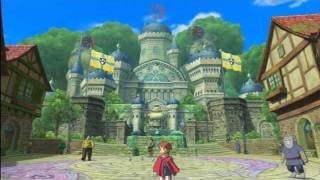
Level-5 and Studio Ghibli’s Ni No Kuni on the PS3 has amazing art.
Given the contributions of Japan’s most storied animation studio, you’d expect the game to look good, but even after all the trailers we’ve seen over the years I wasn’t prepared for the actual game to look good. But it does. The lazy wandering around the world, the getting lost in a town, the menu screens, even the map, the entire thing looks gorgeous.
It helps that the game is displaying a level of polish reserved for the likes of the Uncharteds of this world. On the world map, for example, it’s not just the immediate foreground that’s highly-detailed; there’s a criss-crossed coloured pencil effect that extends all the way to the horizon, making the entire game feel alive. It’s the same in towns, with not just the main characters and locations well-modelled, but the whole settlement, from the front gates to the obscure little areas under the bridge most players will never even see
The animation, too, is a delight, whether viewing half the world at a glance from the wandering map or getting right up close in a fight. You can see both the world detail and battle animation in the video to the left, which sadly was cut short by the most polite “push the guy’s camera hand down and tell him to stop” move I’ve ever had the pleasure of receiving.
OH, AND IT PLAYS WELL TOO
Speaking of fighting, most of the conversation about this game up to now (and hey, even now) has been about how it looked, but not how it played. Which given the fact it’s essentially a traditional JRPG could have been worrying.
But Ni No Kuni played as good as it looked. While fetch-quests and conversations are as per the genre, combat was surprisingly fluid and fun, the action presented not as a series of menus, but as a conversation.
When the battle begins (which is controlled in quasi-real-time), your avatar at the bottom of the screen begins to display little conversation bubbles around his face. Scroll through these (they slide around his face in a circular manner, so you can always see them) and you can do your standard things like attack, use magic, etc. It’s the standard menu presented in a fresh and easy-to-understand manner.
Some commands and items are displayed with words, others – like changing party members – simply with icons or avatars, making them easy ot identify in the heat of battle. Again, when you strip it back it’s not doing anything fundamentally different to a stodgy old menu system, but the way it’s presented feels like a breath of fresh air.
Sadly, there’s still no word on when or if this game is coming to the West, but given its quality and expected demand, hopefully it’ll be out outside of Japan sometime in 2012.
You can contact Luke Plunkett, the author of this post, at [email protected]. You can also find him on Twitter, Facebook, and lurking around our #tips page.