
The first time I played Tekken 3, I was hilariously bad. I was used to 2D fighting games, where the buttons corresponded with attack strength, and tapping ‘Up’ meant ‘Jump.’ This new, 3D genre, where each button corresponded with an attacking limb and tapping ‘Up’ meant ‘Sidestep’ (pressing ‘Up’ still meant ‘Jump’), was difficult to wrap my mind around.
At first, I tried playing ‘for real.’ I practiced my 10 string combos. I scored counter hits from successful dodges. I was learning, albeit slowly and painfully.
I tried mastering Bruce Lee (aka Forrest Law) and Jackie Chan (aka Lei Wulong). But then, I noticed the character in the lower right hand corner of the select screen, with the dreadlocks and the colorful getups. This fighter was Eddy Gordo, and visually, he stood out. Of course, that was the point — the developers wanted new players to pick him — and so, I selected him too.
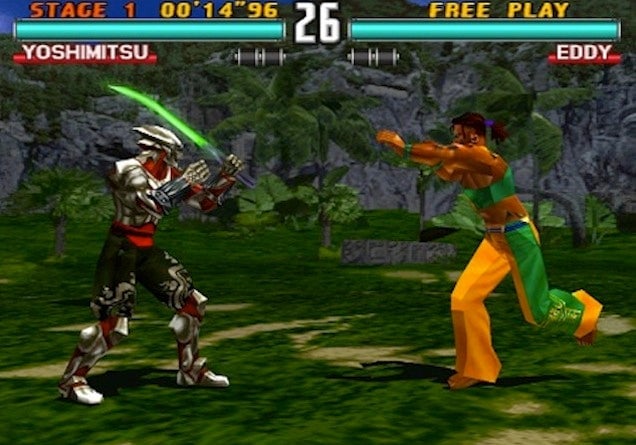 All of the problems I experienced as a novice Tekken player suddenly evaporated. No more stiff movements. No more mistimed combos. No more feeling helpless and weak. This Eddy Gordo guy was smooth. He had Capoeira moves — a mixture of looping kicks, breakdance moves, and flips — that seamlessly strung together. It worked magic on my friends. And now that I have some objective distance, years later, I can see why Eddy seemed so powerful at the time.
The Tekken games set their auto-block to high and mid; they demanded a manual input to block anything low. Eddy, incidentally, loved to hit low. Many of Eddy’s combos were unblockable if the first kick connected. And even if my opponent blocked the entire sequence, the defensive chip damage was considerable. Combine that with his fight animations — which were repetitive, fast, and hard to read — and Eddy was a recipe for newbie destruction.
I didn’t explicitly conceptualize any of this at the time. I was just thrilled to be victorious, damned be the reasons for it. Everyone had to start somewhere, and Eddy was my first in many stepping stones towards Tekken mastery.
But all that could wait, for the time being. I started using Eddy exclusively. I won more matches than I lost. And my friends, suddenly, no longer wanted to play against me.
How was I able to win? I couldn’t duplicate it if I tried. I hammered the two kick buttons as rapidly as I could, and I simultaneously rubbed my left thumb across the bottom of the control pad. It wasn’t a completely mindless process — I waited until my opponent was in range before pounding on the buttons. I knew basic maneuvering, like how to roll back and sprint forwards. But I won’t gild the lily by claiming any sort of thought out strategy. It was definitely button mashing, but I had never had so much fun.
https://www.youtube.com/watch?v=9rNdsndTPcQ
Anyone who plays video games — particularly fighting games — starts as a novice. Competitive gamers call them scrubs. But the term ‘scrub’ has a negative connotation, and it doesn’t apply to all novice gamers — just those who partake in ‘cheap’ strategies.
What is a ‘cheap’ strategy? Well, some scrubs love to ‘spam.’ In nearly every fighting game, there are overpowered moves and combos, whose high effectiveness do not correspond to the difficulty of pulling them off. In Street Fighter games, for example, many novice players learn how to perform Ryu’s Hadouken, and then rely upon it, endlessly, for the entire duration of their matches.
But to be fair, there are different skill levels when it comes to spamming. A more advanced spammer, for example, might vary the speed of the Hadoukens, so that an opponent cannot reliably jump over each one.
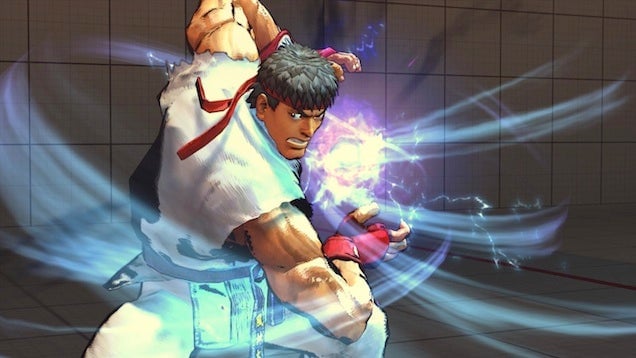 Even amongst pros, a lot of ‘spamming’ goes on. Take, for example, the following match between Daigo Umehara (Ryu) — considered by many to be the greatest Street Fighter player in the world — and Ryan Hart (Sagat):
It may look like a mindless fireball fest to a layman. But the difference is intent. A scrub will throw the Hadouken whenever he or she is able — a competitor like Daigo will use it as a ‘spacing’ strategy, and throw it deliberately, at timed intervals, for the best results. Thus, although spamming is often seen as a ‘scrubby’ tactic, there can be a strategy and intent to it at the highest levels of play.
And then there’s button mashing.
No strategy, no intent — just hitting the buttons, and hoping for the best. And it wouldn’t irritate people so much if it didn’t work. Granted, if I button mashed against a professional, I would get destroyed. But against novice and intermediate players, who probably went into their matches with a basic game plan? I definitely did too much damage, stole too many rounds, and won too many matches for someone who didn’t know what he was doing. And there were always the post-game tantrums — emotional fits that opponents, who weren’t able to consistently block low, would throw at me for being such a ‘noob.’ The irony was not lost on me.
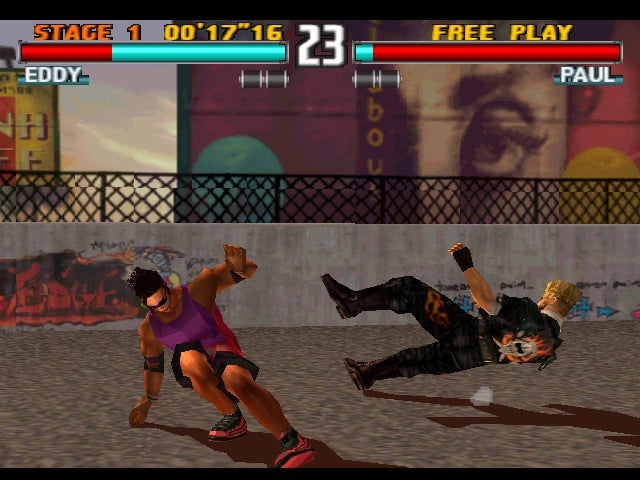 But I loved button mashing for reasons other than schadenfreude. For one, button mashing made me a spectator to my own matches, cheering for myself. It was an out-of-body experience — to ‘play’ a game without truly playing it. I was in suspense, because I had no clue what I was doing, and thus, I had no idea what was going to happen next. Would Eddy do a breakdance? Or do a helicopter handstand? Or do some weird, sparkly flip move that took 80% of my opponent’s health? It was anyone’s guess, and my opponent and I would find out at the same time. It’s the same reason why opponents are so frustrated by button mashers. There’s no counter-strategy against button mashers, because they have no strategy to begin with. Every move is a crapshoot, and every win is a happy accident.
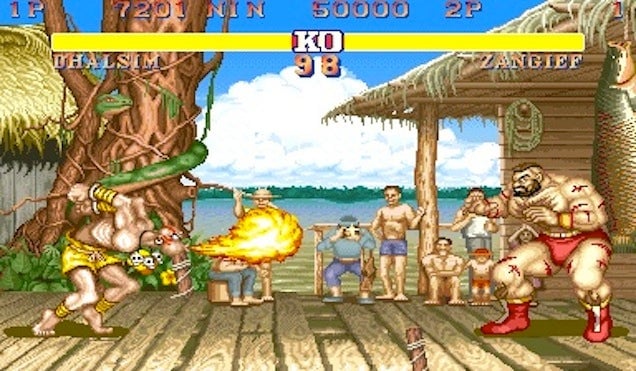
It reminds me of my first button mashing experience, when I was eight years old. I was at a birthday party for one of my classmates, and we all huddled around the Street Fighter II arcade machine, waiting for our turn at the controls. I chose Dhalsim, and at one point, in the middle of the match, my character suddenly reared back. He inhaled deeply, and then exhaled, blowing out a massive plume of fire. My opponent was enveloped in flame, and my classmates and I oohed and aahed.
We had no idea what we had done. But that lucky Yoga Flame sparked our fascination, and none of us could wait to play again. Button mashing may not be the end goal, but it is certainly the entry point for many new players. It can motivate a player to look up the specials, or play around until he or she discovers them again. Learning by doing is the best way to make knowledge stick, and gaming is no exception.
 Button mashing also creates a no-lose scenario, and in Tekken 3, Eddy was my Kobayashi Maru. If I won, then I was lucky and relieved. But if I lost, I didn’t care — I was just a dumb novice who had no clue what he was doing anyway. My pride was never on the line. The same couldn’t be said for my friend, who went hoarse from yelling at the TV when he lost to my button-mashing skills.
But eventually, button mashing lost its lustre. Once my friends learned to keep their distance, choose their spots, and block low, I lost more than I won. So, I began reading the Command Lists again. I learned how to sidestep, parry, launch, and combo, consistently. And although it hurt more when I lost, there was a greater, more resonant satisfaction when I won.
Still, no matter how much deeper, more impactful, and better the gameplay became — and no matter how many more Tekken sequels I bought — I never felt the freedom that I did when I was an unrepentant button masher. There was a childish joy to button mashing — a sense of discovery and mystery when everything was so unquantified. And the couple of times that I tried to button mash again, it wasn’t the same. I knew too much, and strategy kept creeping into my head. Like a child art prodigy, who attends art school and loses his gift, I was too self-aware — I had lost the innocence and purity of the thing.
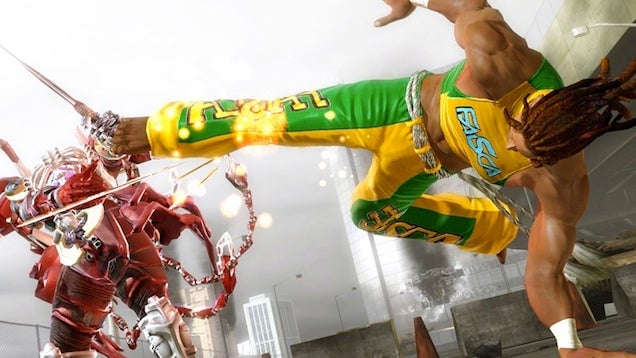 But sometimes, my wife Barbara and I go to the Chinatown Fair arcade on Mott Street — it’s the last of its kind in Manhattan — and they have a Tekken 6 arcade cabinet. I play a few matches — I use Paul or Zafina these days — and Barbara plays too. She’s not really familiar with Tekken, and so the first time she tried playing, I gave her the best advice that I could.
“Choose that guy. That’s who I started with.”
“Eddy? But what do I do? I don’t know any of his moves.”
“Just slam on those two kick buttons, and move the joystick. You’ll get the hang of it.”
Three matches later, Barbara was giggling and snickering in a way that was familiar to me. She finally lost to a guy who used Law, but not before taking two rounds off of him. And the look of anger and frustration on his face? Priceless. He should probably learn to block low.
Art by Sam Woolley
Kevin is an AP English teacher and freelance writer from Queens, NY. His focus is on video games, American pop culture, and Asian American issues. He wrote a weekly column for Complex called “Throwback Thursdays,” which spotlighted video games and trends from previous console generations. Kevin has also been published in VIBE, Salon, PopMatters, and Racialicious, and he will soon be published in Joystiq. You can email him at [email protected], and follow him on Twitter at https://twitter.com/kevinjameswong