
I was already interested in Dr. Chris Hazard’s complex time travel war video game when he mentioned the military was interested in it as well.
The military cares about a time travel game?
Sure, Hazard told me. He mentioned that he’s been talking to three and four-star generals lately at military conferences. “They are very excited about this.”
I couldn’t get a hold of the generals Hazard spoke, wasn’t able to attend any of military conferences he has keynoted, and couldn’t even get a response from DARPA, the U.S. Defense Department’s advanced research wing, whose director Hazard told me he’s briefed. Perhaps the military is in no rush to talk about their interest in time-travel video games.
We’re going to have to go with Hazard’s take and consider the reasons his unassuming game Achron might thrill the commanders of America’s armed forces.
This isn’t about time travel, not the way you might expect. No, the military is not going to be able to use Achron to learn the secrets of time travel any more than they could pluck them from the chassis of a DeLorean. If that’s a project they’re interested in, they’ll have to go sniff around other video games. What they can get out of it, Hazard explains, is a new way to strategize—a new way to think about combat.
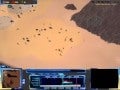
Before we get into what the generals should like in Achron, let’s establish what Achron is. It’s a real-time strategy game, sort of like chess without the turn-taking. It’s set during a futuristic war between humans and aliens, arming each side with high-tech tanks and aircraft and marshaling many powerful troops before their commanders. Like many RTS games, it lets you build bases, develop your forces during the course of battle and order them to march through a battlefield, resting here, attacking there, seizing that base and so on.
(The video at left, running an older version of Achron does a good job showing how the game’s interactive timeline works.)
The generals like that idea of a timeline that can indicate future events and any changes in present-day plans that can change what the future is like, Hazard told me. They think the game could help them explore the question of “What’s the worst thing my opponent can do to me and what can I do about it?” I’ve played the game and have dwelled on just such a thing. I’ve tried to change my actions today and immediately seen on the timeline what that means for my tomorrow. I don’t even have to wait for tomorrow to arrive to understand that I made a good or bad call. That’s simple and profound enough. But I haven’t played Achron against another player, which would amplify the unpredictability of what the future might hold. Achron played by two competing people would give players and the military a laboratory for anticipating how other people’s changes to their plans in the present might effect changes we would make too. I can see why the generals would be into that.
The game also lets you try out another idea, Hazard said: “What is the one thing you could do to turn the tide in your favor?” It lets players explore this not just by allowing the game’s present to be tweaked but by letting players dive into the past—into the previous minutes of the game they’re playing—and make changes then. Like rewinding a DVD, they can watch an already-played scene, but unlike with a DVD, they can alter what happened in past scenes. The game limits this by restricting players with a pool of “chronoenergy” that drains when they execute moves in the past. This limits the number of course-correcting moves they can make. Nevertheless, it lets people revisit past actions once the consequences have sunk in and deduce what they could have done differently—then do that thing differently—and see what happens.
I was most intrigued by the third thing that Hazard told me that the generals liked. “It teaches you loss of information,” he said. That’s another way of saying it teaches you how to deal with leaks. “The idea is to learn how to deal with an information leak after it happens,” he said, imagining a multiplayer Achron scenario. “Being able to jump to the future allows your enemy to get a sneak peak of what will happen. You can delay your actions as much as possible by operating further back on the timeline, but this costs chronoenergy and makes it more difficult for you to react. This is analogous to tight information restrictions in your organization. The more tightly you control information, the more difficult it is to react. The better you conceal your actions, the longer it will take before your opponent finds out your plans, because they’ll find out later on the timeline and it will require more of their chronoenergy to react to your plan.”
Yes, what would you do if your enemy could know what you were planning? What if they could even see the results? That would be the worst leak imaginable. One assumes members of the government in the age of hacking and WikiLeaks might want to get their hands on any tools that could help them guard against the problems of leaks.
Hazard knows you can’t avoid leaks. He just believes that Achron‘s method of showing alterable events in the past, present and future simultaneously to competing individuals can at least train people on each side to make the kind of plans that won’t be obliterated by a leak. Or at least they’ll be used to those leaks happening if they play Achron and they’ll get used to adjusting their plans when they do.
Chris Hazard can’t tell us that the military cares about his upcoming video game because he’s got the answer to time travel that they’ve been looking for. But, as the game designer tells it, his game offers the armed forces a tool for learning about the consequences of action and the real-time results of so many what-if situations. Imagine simulating an upcoming real-world battle on a computer, immediately knowing its statistically-determined outcome and then tweaking it, at any point in its timeline, while a virtual enemy makes the same adjustments on their end. That’s a novel way to plan, a novel way to think, and a novel use for a science fiction time travel video game.
Achron will be out soon for Mac, PC and Linux. [UPDATE: The developers tell me they expect to hit Steam on August 29.] Keep up with the game on the official website for Hazardous Software
You can contact Stephen Totilo, the author of this post, at [email protected]. You can also find him on Twitter, Facebook, and lurking around our #tips page.