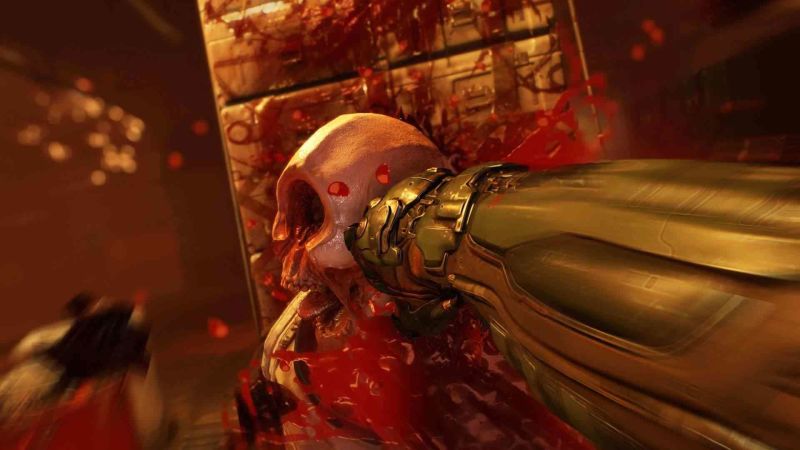
In the past year, 70,000 men and women enlisted in the U.S. Army. Sixty-seven times that amount – 4.7 million – played Modern Warfare 2 on a console or PC, released one day before Veteran’s Day.
In the latest edition of Foreign Policy, P.W. Singer examines the growing phenomenon of “militainment,” a type of game content that draws praise from actual soldiers and officers as much as it gives them pause in its simplification of a deadly job, and bloodless lack of consequence.
The article is an objective treatment of the subject, spending much of its time describing the history of the genre and the surge in the military’s budgeting for computer simulation training. It has an obvious benefit, one top commanders believe in: “Combat veterans live longer,” said Col. Matthew Caffrey, a professor of war gaming and planning at the Air Command and Staff College. “One reason we use war games is to make virtual vets.”
But demonstrators who object to recruiters using video games to lure teens aren’t the only ones troubled by the simulations’ reduced presentation of war. It’s possible that, in the transition from militainment and game training to live fire with consequences, we can see the age-old argument about violence and desensitization writ large. Managing that, and managing young soldiers’ expectations of what they will face and its aftermath, must become a priority. Because it’s clear that military games are here for good.
Meet the Sims … and Shoot Them [Foreign Policy, March/April 2010]
Not everything about militainment is controversial: Who is going to complain, after all, about trying to find a better way to save soldiers’ lives, help trauma victims, or prevent sexual harassment? And as Maj. Gen. John Custer told Training & Simulation Journal, the world has changed: “You have to realize what generation you’re trying to teach. You know what? PowerPoint is not the way to go.”
But there are many concerns about what these dramatic changes mean for war’s future. With only so many hours in the day, some in the military worry that video games are beginning to edge out real-world training. Navy Capt. Stephen David complained in the service’s in-house journal that the virtual vets arriving aboard his ship lacked “the requisite familiarity with even the most basic shiphandling skills.” Others raise what is called the “O’Brien Effect,” referring to the time talk-show host Conan O’Brien challenged tennis champion Serena Williams to a match, only to defeat her on the Nintendo Wii. At some point, piloting a plane in combat is different from piloting a computer workstation, just as hitting a real tennis ball is not the same as hitting the Wii version.
The real danger of militainment, though, might be in how it risks changing the perceptions of war. “You lose an avatar; just reboot the game,” is how Ken Robinson, the Special Forces veteran who produced Army 360, put it in Training & Simulation Journal. “In real life, you lose your guy; you’ve lost your guy. And then you’ve got to bury him, and then you’ve got to call his wife.”
This is not just an issue for the military, but also for a broader public that has less and less to do with actual war. As Celeste Zappala of Philadelphia, a mother who lost her son in Iraq, told Salon, “I’ve always believed when people participate in virtual violence, it makes the victims of violence become less empathetic and less real, and people become immune to the real pain people suffer.” But for most parents, having to send their children to war is not something they worry about, even as it becomes something that more of them play at.
At the same time, the nexus of video gaming, war, and militainment is growing even fuzzier with the rapid growth in unmanned systems that use video-gaming technology to conduct actual military operations (the United States now has some 7,000 unmanned systems in its aerial inventory and another 12,000 on the ground). Indeed, the executive at robot-maker Foster-Miller worries that it is becoming too fuzzy. “It’s a Nintendo issue,” he told me. “You get kids used to playing Grand Theft Auto moving on to armed robots. Are you going to feel guilt after killing someone?”
With more and more soldiers sitting at a robot’s computer controls, experiencing no real danger other than carpal tunnel syndrome, the experience of war is not merely distanced from risk, but now fully disconnected from it. One Air Force officer speaking to Wired’s Noah Shachtman about his experiences in the Iraq war, which he fought from a cubicle hundreds of miles away, described the feeling: “It’s like a video game…. It can get a little bloodthirsty. But it’s fucking cool.”
A commander of a Predator drone squadron based in Nevada probably best summed up to me the quandaries, for both the military and the public. A former F-15 pilot, the officer described the new generation of unmanned systems operators with awe. Years of video gaming had made them “naturals” in the fast-moving, multitasking skills required for modern warfare. But there was also a cost. “The video-game generation is worse at distorting the reality of it [war] from the virtual nature. They don’t have that sense of what’s really going on,” he told me. This might be the essence of this new era of militainment: a greater fidelity to detail, but perhaps a greater distortion in the end.
Every day, this officer heads off to virtual war. But when he comes home, he doesn’t let his own children play the many war games aimed at them. “We do the car ones instead.”
Weekend Reader is Kotaku’s look at the critical thinking in, and of video games. It appears Sundays at noon. Please take the time to read the full article cited before getting involved in the debate here.