

These days, it seems like Valve will let just about anything on Steam. Programs like Greenlight and Early Access make it easier than ever to get a game on the preposterously popular PC storefront. Some of these games are very bad. How does this happen? What is the process actually like?
Redlight, Greenlight
Most developers have to get on Steam through Greenlight, which, in theory at least, lets good games make it to Steam through user votes. It’s also the least consistent way of getting a game on the service. Greenlight allows developers to create Steam store page-like listings for their games that can include a trailer, screenshots, a game description, comments, and a discussion section.
Valve doesn’t have the time or manpower to hand-select every game that gets onto Steam. The goal of Greenlight is to crowdsource that process. The hope is that a game will get enough votes to make it into the top 100, where most games have a pretty realistic shot of getting welcomed into Steam’s gated community.
It costs $100 to submit a game to Greenlight, which Valve says is a preventative measure against joke submissions. (It doesn’t always work.) While expensive, it’s not at all difficult to submit a Greenlight page or, if your game isn’t very far along, a Greenlight concept page. Steam users can upvote Greenlight games they find interesting, which in theory will lead Valve to give them the official Greenlight green thumb of (green) approval. In practice, well, it’s not that simple.
Developers can monitor their vote progress with a page that looks like this:
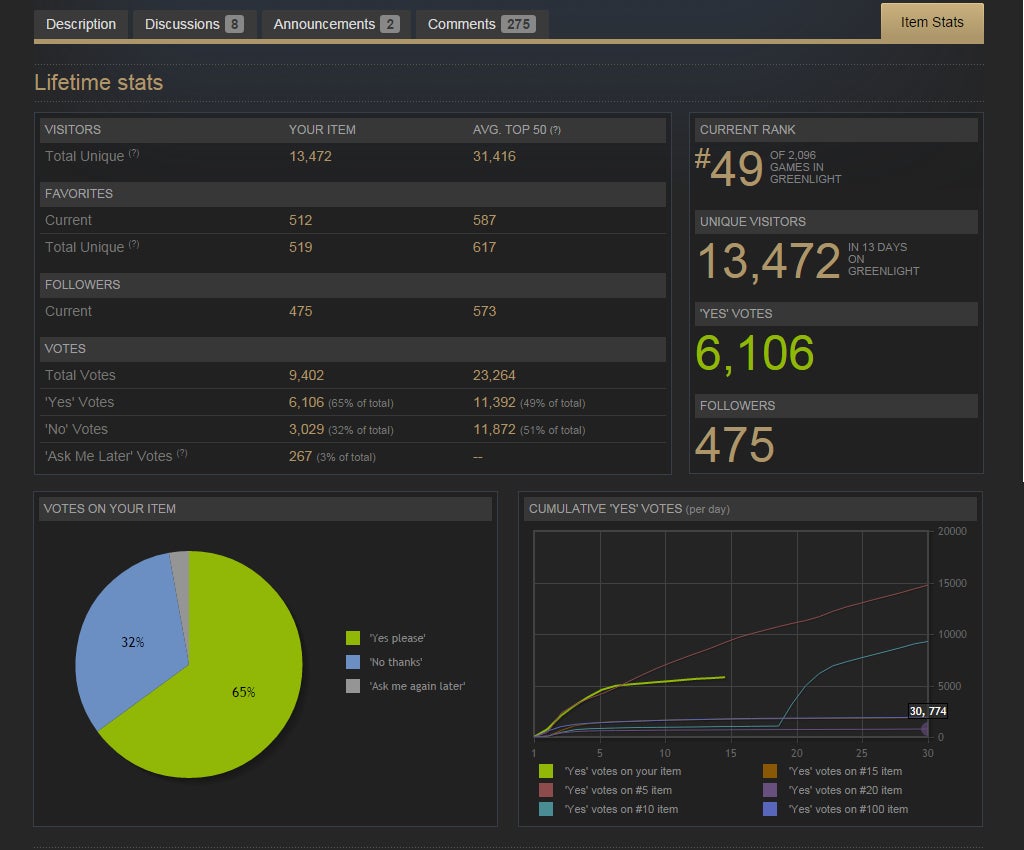 Votes alone don’t get a game through Greenlight, though. “We try to incorporate external factors such as awards, critical acclaim, significant Kickstarter success, press coverage, etc,” Valve’s Doug Lombardi told Kotaku. “At the end of the day, we’re trying to prioritize the games that customers are most interested in having on Steam. The goal is to keep refining the process to get better and better at making sure games customers want are available and discoverable on Steam.”
As of this writing, Valve has greenlit 3667 games. Of those, 2943 have been released. In order to attract votes, it helps to be a good self-promoter. That’s not every game developer’s strong suit, but the Greenlight gods demand it.
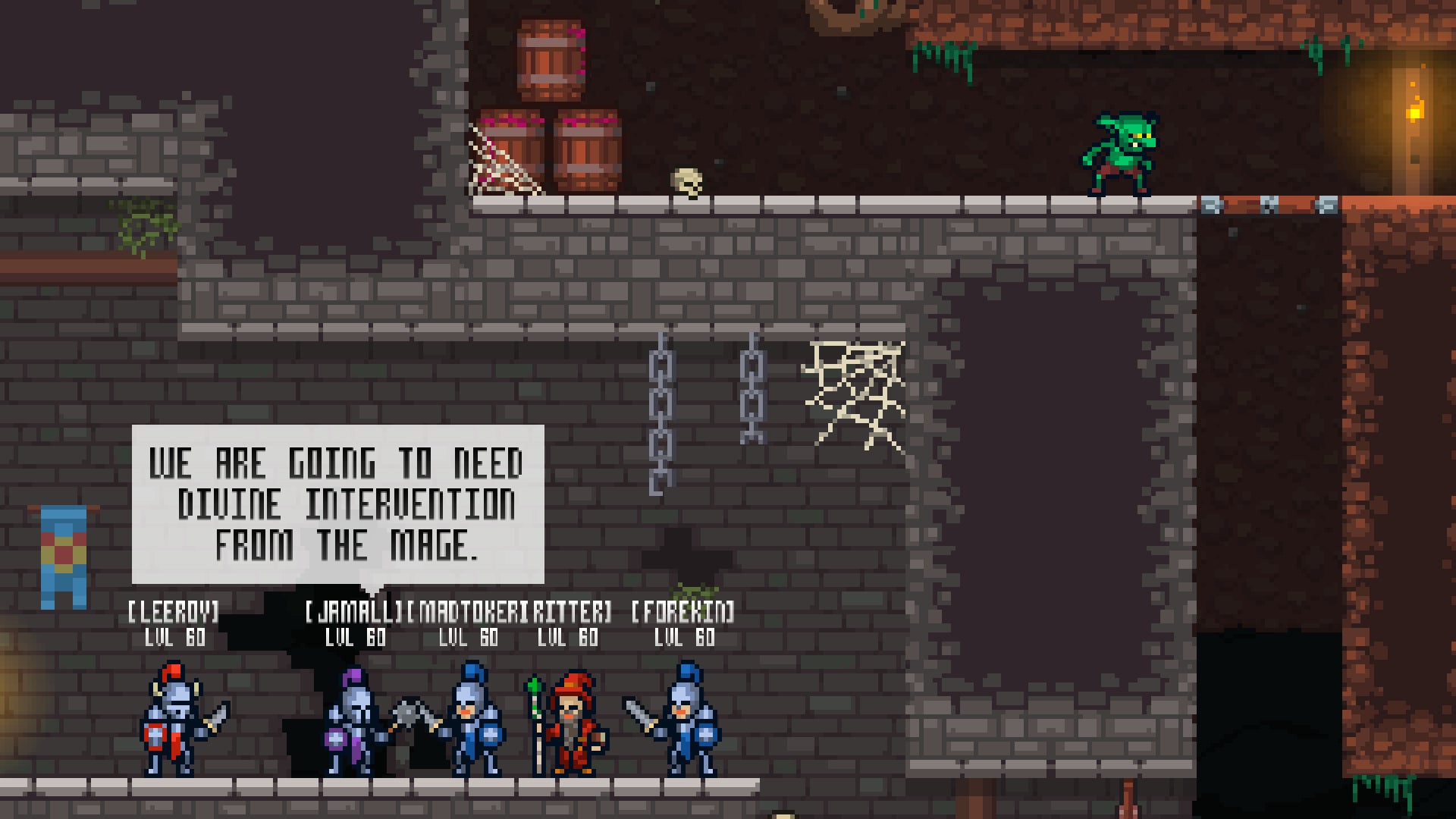
“Our Greenlight campaigns were both very simple, and relied primarily on the organic traffic provided by Steam,” Sam Redfern, developer on Musclecar Online and Goblins & Grottos, told Kotaku. “We did a small amount of additional marketing via Twitter, but I can honestly say that this was irrelevant. All that’s relevant was how well the game appealed to the audience browsing Greenlight. And the overwhelmingly most important thing in that is the trailer video, since that’s the first thing (i.e. probably the only thing) people see.”
Redfern recalled that it was hard to get Greenlit in the early days of the service. By the end of 2014, things were easier, and his studio’s game Goblins & Grottos had an easier path. They also did a better job with the Greenlight listing. “We had a really good trailer which showed off the game in the best possible way: quick, snappy, humorous. The fact is, any decent game gets greenlit these days.”
 Redfern noted that the question literally asked on a Greenlight page is “Would you buy this game if it were available in Steam?” He just doesn’t think people are thinking about that when they’re voting. “The goal is to make people say ‘Hey, that’s cool!’ The goal is not to make them say ‘I’d buy that!’ despite the fact that Valve is asking them that.”
Almost every developer I spoke to who experienced a significant publicity boost—whether discovered through Greenlight or outside of it thanks to, say, a Kickstarter—got greenlit shortly after. Generally, though, that came on the heels of an appealing Steam Greenlight page beforehand. “I made a special GIF just for the Greenlight page icon (the square one you see in the list of all Greenlight games) and I would suggest anyone doing Greenlight to do the same,” said Kenneth Backus, a developer on cel-shaded airplane roguelike Sky Rogue.”The game was already on itch.io, so I advertised the page on all of those and I think some friends posted on Facebook. I got a lot of traffic thanks to NerdCubed’s Sky Rogue video being published a month before I started on Greenlight.”
(NerdCubed is a YouTuber with nearly 2.5 million subscribers, so you know, nice feather in the ol’ cap if you’re angling to get onto Steam.)
 I’ve also spoken to a few developers who eventually made it through Greenlight but couldn’t really pinpoint exactly why. Like, they were completely stumped.
Sometimes it just… happens. Coin Crypt developer Greg Lobanov and Sky Rogue developer Kenneth Backus both told me about games they’d essentially abandoned getting greenlit out of the blue. Lobanov put an Earthbound-inspired RPG called Phantasmaburbia on Greenlight right after the service launched, and Backus took a similar approach with a co-op brawler called SWOOOORDS After two years of nothing, both were suddenly notified that their games had been greenlit in early 2015, shortly after Valve decided to let more games onto Steam as part of September 2014’s Discovery Update. Backus suggested that this might mean nowadays you can get a decent-ish game onto Steam with a purely attrition-based approach.
But even developers who put their games onto Greenlight after Valve opened the floodgates have languished, only to be greenlit out of the blue months later.
“Within the first week, Cloudbase Prime got 633 yes votes on Steam Greenlight,” Tyrus Peace, developer of in-development first-person action puzzler Cloudbase Prime, told me. “In total, over the first 3 months: 770, which I believe topped out at about 40% of what anyone in the top 100 had at the time. And then I got Greenlit on May 12, 2015! I have no real evidence of any reason why. My game didn’t happen to get popular on the Internet that week, and my votes didn’t move an inch that day.”
 The thing is, nobody’s 100 percent sure because, as per usual, the company that brought us games like Team Fortress 2, Ricochet, and Let’s Wait Three Months To Notify People About A Breach That Happened On Christmas doesn’t do much communicating. While a few developers I spoke to knew people within Valve, most said they never spoke to Valve at all during or after getting greenlit. Much of the process is automated. So sometimes when developers’ games get greenlit, they don’t quite know why.
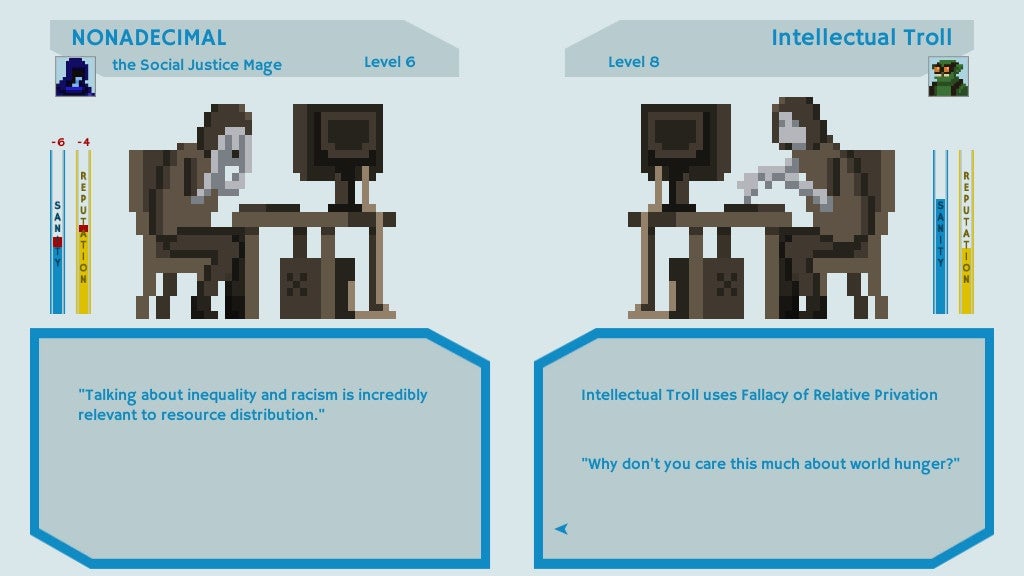
Other times, people don’t know quite why their games don’t get greenlit. On that front, there’s the especially curious case of Social Justice Warriors, a satirical game about trolls, labels, and us-vs-them mentalities. Developer Nonadecimal Creative told me:
“After spending eight months on Greenlight, with half of that time spent in the Top 100 watching other developers’ games get greenlit with fewer votes than my own, I started to wonder if there was some reason Valve was ignoring the game. A lot of my friends started their own Greenlight campaigns and sailed through with only a few thousand votes while I was still waiting.”
“It was around this time that Hatred was banned from Steam and I wondered if Valve also considered Social Justice Warriors too controversial for their store. Hatred was the #1 game on Greenlight and SJW was right behind it at #6. But then Hatred was unbanned and published and I was still stuck at the top of Greenlight. So I sent them an email asking if there was any issue with my game and if I could make any changes to resolve the problem. I never heard back from them but I was unexpectedly greenlit about a month later as I was running a booth for SJW at PAX South. I don’t know if it was in response to my email or because someone from Valve saw the game at PAX.”
Nonadecimal Creative obsessively checked their Greenlight stats, watching votes per day vacillate and freaking out when database errors caused Steam to tell them they were back down to zero votes. “It becomes a really frustrating hourly ritual,” they said.
 For some, it’s total cake to get through Greenlight, even with a game that isn’t super hot. For others, the process is so opaque that it borders on maddening. But, in speaking with so many developers, I did come away with a few agreed upon pieces of conventional wisdom:
Have a good trailer that’s snappy and shows gameplay. Save the long-winded story mumbo-jumbo for later.
Being at the top of Greenlight’s “new” section brings lots of attention. It’s a make or break period, so be ready to hustle and engage with people during that first week.
If you have a means by which people can play your game (a demo or the whole thing hosted on a site like itch.io), so much the better.
Games that can quickly express why they’re unique usually do better.
Positive attention and press helps, but it’s not a necessity if you’ve got a solid trailer/description on Greenlight.
If all else fails, wait. Something might happen… even if you never really find out why.
So that’s Greenlight. From there, developers have to integrate their game with Steam’s API and add achievements and trading cards. It’s a fairly smooth process relative to, say, Apple or Google’s app stores, but it still takes a lot of work—sometimes weeks’ worth. Still, at the end of it all, they’ve got a game on Steam (or Steam Early Access). Doing even moderately well on Valve’s PC gaming mega-mart is huge for smaller developers. It may not be a golden ticket to the indie champagne party in a delicately almond-encrusted sky like it was in the pre-Greenlight days, but it’s still a big deal.
What about the other ways to get a game onto Steam, though? Well, they tend to be much more straightforward, but there are some big “ifs” involved.

The Alternatives
There are a few main ways to avoid slogging (or speeding) through Greenlight: signing on the dotted line with a publisher, personally knowing somebody at Valve, or having a previous noteworthy Steam game to your name. Once again, though, none of these things are 100 percent reliable, nor do they necessarily get a game past the hoary old Greenlight cerberus.
“Working with a publisher does not bypass the process,” Valve’s Lombardi said. “If a developer has a proven track record with customers, that helps a bunch, but ultimately it’s the game that is the deciding factor.”
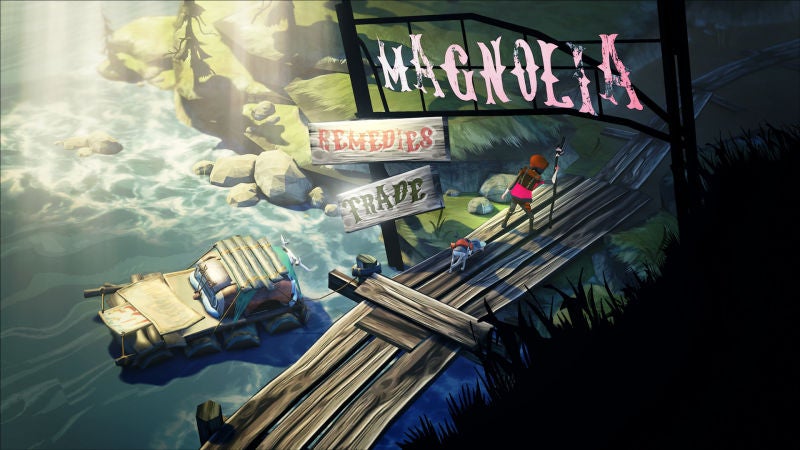
So it’s a case-by-case thing. Sometimes, it’s extremely straightforward. Forrest Dowling, designer on survival roguelike The Flame in the Flood, told me that getting hoisted from uncertainty’s choppy waters and onto Steam’s bountiful land was as simple as pitching the idea of the game to a Valve contact. He told me it happened before the game’s Kickstarter, so the studio didn’t even have much to show at the time.
“Basically we got in because we knew folks at Valve and were able to bypass the Greenlight process… In our case, the studio was new but the developer pedigree was high [because we’d worked on BioShock]. So it was essentially, ‘Hey, can we get an App ID?’ And Valve was like, ‘Sure, seems fine.’ It did involve talking through what we wanted to do with our game, to show that we weren’t doing some super weird thing that’d never show up on Steam anyway.”
It was barely even A Thing, in other words.
 On the opposite end of the spectrum, Michael Molinari, designer of Twitch-powered platformer Choice Chamber and rhythm game Soundodger (among others), told me his publisher, Adult Swim, had to fly to Valve’s Bellevue, Washington HQ, because the publisher wasn’t even responding to e-mails. The Adult Swim folks brought a laptop loaded with hopeful games. “Valve only ended up picking a couple games from that lot, which thankfully included Soundodger,” Molinari said. “I would assume with their multiple Steam successes since then, the process is a bit easier and requires less flying across the country.”
Despite that (eventual) success, Molinari said Valve still told him to put Choice Chamber on Greenlight. When in doubt about a game, that seems to be Valve’s go-to solution.
So really, Steam’s direct route can be almost as variable and complicated as Greenlight. It can be tough pretty much no matter what you do. That in mind, we now turn to face the elephant in the room: bad games on Steam. Some good games don’t make it, some developers with proven track records don’t make it, and some publishers have to fly across the country to avoid getting caught in a glorified game of “redlight, greenlight.” How, then, do so many subpar games show up on Steam?

Why so many bad games?
Greenlight was designed to get the cream of a crop of lesser-known games onto Steam. Having people go through a publisher or be a similarly known quantity is another way to hopefully ensure that a game won’t be, you know, garbage. And yet, if Steam was a restaurant, the health inspector would almost certainly flunk it, because there’s crap everywhere. Why? Where does the process break down?
The most glaring issue, most developers I spoke to opined, is the structure of Greenlight itself. It’s a consequence-free buffet of games. People can glance at a game, think, “Huh, sounds like an alright idea I guess,” and hit the “Yes” button without a second thought. On second inspection, said game might look horrible, or it might quickly become evident that the developer doesn’t have the needed skills or resources to realize their ambitions. But many Steam users don’t make it to the second inspection. By then, they’re looking at another game.
“Your pitch on Greenlight is really simple, there are ‘Yes’ and ‘No’ buttons directly below and the users will probably make a snap judgment in a few seconds. They are not making binding decisions to pay money right now,” said Sky Rogue’s Backus.
Goblins & Grottos’ Sam Redfern concurred. “Basing the decision on the fickle whims of the Steam users is a flawed process,” he said. “Their ‘yes/no’ clicks are taken very lightly by them, perhaps based on genres of game they like, or a split-second impression, and little else. Although Valve ask them ‘Would you buy this game?’ that’s not what they’re really voting on, in most cases. It’s not a shopping decision, it’s just a first impression.”
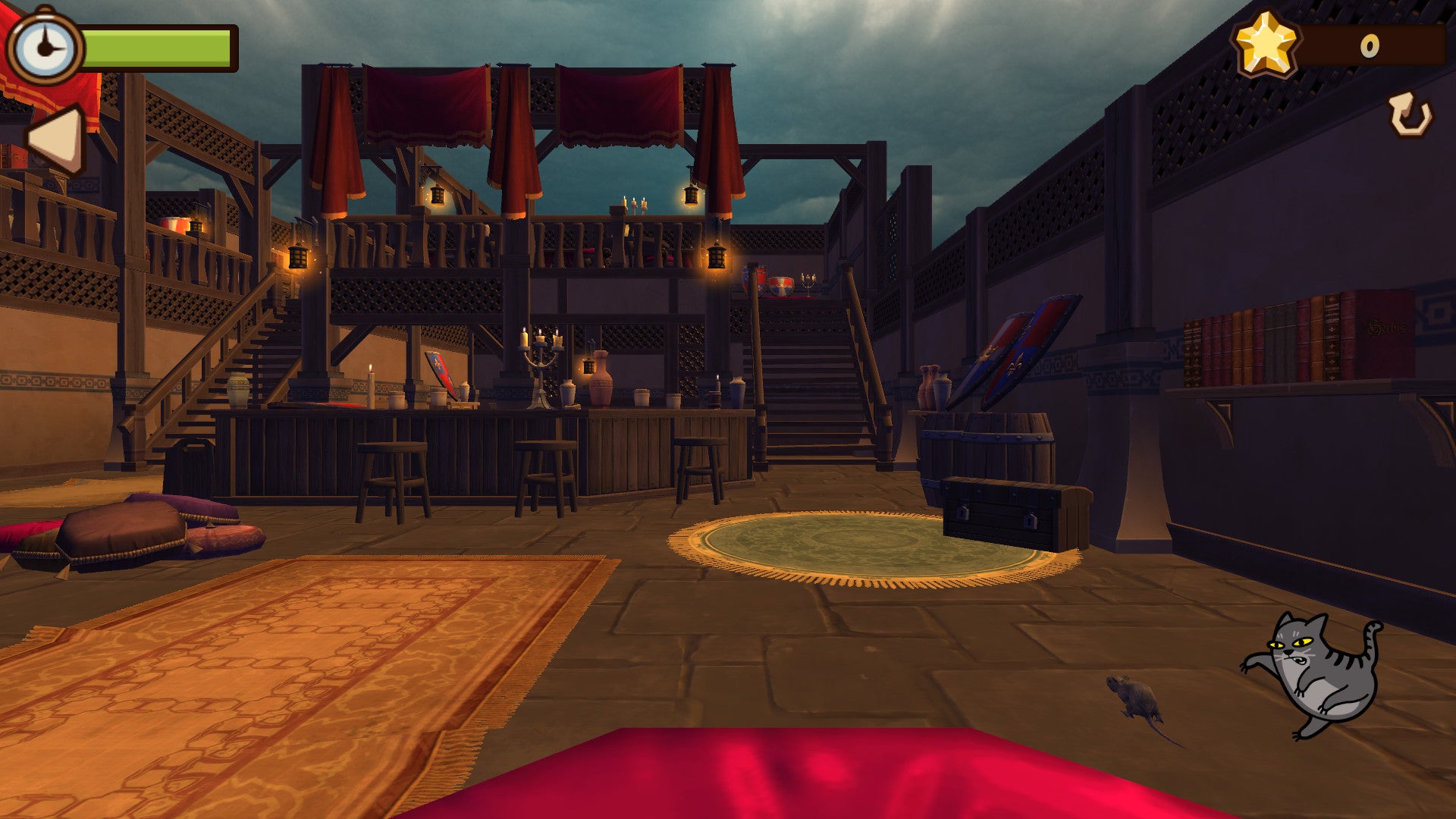 As a result, people often upvote things that are zeitgeist-y (survival games, puzzle-platformers, dating sims with preposterously busty anime ladies) or things they find funny at first glance (insipid joke games like Cat Simulator). I mean, why not? In the short term, there’s no consequence.
Steam Early Access, while a useful tool for many developers, is also giving creators of some bad games an out. Developers can excuse away obvious flaws or a lack of polish by saying, “Oh, we’re planning to go into Early Access, not regular Steam.” Some games then languish in Early Access, unfinished by their creators as audiences grow increasingly impatient.
Coin Crypt’s Greg Lobanov thinks standards are also going down. Back when he first tried to get a game, Phantasmaburbia, onto Steam, it was lambasted for looking “like a Flash game,” something to be justifiably wary (though not immediately dismissive) of. Now, thanks to an across-the-board lowering of standards due to Early Access, stuff like that gets greenlit all the time.
“It seems to me like with each wave of Greenlight passes, the average game quality on Steam takes a fraction of a percent of a hit, and over months and years it’s taken enough of a hit that people’s expectations of games are wildly different now,” he said. “Just clicking around what’s on top of RPGs now, I found games like this which despite having way more of that ‘Flash game’ aesthetic than Phantasmaburbia does, generates totally opposite response to what we got… I think it’s symptomatic of shifting opinions which let the ‘worst game on Steam’ get a little bit ‘worse’ over time as the ‘average game on Steam’ is getting ‘worse’ too.”
 Two developers I spoke to said they believe that publishers are a much bigger part of the problem than most people think. Social Justice Warriors’ Nonadecimal Creative pointed a finger at one such publisher, whose library includes one of the most notoriously terrible games on Steam:
“While Greenlight seems to get a lot of complaints from the public for watering down Steam’s catalog, I think these sorts of publishers are more to blame. This publisher Strategy First for example has 135 titles on Steam (including the infamous Bad Rats), with almost half of them lower than 50% positive user reviews and often heavily discounted below $1. I don’t know the circumstances of their relationship with Valve but with them getting a percentage from every developer they sign, it seems like they have an incentive to publish as many games as possible with no discernible downside.”
I attempted to contact Strategy First multiple times to find out why they seem to publish quite a few subpar games, but as of writing they had yet to respond.
“The strangest publisher by far is Black Shell Media,” Sky Rogue’s Backus told me. “It’s very common that if you release a game, you’ll get a creepy form email from these guys, and you’ll get it at least five or so times. They have a fair number of seemingly successful titles, but a lot of their games either sell under 10k or sell more but have really bad reviews.”
I got in touch with Black Shell about this curious practice, and they acknowledged that, yes, they do reach out to developers by way of “cold email” sometimes, but they’ve cut down on doing so in recent months. Still, nearly half their selection of games on Steam have either “mixed” or “mostly negative” Steam user reviews, so I decided to ask how that happened.
“Some of the negative titles may have resulted from a variety of factors,” said chief marketing officer Raghav Mathur, “including the development team straying from their original vision or falling off the wagon, complications arising when certain features were integrated, a lack of initial funding to get solid artwork and visual polish, or simply just things not ending up as great as we all initially thought they would. We always strive to work with our more negatively received titles to help identify what the actual issues are.”
“Sometimes that gamble doesn’t work out for us,” he added, “but I am proud of the fact that we have given the opportunity to get on Steam to developers that are excited to enter the market but were not able to alone.”
He also noted that some Black Shell-published games get to do a sweet kickflip over the Greenlight barrier and go straight onto Steam, but others (usually ones from lesser-known developers) have to wait in line like everybody else. Sometimes a publisher’s job is to help usher a game through Greenlight, which Mathur claimed Black Shell can reliably do in a few weeks. It just doesn’t always lead to good games.
 Ultimately, though, it’s hard to know how many of Steam’s quirks to chalk up to intentionality and how much of the blame belongs to obliviousness, neglect, or Valve’s notoriously slow and secretive development process. Valve is a company made up of extremely smart people. They are also, on the whole, pretty observant, even if they don’t always talk about it. But that lack of transparency leads to questions on top of questions, many of which fall on deaf ears.
Once upon a time, Valve was planning to eliminate Greenlight altogether and replace it with a series of user-generated stores. Last time I asked them about that, they said they still were. That interview happened a year ago. When is the big change happening, and what’s going on behind-the-scenes with Greenlight to pave the way? Nobody really knows. On the upside, there are now safeguards like refunds in place to protect users as they navigate Steam’s winding labyrinth, but that cures a symptom, not the overall sickness.
Steam is a strange ecosystem, and Valve occupies an even stranger place within it. Once upon a time, Valve hand-curated Steam entirely, but they say they want to be completely hands-off in the future. At the moment, they’re awkwardly wedged in the middle, and it’s led to a system rife with questions and contradiction. Perhaps in time Steam will reach its ideal state, as Valve has proposed on multiple occasions, and this cloud of confusion will dissipate. Until then, though, it’s an identity crisis, and a messy one at that.
You’re reading Steamed, Kotaku’s page dedicated to all things in and around Valve’s wildly popular PC gaming service. Games, culture, community creations, criticism, guides, videos—everything. If you’ve found anything cool/awful on Steam, send us an email to let us know.
To contact the author of this post, write to [email protected] or find him on Twitter @vahn16