The great escapist fantasy of Dungeons & Dragons is that you are not a salaryperson shoveling handfuls of gummy bears into your mouth and rolling 20-sided dice. Rather, you are a singularly important hero with a singular capacity to disarm some impending plot bomb. It’s a time-tried formula, one that basically spawned an entire industry (see: role-playing games)—but let’s take a pause on that and consider a less-trodden way to play Dungeons & Dragons: being an incompetent dimwit.
Sucking in totality is just not something Dungeons & Dragons readily accommodates. And yet playing an idiotic character tests everything you knew about Dungeons & Dragons, from the core of its mechanics to the way you navigate your dungeon master’s plot.
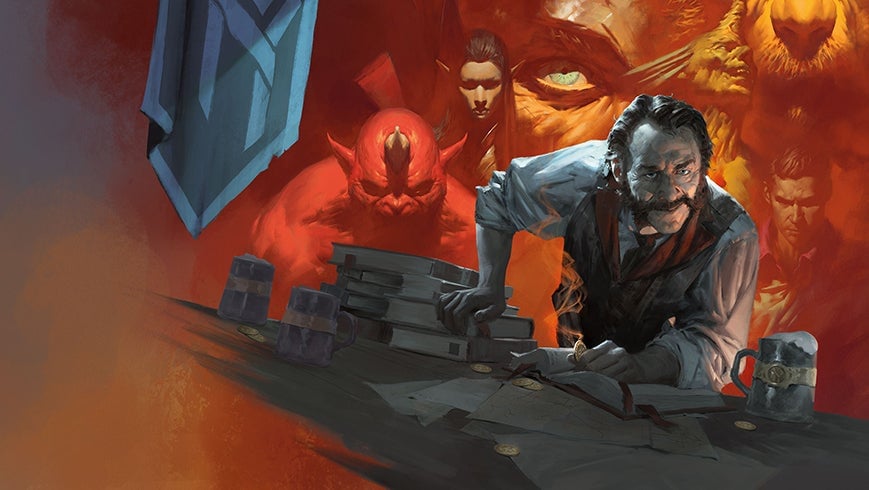
On Sunday, I made Vicco “The Veech” Vadalucci. He’s a Dwarvaan acquirer-of-things, a man of business, a hobbyist gambler with a New Jersey-Italian accent. He’s the kind of guy who says he can get you anything—whether it fell off the back of a cart somewhere or he knows a guy who knows a guy with some connections in rare potions. “The Veech” might leave a room for 30 seconds and then come back saying he’d just consulted with “his buddy outside,” who told him to ask the quest-giver for more gold. In truth, the only “product” he can reliably come by is toy dolls for his beloved little daughter, and he has essentially no business connections at all. He’s full of shit. He can’t do anything—at least anything epic.
Lest it come off like I was purposefully sabotaging the campaign, allow me to defend myself: Dungeons & Dragons changed the world in 1974, in part, because it was a game that could not be won. It’s a storytelling game played using tactics and strategy. Yet battles must end, information must be extracted, and campaign adventures must come to a close. Inventing an incompetent stooge and inserting him into a party of sharpened blades with lofty personal fitness goals runs a high risk of making everyone have a bad time—if they’re focused on taking down baddies and amassing treasure. That wasn’t our vibe on Sunday. We were all about role-playing dummies and telling a good story. “The Veech” was in-bounds. The only problem was making sure his stats matched his unskilled character.
In Dungeons & Dragons’ player handbook, the player-character is described as someone who can “solve puzzles,” “battle fantastic monsters,” and “discover fabulous magic items and other treasure.” This is how the game is designed, and making a character who can’t do these things is surprisingly tricky. For example, first, a player must choose a character class like Sorcerer, Ranger and Bard. By even falling into one of these classes, each of which demarcates the player as someone with special capacities, the player-character is immediately assumed to be a little more powerful or have a little more potential than the norm.
“The Veech” is a phony and a plot catalyst, which made it hard as hell for me to fill out abilities and statistics on his Dungeons & Dragons character sheet. I made him a Cleric of the trickster god Tymora, also known as Lady Luck. (I couldn’t think of another class that made sense, although I’m willing to admit there may have been better options.) He was someone who had to rely on his Charisma statistic to keep up the charade. But he definitely was not a powerful sorcerer, an artistic bard or a holy paladin warrior. As a devotee of Tymora, “The Veech” could gamble to his heart’s content. He could disguise himself with magic and make mirror images of himself. That all fit. Alongside all that, he also had this whole “intermediary between the mortal world and the distant planes of the gods” thing going on. He could proficiently battle with a warhammer and could casually turn undead.
After choosing a class, I needed to fill out his stats. Players in Dungeons & Dragons can either roll their scores with six-sided dice or assign predetermined scores to their stats. I wanted “The Veech” to be bad at everything—just a very sad man—except maybe Charisma-based things, since his bullshit being believable made the game more fun for everyone. The predetermined stats—15, 14, 13, 12, 10 and 8—all indicate that the player-character is, for the most part, well above the average, which is 10. So I wanted to roll the dice, like my man “The Veech,” hoping he would find no success.
The way you do that in Dungeons & Dragons, though, also assumes higher-than-average capacities: You roll four six-sided dice, drop the lowest score and add up the others. Alas, “The Veech” turned out to have ridiculously high stats in every category. He was as wise as the oldest monk, as formidable as a brick wall. He was persuasive as a seasoned used car salesman and as strong as, well, a guy who was pretty strong. His lowest stat was intelligence, which was just one point below average. “The Veech” was too capable, and we hadn’t even started the game yet.
The Dungeons & Dragons player’s handbook says that it’s fine to break whatever you rule you want in pursuit of a good game with lasting memories. Yet at the core of the role-playing game are some truths: Your character is special, and their class and stats make them more special. There are other role-playing games out there that facilitate overt buffoonery and shittiness, but I wanted it to work for my little man, “The Veech,” in Dungeons & Dragons.
In the first hour of the campaign, “The Veech” spent more time arguing his quest rates up with increasingly elaborate hoaxes than murdering goblins. This was expected; though as the campaign went on and as I kept trying to up the ante with his ridiculousness, I ended up tapping more and more into “The Veech’s” Cleric-specific talents: Taking a mission off a police officer, he duplicated himself and put on a mustache to pretend he wasn’t, in fact, that “Veech,” a known criminal. In a temple dedicated to a more pure and good god who despises undead, “The Veech” bragged that, in fact, he’d turned a couple undead in his day.
He wasn’t about “ghost ships,” “cursed bones” or “cults amassing increasing power across the realm.” “The Veech” was there to play the fool to my friends’ more focused heroes-in-training, and even if I wasn’t role-playing completely true to his capacities, some of what made him super-powerful made his super idiocy just that much better.