Game designer Ken Levine was here in Washington, DC last week for the Art of Video Games festivities at the Smithsonian American Art Museum last week, and I had a chance to sit down with him and discuss Irrational’s big upcoming project, BioShock Infinite
We’ve heard about some of the game’s bosses and about how player choice will influence the game’s outcome. I asked Levine to tell me more about how this world of Columbia came to be.
https://lastchance.cc/the-boys-of-silence-are-bioshock-infinites-most-terrify-5894790%3C/a%3E%3C/p%3E%3Cdiv class="not-prose my-8 -mx-4 xs:mx-auto">
It all begins, Levine explained, with the desire to create environments that have natural boundaries, rather than relying on invisible walls: “It’s nice to make environments that have their own borders, so you don’t feel like, ‘Oh, I should be able to go beyond that.’ When I play an open city game, I’m kind of like, ‘Oh, why can’t I go over there?'” Rapture in BioShock worked well in this way by being underwater; the walls were not only visible, but made perfect sense in context. As for Columbia, as Levine put it, “You jump off the edge of there, you’re gonna regret it.” (And yes, he confirmed, you can jump off the edge.)
But why a floating city at the turn of the last century? What was it about this point in time that drew the design team’s attention? Levine explained the thought process and the research behind the development:
We create these environments, and then we go: Why? Why would there be this thing? Rapture was one solution, which is this secret city for this guy who felt he couldn’t live in America anymore, and then you have Columbia, which was a public spectacle, launched as a representation of America, that went rogue. So, when we come up with the reasons for the city, we tend to have this idea, this macro idea of the city, and then we say, well why is it there, that’s when we sort of dig into… when I dig into history, usually, and things I’m interested in, and things the team are interested in, and we sort of … in BioShock 1, I was definitely bringing the Rand to it, that was me driving it.
This one, a bunch of my artists were reading this book called Devil in the White City, which was about the 1893 World’s Fair. They turned me on to that, and that sort of became the beginning point of thinking about this period, and thinking about both American Exceptionalism and the emergence of technology, of American technology, at the same time. And [I] started thinking about making a game that centered around both a technology basis and the feeling in America at the time. And fortunately, I think that really supported what we were doing. The shining city on the hill — this is quite a hill that they have. Shining city on a cloud. Which is even more symbolic of what the viewpoint in America was. Sort of a new Eden for the people in the city. But there was a lot of thought [then], and there’s still a lot of thought, that America was sort of touched by God in a special way. And it was fun to play with those notions.
Levine and I agreed that the period of history between the Civil War and World War I often gets overlooked or quickly swept through, over the course of education. I asked if any particular facet about the period leapt out, during research, as particularly interesting. Levine responded, enthusiastically, by telling me about U.S. president Theodore Roosevelt.
For me the interesting thing was… it’s not a very well known period of American history. [You go from] the Civil War to World War I… it was probably… without a war, it was probably the most transformative period of history in America. Because America was basically still in this period of cocooning, because it was still part of an empire and the notion of being an empire was antithetical to what the American sort of way of thinking was. And then you have guys like Roosevelt, Teddy Roosevelt show up.
Roosevelt is a really hard figure to pin down because he doesn’t fit the model of Republican or Democrat as we think of them today. Yes, he was a Republican, but he was incredibly progressive in terms of his social thinking. Anti-trust and all that other stuff. But also incredibly… essentially a neo-conservative in terms of how he thought about the world and geopolitics, which is almost completely antithetical to how American thinking was at the time. Panama Canal, Philippines and, you know…
Levine continued immediately by explaining more about the moment in time where Roosevelt rose to power as President, adding:
The technology, these incredible, transformative technologies all coming in over a period of twenty years: electricity, and radios, and cars, and airplanes, and movies, and… everything just changing! And these two sort of things, these catalysts that would really be the foundation of modern America as we think of it. Really America coming out of its cocoon in a lot of ways, I think for good and for bad. But America was about to become what we think of it [as] now.
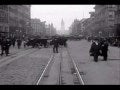
Levine continued to discuss the influence that technology and the arts had on each other and on the development of the world for BioShock Infinite. There was a film, he said, shot in San Francisco around 1905 that was like time travel, just going down Market Street and showing how people lived. “Just being in another time and being in another place is so fascinating,” Levine said. “For us to make this convincing, especially in our fantastical setting, there’s just a ton of research we have to do.”
We go look at paintings … or musicians, or artists, the sort of, early, early sounds of jazz, and how transformative that was. That’s another thing that was so transformative! You look at music prior to jazz, and it’s like… [plinky sounds] and you want to kill yourself. And that’s been a challenge on BioShock Infinite, because on BioShock 1, you had this amazing catalog of music to choose from. And you look at BioShock Infinite, and you look at 1912… and there was just the beginnings of what an ear today would think of as musically interesting. You have to dig really deep, and we’ve done that. You go into spirituals, and you go into hymns, and you go into gospel and ragtime and stuff like that, and you start seeing… if you go to the top of the catalog, to the obvious place in the catalog, the modern ear sort of rejects that as uninteresting.
Music also led our conversation to the topic of culture in Columbia, and how it echoes the reality of American history. Blues, jazz, ragtime, and spirituals all come from the African-American musical tradition, and it seemed to me that citizens of Columbia were unlikely to handle issues of race any better than citizens of the America from which it sprang. Levine confirmed that race is indeed an issue in Columbia:
I don’t want to do any spoilers here, but the music will tie into the macro story, to some degree. But we have a lot of little stories we tell. And what’s interesting to me is that you have a city that is quite segregated, there is a sense of the minorities being looked down on, but the music that’s coming out is quite… driven by, and the music that white people — this happened in the ‘20s — that white people were dancing to was coming out of the minds of people that they looked down upon. And it was an interesting tension, and eventually it gets co-opted, right? That music gets co-opted.