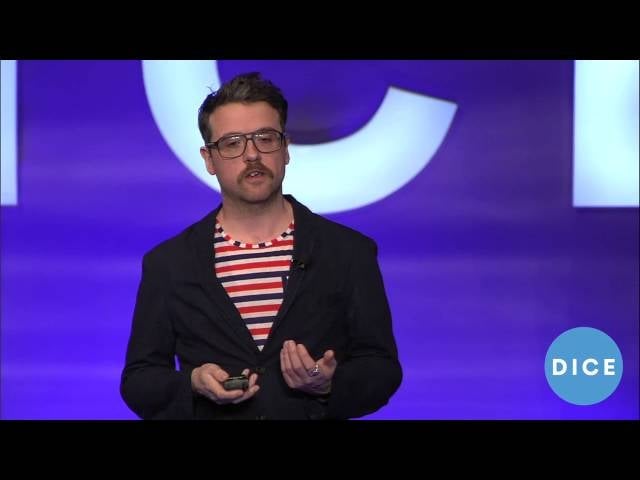
Rex Crowle and Christophe Villedieu don’t say the kinds of things most of the video game developers I’ve ever spoken to say. For example, when they’re feeling down they… go to Twitter to see what people have to say about their game.
Really? I get that their recent game, the PlayStation Vita adventure Tearaway, was pretty cheerful, but we all know how the Internet works.
So when Crowle and Villedieu told me this a couple of weeks ago during an interview in a hotel suite in Las Vegas, I was incredulous.
“I was going to uninstall Twitter from my phone when the game came out, because I didn’t want to look,” Crowle said “But strangely it was good to read.”
“Nowadays there are lots of haters,” Villedieu added. “They are the ones that shout louder, those are the ones you hear. That never happened with Tearaway. They’re shouting: ‘I love it!’ ‘Buy it now.’ It’s not constructive what they’re saying but it’s so positive. Sometimes when I feel a little bit down I go to Twitter and…”
He let out a little cheer.
Tearaway was one of the great creative successes in gaming last year. It may not have been a sales blockbuster, but that doesn’t negate how wonderful it was. The game was cheerful, charming and wildly imaginative.
It used the portable Vita’s front camera to perpetually capture a video feed of the game’s player and projected that feed into the game’s world, making the player the sun in the game.
It used the Vita’s rear touch panels to enable a player’s fingers to appear to poke through the game world’s terrain.
The game itself appeared to be made of folded pieces of paper and used a sort of in-game Instagram to let players take filtered photos of its wondrous sights.
As happy a game as Tearaway is I was still surprised at how cheerful Crowle and Villedieu were. Talking to them was like what you’d think talking to people who make candy or rainbows would be like. The studio they work for, the Guildford, England-based Media Molecule, merely makes video games. LittleBigPlanet games, most famously, crafted by a team that is composed of game makers, artists, architects and creative types.
Everything they do is imbued with good cheer. Consider Crowle’s comment: “I think we as a company try and marry up stuff we enjoyed as kids—splashing around in puddles or whatever, dressing up and making forts—but with modern trends as well. We did that a little bit with LBP when we trying to create the first gaming social network and slightly different with Tearaway by keeping an eye on Pinterest and Instagram and general web technology.”
I asked them both if—I don’t know—if this was a show, if anyone ever curses at their studio. “Oh yeah,” Crowle said, not entirely convincingly.
If you’re not getting the vibe, I suggest you watch this presentation Crowle made the day before I spoke to him and Villedieu. It’ll give you a sense of what he’s like and of what Media Molecule seems to be… some sort of merry band of folks making happy games. In this, he mentions such delightful ideas as a Zelda game attached to a knitting machine that crafts you yarn versions of the gear you unlock, as you unlock it—and a Mario game attached to your thermostat that heats the room you’re in when you enter a lava zone.
Happiness. That is the coolest thing about Crowle and Villedieu. It’s not just that they seem happy, but they seem to want their players to be happy. But it’s not just that. Plenty of gaming people talk about putting smiles on faces and stuff like that. They’re talking about making players feel good. That stopped me in my interviewing tracks, too, when they said that. They wanted to make the player feel good?
“I think you can have fun by killing people—enemies—in a video game,” Villedieu said, “but you don’t feel good doing it. I think in our game you’re helping people, you’re helping the world to heal and change and you’re sharing a bit of yourself.”
“I would change the terms,” Crowle said, disagreeing a little as politely as possible. “It’s more about making the player feel good about themselves. It’s less about the player feeling good, as it is sort of showing them that the fact that they are in the sun and glowing is kind of positive message. The world is looking at them in a positive light.”
“When you first see yourself in the sun, the first thing you do is smile,” Villedieu said. “It’s just perfect.” He smiled.
Save the cynicism for other articles and other interviewees, I guess. I really liked this idea of a game meant to make you feel good/uplifted/positive a lot. Crowle elaborated as he described making Tearaway, a game for which he was the creative director and Villedieu served as game designer:
“I wanted to get a feeling in the environment like it really wanted you to travel through it, that you were being rewarded by being shown new things, that new things were unfolding, and that kind of each footstep is rewarding through the tactileness of the paper and it responding, rather than the sort of more stop-start approach [in video games] where you go into a room, battle everyone, the barrier goes down and you go to the next room. [I was] just trying to let you ramble through the environment a bit more.
“It’s kind of like instead of seeing XP and numbers fly out, it’s like seeing heart-shaped confetti instead,” Crowle continued. “It’s lot of positive reinforcement. I also tried to make sure there were some peaks and troughs as well so it wasn’t all a lovefest.”
No, Tearaway isn’t all a lovefest. Neither is most of gaming. Neither is much of game development. Or Twitter. Or interviewing people. Or reading articles. Or living life. It is nevertheless as refreshing as can be to talk about happiness for a bit, to meet happy people making a happy thing. Sometimes the skies can be blue. Sometimes, thanks to a video game, we can be in the sun. Sometimes it’s cool to smile.
https://lastchance.cc/tearaway-the-kotaku-review-1467706606%3C/a%3E%3C/p%3E
To contact the author of this post, write to [email protected] or find him on Twitter @stephentotilo.