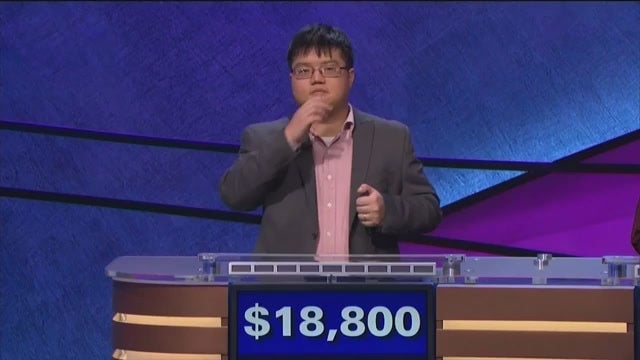
When Arthur Chu got the call saying he’d been selected to go on Jeopardy, his first move was thorough and decisive: He went to Google and typed in “jeopardy strategy.”
“I knew that just like in terms of my natural knowledge base, I wasn’t ready to go on Jeopardy,” Chu told me on the phone this morning. “I wasn’t like Ken Jennings—automatically knowing everything from the top of my head. So I had to train.”
By training—that is, going through Internet message boards and reading up on past Jeopardy winners—Chu developed an unorthodox strategy that has made headlines over the last week. It’s rare, controversial, and effective—and it’s turned him into something of a grand villain for some fans of the long-running quiz show. Just one glance at his Twitter feed will show you some of the ridiculous vitriolic messages he’s gotten over the past few days, as his story—and winning streak—started picking up steam. (He’s won four games so far, and needs one more to get into the Tournament of Champions. His next appearance will be televised on February 24.)
So what makes Chu so unusual? While most players will start from the top of each column on the Jeopardy board and progress sequentially as question difficulty increases, Chu picks questions at random, using what’s called the Forrest Bounce to hunt for the three Daily Doubles, which are often scattered among the harder questions in every game. Instead of moving from the $200 question to the $400 question and so forth, Chu might bounce between all of the $1,600 or $2,000 questions—not the kind of strategy you often see on Jeopardy
Chu does this for two reasons. For one, it throws everyone off balance. “It’s a lot more mentally tiring to have to jump around the board like that,” Chu told me.
More importantly, snagging those Daily Doubles offers him a massive statistical advantage. Since Daily Doubles allow players to bet up to their entire bankrolls, just one can swing an entire Jeopardy match—and Chu’s strategy is to control them all, even just to prevent other players from using them.
“The only chance you have to give yourself an edge—the only moment of power, or choice you have in Jeopardy
is choosing the next clue if you got the last one right,” Chu said. “So if you’re unpredictable when you do that, and keep opponents on their toes, it’s a lot more mentally
tiring and might tick off people in the audience, but it lets you gain and keep an edge that’s very important to winning the game.”
Chu’s Daily Double hunting can be disorienting and unpleasant for an audience accustomed to watching one category at a time. Check it out:
It’s clear why this style of play—combined with Chu’s slightly arrogant smirk—might upset some Jeopardy fans. But Chu points out that it isn’t his job to entertain people. “For us, we’re out there playing for real money, and quite a bit of money,” he said. “I think it’s obvious for me why that’d be more important than making the game fun for the viewers at home. I don’t get paid for that—I get paid for winning the game.”
Chu, who is 30, works in the legal department of an insurance company, where he reads contracts and does other technical work. He’s into gaming, citing BioShock, Portal, and the Arkham games among his favorites. And his dream job, he says, is to work alongside the likes of Troy Baker and Jennifer Hale.
“My first love has always been acting and performing,” Chu said, pointing me to his website, which has a voice acting demo roll. “I’ve always wanted to voice a video game some day… I would be happy to just be the voice of the grunt who gets killed in 20 different ways.”
Chu does narration for a webcomic called Erfworld, and he even auditioned for the reality show King of the Nerds:
Chu’s unusual Jeopardy strategy has netted him $108,000 so far. Given all this attention—and his success—it’s likely we’ll see future contestants start adopting it, but it’s not a new invention: Chu cites older Jeopardy champions like Chuck Forrest and Roger Craig as inspiration for his techniques. In fact, Chu says, Jeopardy’s “contestant coordinators” make it clear to everyone on the show that bouncing around the board is totally allowed.
“They tell you when you come onto Jeopardy, this is how most people play because it’s easier to play the game this way—and it is,” Chu said. “But the important thing for me was, I wanna maximize my chances of winning.”
In theory, the producers of Jeopardy could nullify the bulk of Chu’s strategy by shifting up board placement —if every question had an equal chance of being a Daily Double, board bouncing would be pointless. But there’s one other wrinkle to Chu’s technique: during the Final Jeopardy round, instead of playing for a win, he plays to tie.
Here’s where we get into hardcore game theory: to sum it up, Chu bets for the possibilities that 1) both the first- and second-place players will get the final question right, and 2) they’ll both get it wrong. (If one player is right and the other is wrong, it’s safe to assume the correct player will win.)
So let’s say Chu is in first place with $20,000, while, say, Julie is in second place with $18,600. Common sense might dictate that Chu should bet $17,201, so that if Julie bets her whole bankroll, and they both win, Chu beats her by a dollar. (Julie would have $37,200, while Chu would take home $37,201.)
But what if Julie considers that possibility, and then wants to bet so that she’d win if they both get the question wrong? In that case, playing on the assumption that Chu is betting $17,201, Julie would bet $15,800—that way, she’d make the most money if she was right and he was wrong, but she’d still win if they were both wrong, because Chu would have $2,799 and she’d have $2,800.
If there’s a tie, of course, both players move on—so Chu bets $17,200, knowing that in both scenarios he’d make it to the next game. (Granted, Julie would still win if they both got the question wrong and she bet less than $15,800, but that’s one of the risks to this approach.)
Here’s one example of his plan in action:
Of course, the strategy was irrelevant in this case, because Chu was the only person to get the right answer, but you can see why he bet what he did—if they had both been wrong, a tie would be the worst-case scenario, and if they had both been right, he’d win.
It will be fascinating to see whether future Jeopardy contestants emulate Chu’s strategy, and how the game changes accordingly. Internet reactions have been mixed; some fans and pundits think he’s ruining the integrity of the quiz show, while others think he’s improving it. No matter your position, it’s hard to deny that now that “optimal Jeopardy strategy” has gone viral, Alex Trebek could have a whole new type of show to host.
“When I first started, I thought maybe I should just hide in a hole and wait for this to die down, because it’s gonna be so unrelentingly negative,” Chu said. “But I discovered it’s not really so bad. Most people get what I’m trying to do, and don’t judge me for it. And the people who don’t like me? Well, you can never please everyone.”