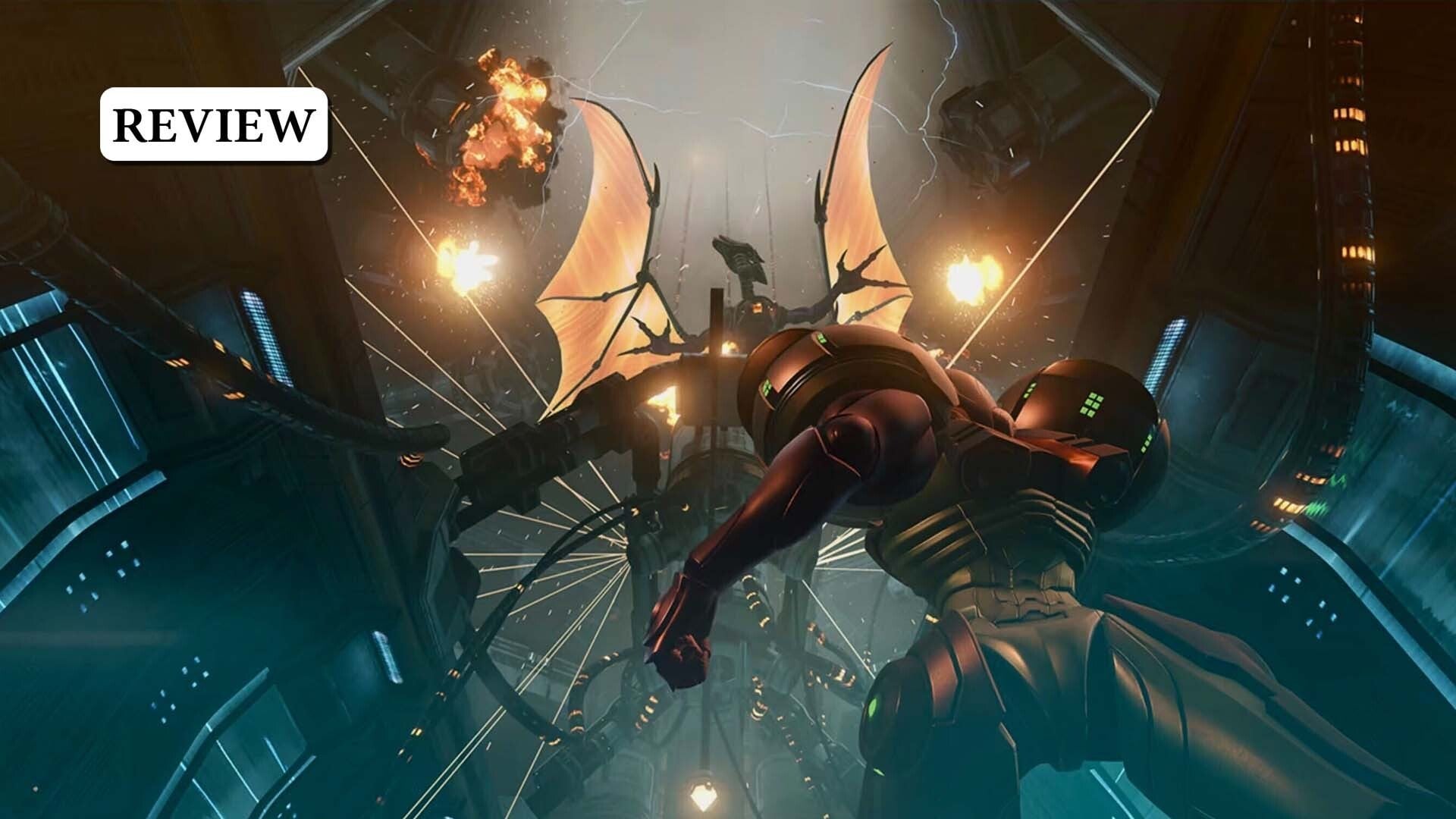
I started growing up with games at a time when a lot of them weren’t advertised as “for girls,” and especially not for girls who couldn’t afford it. I started playing games in earnest with the Nintendo DS, which advertised plenty of “girly” games, but when I got my Xbox 360, I wasn’t used to more neutral or stereotypically boyish games like Skyrim and Assassin’s Creed, and I found them more difficult to get into. That discomfort made me miss the Metroid games, which aren’t necessarily marketed to women, but do, I was surprised to learn at some point, revolve around the nonchalantly female bounty hunter Samus Aran. I loaded Metroid Prime Remastered with these memories in mind, hoping it would let me try a bit of what I missed when I was too young to even really understand what makes someone “a girl” (I’d just turned 4 when it was released for the GameCube in 2002). It delivers.
The immersive atmosphere of Tallon IV
Remastered leaves the story of the original untouched. It’s a 13-ish-hour journey across the planet Tallon IV, the former habitat of the birdlike Chozo race, before it was taken out by a meteor weeping the toxic substance Phazon.
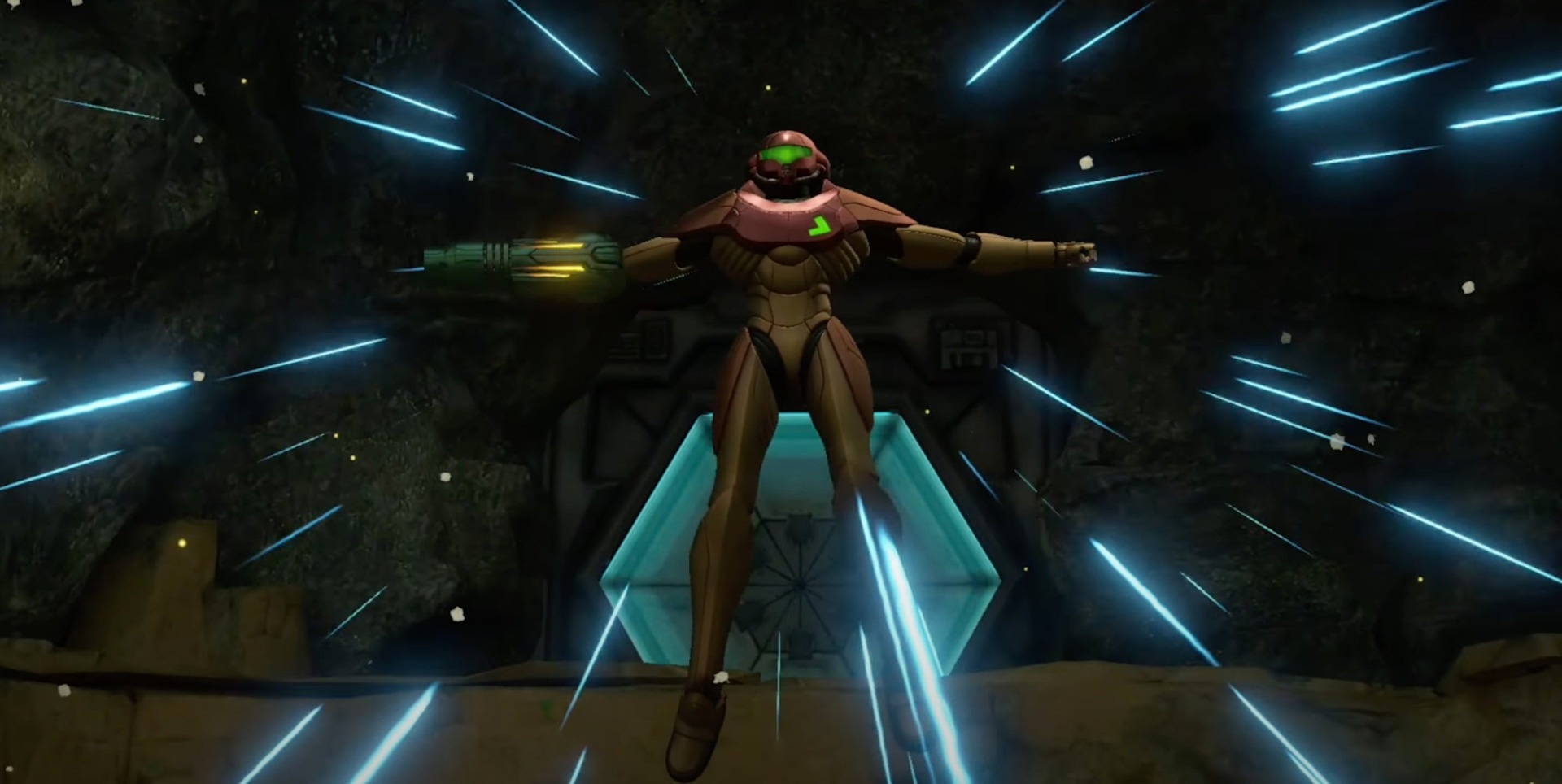
Still, Tallon IV abounds in the Chozo’s dilapidated stone temples and resplendent rainforests, now overrun by Space Pirates hoping to use Phazon for their own wicked experiments. Samus —who you only see when she’s riding an elevator in third person, staring out her helmet glass in disbelief, or when you get a flash of her reflection in a bright beam blast through your first-person view—needs to take them down. Navigating her gliding, heavily armed and armored body, I recover artifacts, scan environments and the nasty creatures in them to record as field notes, and blast through bad guys.
Most of these guys, of which there are a memorable menagerie—porcupine-like aliens with spindly legs, gassy globes that look like the novel coronavirus, or the muscled, reptilian Space Pirates who pop out from dark corners to take you down—didn’t take me more than a couple of seconds to destroy on the game’s normal setting.
This shooter’s breeziness is noticeable immediately in the game’s introductory tutorial section. Shortly after I arrive on the Pirates’ Orpheon spacecraft, copper-colored Tallon IV looking like a shiny penny in the distance, I am encouraged to shoot at enemies with my Pulse Beam. Boom. The Pirates go down. I’m told to press B while using the game’s very generous lock-on setting, which pulls the game’s already basic shooting elements down to their baseboard, to move around potential hits. Boom. A swarm of creatures vomit green goo at me. Some splats and slides off my visor, but I kill the creatures quickly.
From this benign beginning, Metroid Prime establishes itself as more of a Lara Croft-type adventure than a shooter. Tense moments—the seconds after killing a boss, missing a jump and slipping into a pit of burning magma—are pinches to keep pushing forward, get the next bit of gear, go down another secret tunnel, add more Chozo history to my logbook.
The same game but better
It helps that this Remastered version looks so…remastered. I forget that this was first released for the GameCube in 2002, taken by the beads of orange light that peel off of Orpheon like spiderwebs illuminated by the hot sun, taken by its cute, cartoon-y graphics as I progress.
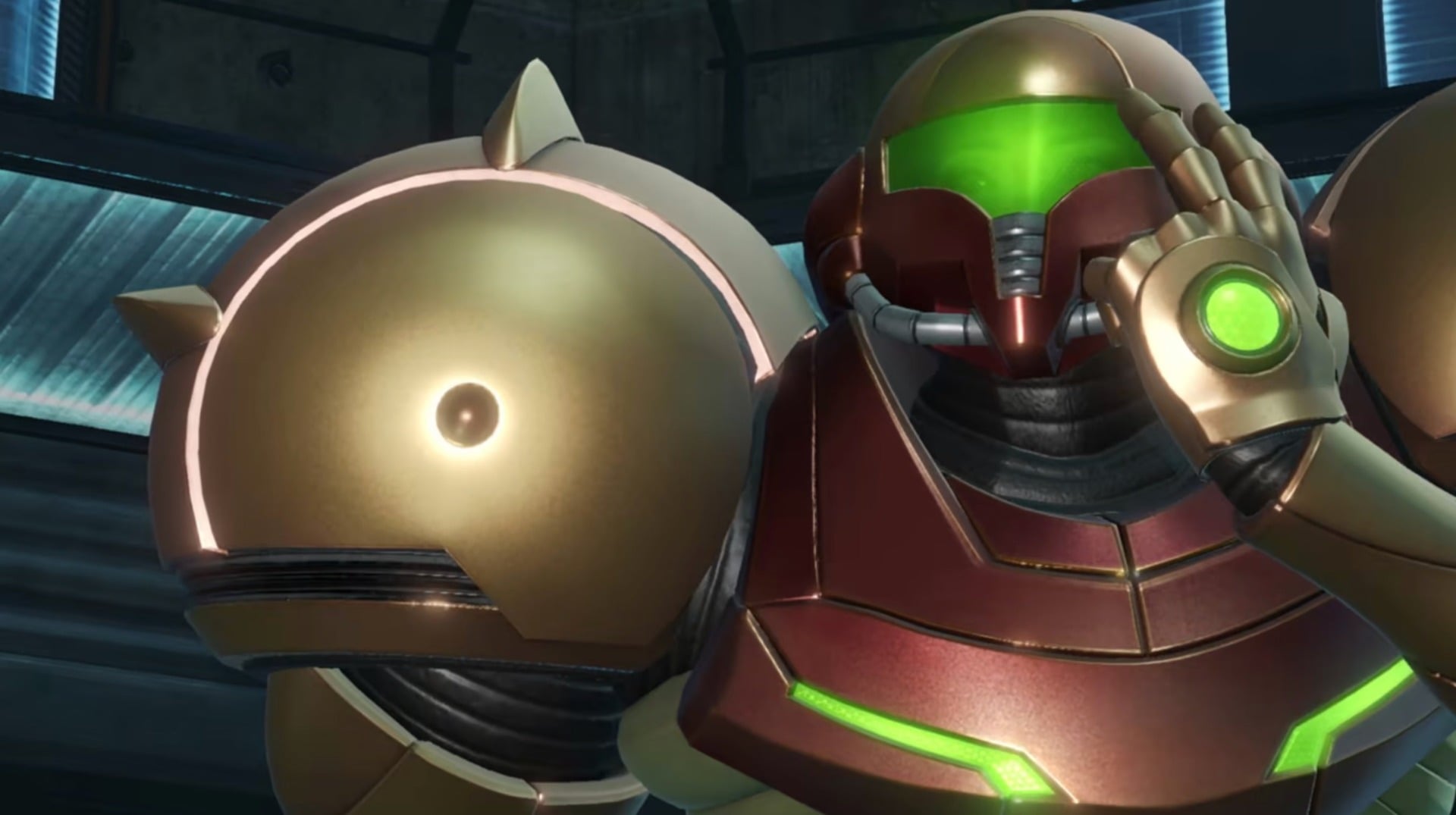
Samus’ eyebrows, through the reflection of her helmet, are perfect bark-colored rainbows. The fallible enemies, some with cases of ice on their backs like turtle shells, some crackling with painful white lines of electricity, and those Space Pirates with their long legs and jet packs, are richly colored like gummy bears.
But Remastered hasn’t forgotten where it came from. Aside from the default “dual-stick,” for modern, dual-stick control, the game offers robust controller settings, including “classic,” modeled after the GameCube controller, “pointer,” which operates “similar to Metroid Prime: Trilogy for Wii,” the game says, and “hybrid,” which combines dual-stick and classic. I play mostly with dual-stick, though I feel like hybrid is a fun limitation, with a sticky up-and-down control that I find beneficial to my motion sickness.
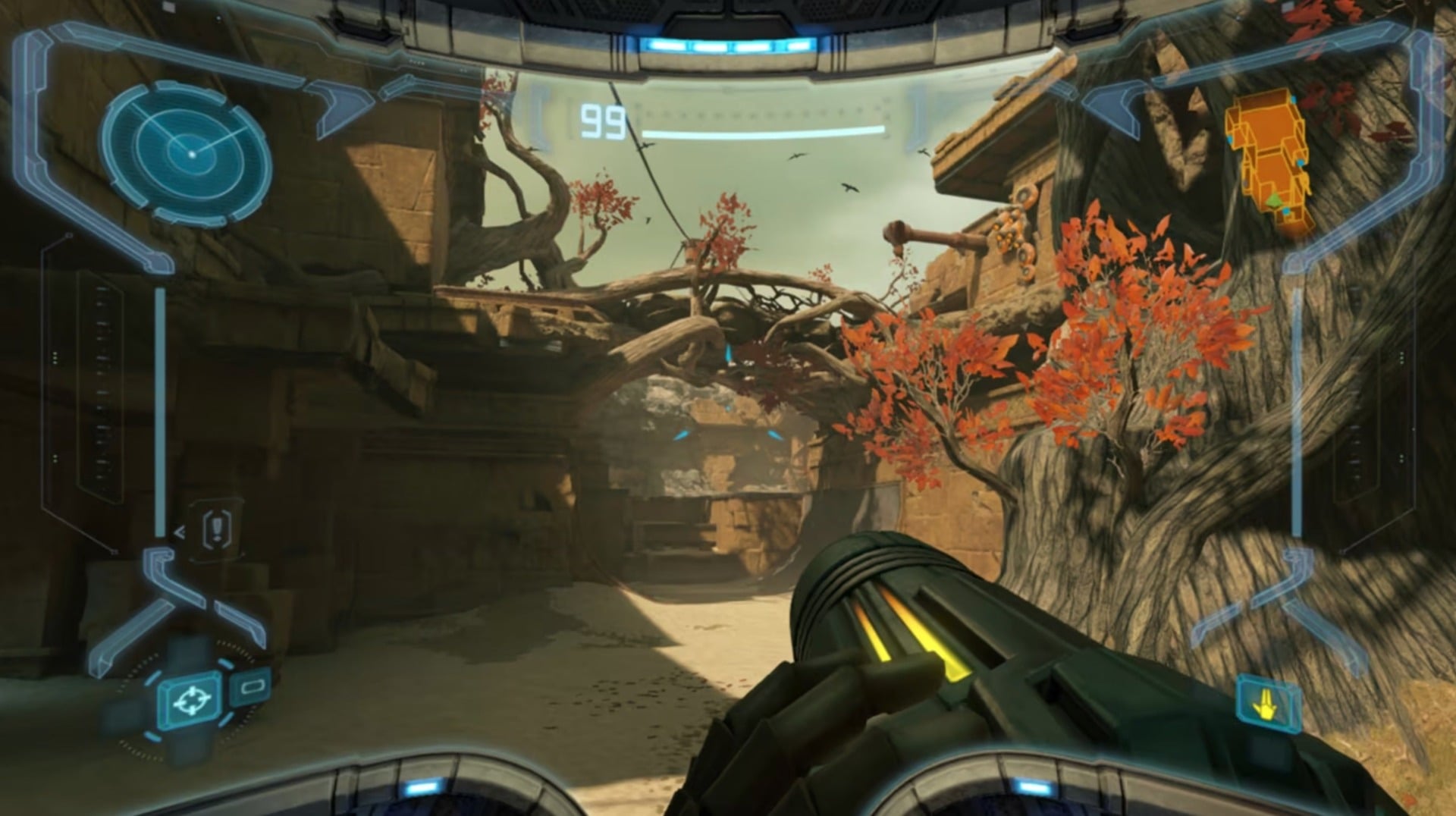
I appreciate that, too. For some reason, Metroid Prime doesn’t inflame my video game-induced motion sickness, which sets in especially while playing first-person games, but even if I’m playing a third-person game for too long. Being able to alternate between playing on my big screen TV and baby-sized Nintendo Switch OLED screen is helpful, and the graphics are crisp on both.
The music, always atmospheric, sprinkles of stardust piano here, a bit of groovy drum machine there, also sounds great on both my stereo speakers and through my Switch, taking on a pleasantly tinny quality on the latter, like cookies rattling around in their box.
The only thing that I really felt was missing from my play experience, like with my playing the Dead Space remake, was nostalgia for this game. Without it, although rare, annoyances were more difficult to cover in candy.
As I progress through the game, I pick up expansions to my health bar and to my Power Suit, like a thermal visor, boots that help me do moon landing high jumps, and weapon expansions that help me shoot out missiles spun from purple light. The enemies that crowd the different environments I navigate and return to, hunt in, plunder, and return to stay at pretty much the same low-level difficulty because of this. I don’t mind that so much—quickly downing enemies helps make the game feel like an elastic snap, and I like moving on.
But repetitiveness and simplicity become less fun when it comes to the bosses, which either have tricks to them (a light beam you need to change the position of, some rocks you need to methodically obliterate) or require boringly little skill (hold B to avoid an attack, shoot until they die). By my fifth boss battle, I’m more annoyed than exhilarated, wanting to get it over as fast as possible so that I don’t have to double back to my last save station.
I can respect that purists like the save station—the health-replenishing checkpoints are, for the most part, conveniently located in each new place you enter—but, like I said, this is a game that’s all about travel. Adventure, right? But when I trip into magma again and need to retrace 10 minutes worth of my steps, taking down the weak enemies that light that path again, I don’t feel challenged, I feel annoyed. Exploration, the crux of the game, turns into a chore.
At slower, more frustrating points of my playtime, I find it difficult to connect with the obscurity of Samus’ mission. Unlike Alien, the seminal sci-fi horror film that inspired the Metroid games, Remastered doesn’t give me a clear reason to root for my female protagonist’s success. I can’t say I’m that personally invested in the Chozo’s demise, and the game isn’t heavy enough on mystery to make me want to be. It’s all pretty cut and dry, evil mutant stuff.
Metroid Prime Remastered
-
Back of the Box Quote
"We have to go deeper"
-
Type of game
Adventurous, sci-fi first-person shooter
-
Liked
(Mostly) fast-paced, undemanding game experience, impressively 2023 graphics and feminism
-
Disliked
Flimsy story, unpleasantly 2002 save points and bosses
-
Developer
Nintendo
-
Platforms
Nintendo Switch
-
Release Date
February 8 (digital), February 22 (physical), 2023
-
Played
12 hours
To give myself more to chew on, halfway through, I turn on “full” narration settings, so that voiceover from the game’s original European and Japanese releases would play as I do. I’m disappointed when I realize that those old voices are confined to the opening and closing cutscenes, and to announcing locations, like the translated Ice Valley (Phendrana Drifts).
Samus Aran lives
I’m more interested in the careful details Metroid Prime uses to make up for its hashing and rehashing (it is a 2002 game, after all). The white-blue snowdrifts in the Phendrana region, the way water sloughs off Samus’ visor like she’s a stone in a river.
They endear me to Samus, as silent and stoic as she is. Similarly to Alien’s Ripley, Samus is presented as refreshingly gender-neutral, her suit fixed with massive armored biceps, a bit of flat orange metal around her waist, too protective to allow for curves.
Remastered’s graphics look great, and while the game continues to, for the most part, translate well as an expansive, engaging shooter, I’m most struck by how the game allows Samus to be a person. Not a woman with her baggage, sexualized and discarded like a Grand Theft Auto: Vice City sex worker from the same year, and not relegated to the background the way 2023’s Dead Space does to its female characters.
Metroid Prime doesn’t linger on Samus’ fear, either, instead allowing Samus to navigate Tallon IV with indifference, something real women walking alone in the real world are rarely encouraged to have. But Samus never needs to hurry because Metroid Prime keeps her safe. And the immediacy in which she gets to exist has nothing to do with her gender. Unless I see her reflected eyes, fluttering with black mascara, in her visor, I’m not thinking about Samus’ gender or what she looks like.
And I’m thankful for that. I’m old enough now to witness girls partake in the video game industry outside of “girl games,” and to experience its full breadth for myself. Metroid Prime Remastered isn’t as perfect of a game as it seemed to be over 20 years ago. Too much time has passed for that to have ever been the case. But it will always know how to let a woman live.