I have a three-year-old daughter. I probably shouldn’t be playing Murasaki Baby, a game which is, in essence, about leading a toddler girl into and out of danger.
But, like fatherhood, I volunteered for this responsibility. The dangers here are metaphorical and not physical, yet Murasaki Baby feels all the more disturbing for it. It’s a game that haunts you with how wrong decisions can result in heartbreak for those too young to understand the idea of consequence.
Baby is looking for her mommy. And you—the player solving the puzzles, shepherding her across gaps and controlling little slices of her world—are the only hope she has of finding Mommy.
Baby, well… there’s no other way to put it: Baby looks weird. Damned weird. She’s got an upside-down face and stick figure body. Baby is essentially the creepy-cute Frankenstein lovechild of Jhonen Vasquez and Edward Gorey. But none of that means that Baby shouldn’t find her mommy.
Baby loves her balloon. It’s shaped like a heart. If it pops, Baby cries inconsolably and you have to start over from a save point. Having a balloon stand in for a health meter means that the child is never really in jeopardy, for the most part. That should make the ESRB happy. But the balloon also symbolizes Baby, and the larger dynamic of parent/child relationships. Baby and balloon are exposed to the elements at all times. You become far more aware of her vulnerability when it’s in the form of a balloon that’s constantly in danger of being let go or popped by a sharp object. The outsize, inflated heart acts a signifier in another way, too. Kids lose their shit when balloons pop or float away. Their little brains view them as magical paradoxes, solid yet filled with air. And, to developing minds unable to grasp impermanence, changes in state are very hard to deal with. So, yeah, protect the balloon.
Baby’s scared of the dark. Baby vocalizes unintelligible coos and gurbles which still manage to communicate tone and emotional state. She does happy little jigs when she finds a new door that might bring her closer to finding Mommy and quakes in fear when there’s not enough light. She’s real enough.
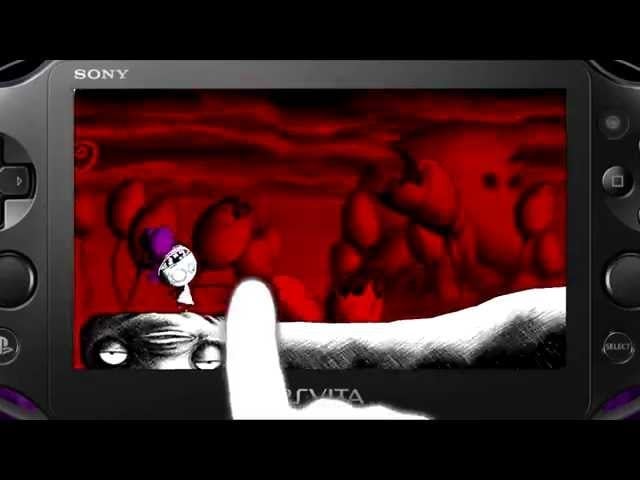
You have to make sure Baby’s going the right way by holding her hand on the Vita’s touchscreen and pulling her along. Dragging a young child forward gets tiresome as a main form of locomotion. But the game doesn’t give you any choice. This is the way you’re going to play. Baby’s never going to move fast enough for you, either. And, just like in real life, yank on that child’s arm too hard and she stumbles. Take it easy, will you?
The main play mechanic in Murasaki Baby is swiping two fingers across the rear touchpad to change a scene’s backgrounds and then tapping it to activate the specific effects unique to each one. A desolate backdrop creates gusts of wind when tapped, blowing away the safety-pin-shaped flies that threaten Baby’s balloon. Alternatively, a cumulus-choked horizon lets you guide lightning to specific spots to power on mechanisms. Your taps turn a light drizzle into a useful downpour on yet another backdrop.
In some scenes, you’ll need to combine effects from the various backdrops. It means using the rain background to raise a boat on floodwaters in one such sequence, then switching to the wind backdrop to fill its sails and move it forward. Other backdrops will present alternate paths and interactive objects to get Baby around or distract the threats moving on her. Later levels will demand that players use all the mechanics in rapid succession—tapping away at enemies, activating platforms, re-orienting perspectives, all within a quick few seconds—and a few instances will have a metaphorical-but-real timer ticking down, too.
Along the way, you’ll encounter placement/positioning puzzles where you need to float Baby’s balloon above or below fire, thorns or other hazards. These moments can lead to serious finger obscuring, where your hands’ contortions hide almost the entire screen. It’s not a frequent occurrence but it becomes annoying when Baby’s balloon pops on account of not being able to see what you’re doing.
Baby calls for Mommy a lot. It’s the only intelligible thing she says. The repeated keening is as disturbing as Baby’s waking up without her in the first place. Even in a broad, darkly comedic game like this, the idea that both of a child’s parental units have up and disappeared for no defined reason—leaving Baby to wander through an extremely dangerous world—is disturbing. The game’s world doesn’t look anything like ours but the sense of danger still resonates.
Now, Murasaki Baby isn’t exactly deep, textually speaking. It does use symbolism to gesture at bigger existential ideas and create a sense of dread. But, it’s a very rote sense of fucked-up-ness at work here. “Oh, man, turning on the TV will distract that well-meaning but still-destructive parental unit! What a critique on the perverse, double-edged power of television in our modern world!” That kind of thing. However, as ham-fisted as some of the execution is, I still found myself thinking about how neglect, poor rapport, and smothering can really mess up a kid. I’m still somewhat new to parenting so I think about this stuff a lot. But it’s rare to encounter a game that sets out to touch these prickly issues and this Vita title deserves some credit for that.
Playing Murasaki Baby made me feel queasy. The puzzles weren’t ever so hard that I wanted to throw my hands up and quit. But the relative ease of the game paired well with the morbid curiosity I had about the next cartoony bit of body horror Baby would wander into. The reasons I kept playing were the same reasons I was hoping it would end soon. The short clutch of puzzles and peril winds up stumbling onto a weird little allegory that stops and makes you think despite its diminutive size. Not that different from when a kid blurts out grown-up language, like “No, YOU’RE not being nice!” or “I love you so much it hurts.” Like a kid in between infancy and adolescence, Murasaki Baby scribbles down something that’s awkwardly meaningful in a small way, despite its flaws.