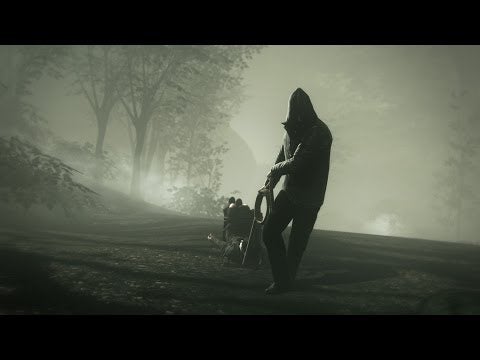
I came across something midway through Murdered: Soul Suspect that summed up the majority of my experience playing this game. I was strolling through a police station as Ronan O’Connor, a detective so hard-boiled that his own death could not stop him from hunting down the notorious murderer as The Bell Killer. The game begins with O’Connor being killed by that very serial killer, so the hunt has taken a turn for the personal by the time the player steps into Ronan’s shoes.
During a trip downstairs at the station, I happened upon my own corpse. This was an opportunity for real emotional drama in a game that first opens with the untimely and tragic death of Ronan’s wife before showing O’Connor himself getting the axe a moment later. Not only that, it posed an introspective, almost philosophical dilemma about who or what you’re playing as in a video game about the burden of immortality.
Most games let you behave as if you’re immortal. Few are bold enough to turn this into a dramatic conceit. So how did Murdered: Soul Suspect have Ronan respond to witnessing his own nonbeing? He said nothing.
Actually, that’s not entirely true. Ronan doesn’t “say” anything, but he technically writes something. I just had to dig for it in the notes after an alert popped up telling me that I’d seen my own physical remains.
“Nothing can prepare you for that,” Ronan wrote there. “For seeing your own corpse. It never felt so much like an empty shell until now. God, I look like a criminal.”
Murdered is a game with strong inspirations in film noire and horror movies of all shapes and sizes, so there are plenty of cinematic cutaways here. I imagine in an alternate version, Ronan’s encounter with his own flesh and blood might have been handled differently. Maybe the camera would be pulled away from the player’s control to focus on his ghostly visage as he stared aghast at what lay before him.
Instead, the actual, lived moment in the morgue delivers nothing close to that emotional tone. When you encounter the body, his body, Ronan remains entirely impassive. You can linger over your…self as long as you want, but the orderlies attending to the corpses in the police station’s dead person wing won’t say anything either. Eventually, if you want to finish Soul Suspect, you’ll have to walk back upstairs, where a good percentage of the computers in the same police station are illuminated with loading screens for Deus Ex: Human Revolution for some reason.
If I were a middle school English teacher, I’d call this a textbook example of “show, don’t tell.” I’m not, and we’re not talking about a book here anyways. But it’s the same basic problem, and the one that plagues all of the mysteries—murder-themed or otherwise—in Soul Suspect. The game offers up oodles of traumatic scenarios. But it almost never lets you play through them in any provocative or meaningful way. By the end of the game’s relatively short single player campaign, I felt like Ronan says he did in that moment in the police station: staring down at the empty shell of something that could have turned out much better.
I’m not really sure what to call Murdered: Soul Suspect genre-wise, so I’ll just say it’s an adventure game. A serial killer plot set in a modern-day-ish version of Salem, Massachusetts, the game mixes occult phenomenon with procedural police drama in manner akin to Seven or True Detective—the main difference being the ghosts are real in this story
https://www.youtube.com/watch?v=Zkh1NP5TBQI
It’s similar in tone and style to a game like LA Noire or Heavy Rain if one or both of those was thrown into a blender with Legacy of Kain: Soul Reaver. The game centers around Ronan’s mission to uncover the true identity of the Bell Killer, the twist being that you’re dead so you can’t indulge in the same interrogation tactics as Cole Phelps does in LA Noire or the fast-paced fighting and fleeing in Heavy Rain
You still have to do a similar kind of environment-based puzzle solving as seen in both those games, however. Ronan’s ghostly status just gives him access to a different set of abilities and limitations. He’s invisible to most people, and can walk through physical barriers such as walls and furniture. The majority of humans in the game can be possessed, giving you an ability to eavesdrop on their conversations or their innermost thoughts. You can also manipulate the people you’re inhabiting to trigger relevant memories or sometimes make them do things—but never anything more significant than, say, moving a pile of papers so you can analyze a photograph for clues.
Oh, and you can possess cats too. That’s probably my favorite part of the game. Because, I mean, they’re cats. Just look at the kitty go!
The sad part about that is: I’m not actually joking. The feline-centric levels in this game honestly stand out as of its most dynamic sections. Partly that’s because the cat is a more nimble beast than a human being—living or otherwise. But it’s also a sign of just how restrictive most of Soul Suspect’s world feels.
Murdered’s gameplay is broken up into a few separate chunks. The first involves walking around the world. This is a harder process than you might think—and not really in a good way. Ronan is a restless soul, which means he’s tasty prey for gangs of roving demons that pop up from time to time. These are toothy, caped beasts that suck the life out of Ronan in short order once they see him. If you sneak up behind them, however, you can give them the same treatment.
That’s obstacle number one. Number two is another demonic scourge: this one in the form of little volcanic mounds that occasionally block your way. If you try to walk over one, a series of ash-colored arms will clutch at your legs and drag you down towards hell. I called these “floor demons” for no better reason than the fact that they’re demons coming out the floor. They’re usually deposited in neat little squares right in front of some place you’re trying to go, which gives a good opportunity for some puzzle solving.
This leads to the third obstacle. They’re called “dusk objects,” and they’re essentially an undead version of the same walls and furniture that populate modern-day Salem. Only difference is, you can’t pass through them.
I take it that these threes types of barriers were put into the game to make traversing the world more challenging, and thus more interesting. The problem is, none of them are all that difficult—at least in any compelling way. From the beginning of the game, for instance, you can toggle a sort of stealth-vision mode that lets you see exactly where demons are and in what direction their cone of vision is pointing. As far as I could tell, they never get stronger or more formidable as Soul Suspect progresses either.
I realized within seconds of encountering my first demon, therefore, that all I had to do was stand behind a wall and wait for them to turn the other direction. Once they did, I could walk through that same wall and kill them. Or whatever the hell you’re doing to them is called. Either way, it’s very easy to make the bad guys in this game go away.
Similarly, every time I saw a floor demon, there was always—always—an immediately apparent way bypass it. Usually, the solution involved using a “poltergeist” action to set off some electronic device, make a living person standing on the other side cross over the floor demon to, say, turn off the vacuum cleaner you just switched on with your otherworldly powers, and possess them so they can transport you across the noxious bit of floor unharmed.
A good puzzle is meant to present itself to you gradually, making the act of discovering its solution the fun part. The levels in Murdered: Soul Suspect aren’t like this. They feel less like intriguing mazes to be wound through cautiously, and more like mousetraps you want to get out of as soon as possible.
This just gets worse in the mystery-solving portion of Soul Suspect, which is the other main chunk of its gameplay. Once you manage to find your way to one of the game’s many crime scenes in need of investigating, you’re challenged with walking Ronan around a tiny space in search of clues. Since many of these are full-blown crime scenes with real-life policemen milling around, the clues for which you have to search are often highlighted with police tape or little yellow evidence markers.
Once you’ve found enough, you press a button (triangle for the DualShock 4) to go into a sort of analysis mode where you have to sift through all the available clues and select the ones that are most relevant to the question at hand. Unlike a game like Heavy Rain or LA Noire, however, there’s no real consequence for failing to do so effectively or efficiently. If you don’t get it right on the first try, your score for the puzzle goes down (it’s rated on a one-to-three scale marked with little detective shields that disappear when you get a wrong answer). But it also crosses out the wrong answer definitively each time you mess up, meaning you’re always eventually going to end up with the “right” choice.
Again, this ends up feeling more like an endurance test than an actual intellectual challenge. Or an emotional one, because this is a horror game after all. But at its worst moments, these puzzles are something worse than repetitive or easy. Oftentimes, Soul Suspect prompted me with questions that left me thinking: “Wow, this game really doesn’t respect my intelligence.”
During one crime scene late in the game, for instance, I walked up to inspect a mangled corpse that was stuck underneath a giant rock. Looking down at the body and pressing the “investigate” button, I was greeted with an onscreen message asking how I thought the person died. I really, really don’t know how one would end up choosing anything other than “crushed by a giant rock.”
Ok, maybe saying that the game doesn’t respect the intelligence of its players isn’t fair. But no matter how I look at it, there’s something disquieting to the blandness of Murdered: Soul Suspect. It’s a game about ghosts, demons, and the Salem witch trials. For a story that’s on some level interested in scaring its players, it never has the courage to let those same players make their own mistakes.
This is frustrating, because there are some intriguing ideas at play here. Ronan’s life as a ghost is one of the most frank attempts I’ve seen from a game developer to take the ability to pass through walls from its origin as a cheat code in early first-person games and turn it into a viable type of gameplay of its own.
The social dynamics at play between Ronan and the game’s other characters—most of whom are still alive—are also interesting. There’s a real potential for terror in scenes where O’Connor is stuck powerless to intervene in the events of the living that unfold before him.
The game doesn’t do much with any of this potential, however. So if you’re in the mood for a tense, murder-driven adventure game, I would just recommend dusting off a copy of something like Heavy Rain instead.
Actually, now that I think about it, I’m sort of jealous of all the people in Salem’s police station who had copies of Deus Ex: Human Revolution installed on their desktops. Maybe I’ll go play that instead.
I couldn’t walk through walls in that game, I guess. But contorting myself through the the vents in that game was a lot more fun anyway.
To contact the author of this post, write to [email protected] or find him on Twitter at @YannickLeJacq