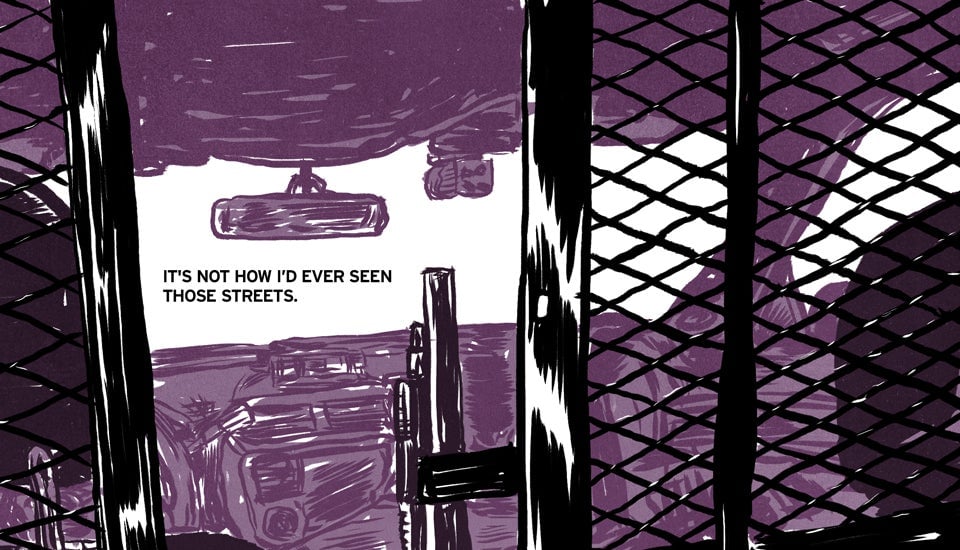
The world outside looks different when you see it through the windows of a police car. And, when you’re in one, you can tell the world sure as hell looks differently at you.
I’ve been in police cars three times in my life, once in 1998 and then twice, in rapid succession, in late 2011.
I was in them by choice, first as a reporter and then as the victim of a crime. And, yeah, I get it. I’m a well-off white guy talking about being in cop cars. I wasn’t arrested. I wasn’t a suspect. I wasn’t harassed. I hadn’t committed a crime. The cop cars I was in were safe places for me, but that made them no less revelatory regarding how I think about the good and bad of policing, crime and community.
There’s an in-car moment that struck me in the new police video game
Battlefield Hardline that I think nails the change in one’s connection to the rest of the world that I experienced when I was in a real police vehicle. The game briefly puts you in a virtual one. You’re a Cuban-American cop named Nick Mendoza, and your new partner is driving you through Miami. The city’s residents have been programmed by the game’s creators to interact with police driving through it. You get approached by a man asking for money. You see fellow cops handcuffing a man over the hood of a car. You see a woman rifling through trash.
You drive up to one intersection, and if you look to the right, you’ll see this:
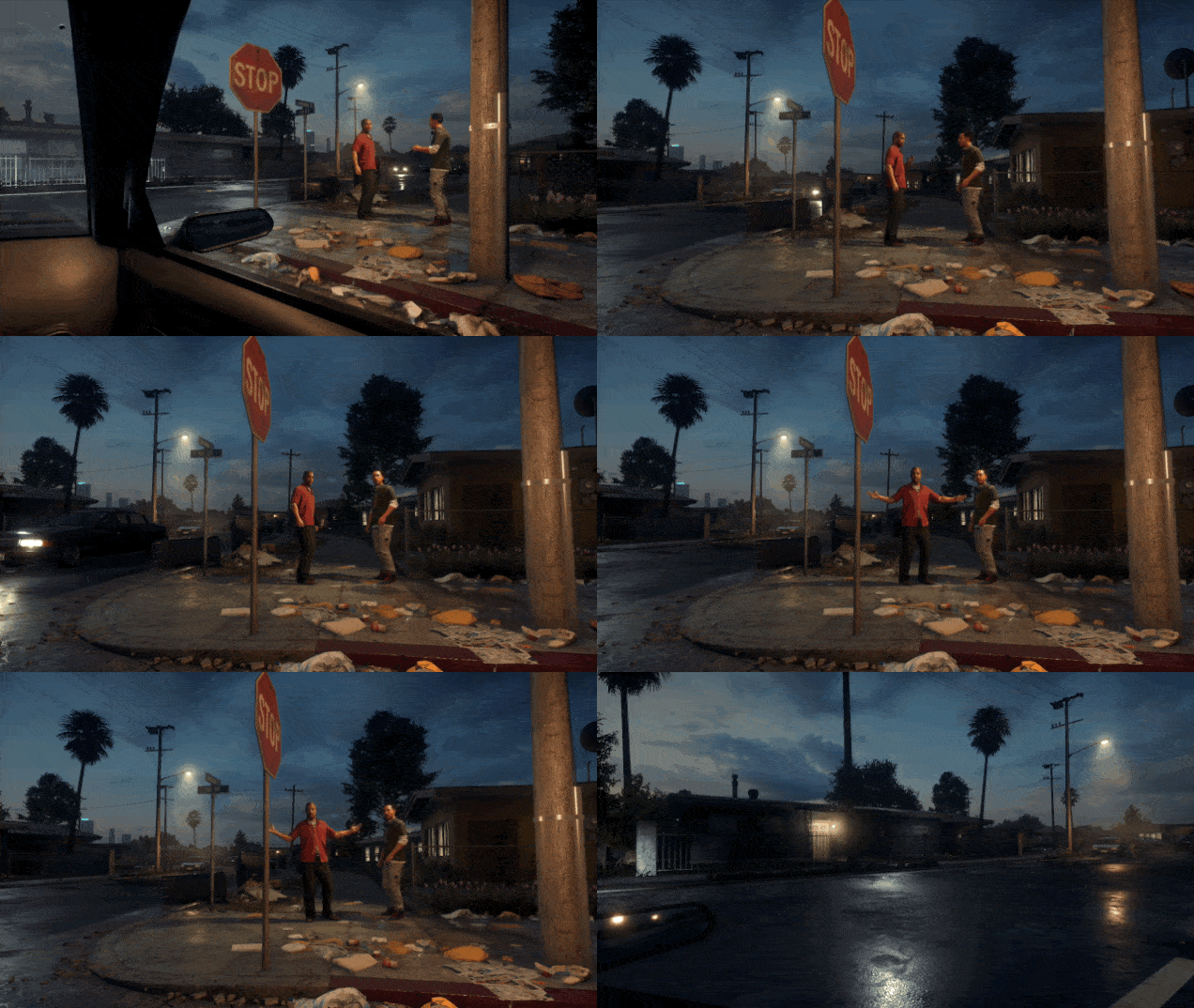 You control whether you look at those men. You can’t interact with them, though. Still, the ambiguity of the scene is potent. What’s their problem with you, with the police pulling up nearby? Is it them? Is it you?
If you’re interested in the problems of policing in America, I imagine you’re partially interested in issues of empathy, issues of getting into the heads of cops and the people cops interact with. You might wonder about what cops see when they look at the people outside their cars or what they see down the sidewalk as they patrol a beat. You probably have your own feelings about what seeing cops in a cop car means to you. People have been protesting around the country because they are not okay with how policing works in America these days.
To figure this stuff out, we can share our own experiences with police and listen to others. Or maybe you are a cop or, as in my case, have friends and family who have served and can share their experiences, good and bad.
Video games can also play their own bit role. I’ve argued that the way they simulate environments and let gamers role-play can let them serve as
potential engines of empathy. There was a video game, for example, that let you experience the verbal harassment many women hear when walking down a city street. Then there’s Grand Theft Auto V, where some players were convinced that the cops bothered you more when you played as the game’s black protagonist than when you played as the white ones (the creators maintain it wasn’t programmed that way).
I was struck by that moment in
Hardline, a game that’s otherwise been criticized for not having anything sophisticated to say about modern policing. The whole ride through virtual Miami was interesting because it emphasized those divides between people in cop cars and people outside of them. It shows how different the world can look and, at least there, didn’t provide easy explanations.
Obviously, my experience vis a vis the police is my own. I’m a 5’6″, 150-lb white guy who has never been treated by law enforcement as if I’m a threat. I’ve never had the kind of encounters with police or police cars that many people of color talk about.
I don’t think I’ve committed many crimes, either. I’ve also never been arrested. The closest I ever got was being grabbed by a cop after I jumped a turnstile in a midtown Manhattan subway station in the late 90s. (The cop didn’t seem to care that I’d paid my fare but been pushed back through the turnstile by someone exiting the station and that I’d jumped after having paid my way.)
I live in Brooklyn, a borough away from Staten Island, where Eric Garner, who was merely selling loose cigarettes, was horrifyingly choked to death by a police officer while saying he couldn’t breathe. I live just a neighborhood away from Bedford-Stuyvesant, where police officers Rafael Ramos and Wenjian Liu were ambushed and murdered by a man from Baltimore who claimed to be seeking revenge for the death of Garner and Missouri teenager Michael Brown. Late last year, I was sitting in my living room and could hear people marching on behalf of Brown just a block away. I went out to see as they went down the street.
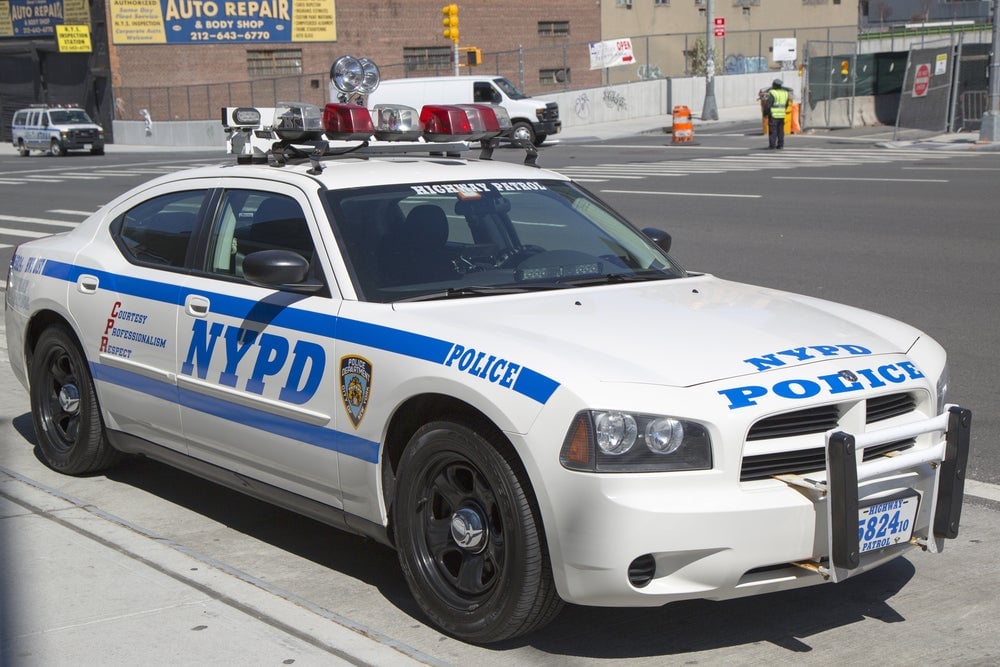 My 2011 experiences in cop cars were illuminating and complex. They’ve been on my mind, partially because of that
Hardline scene but also because my experiences happened on the same streets where Ramos and Liu were killed, the same streets where police helped me after a stranger stole my cellphone out of my hands.
It was late fall on a weekday morning, maybe 8am. I was in Brooklyn and had just finished running at a gym in Bedford-Stuyvesant. I ran there all the time, always with headphones plugged into my iPhone so I could listen to music.
I was walking the 15-minutes it’d take me to get home but for the efforts of a man who snuck up behind, unplugged my headphones from my phone, grabbed the phone and ran off.
I chased him on foot, tired as I was from my run. I yelled at him. “Give me back my fucking phone!” He kept zigzagging from block to block. Just about no one was around except for a guy he brushed past who warned me that the man had a gun. “No, he doesn’t,” I breathed back with foolish confidence.
The thief took a tight corner and lost me in a relatively crowded intersection. I stopped, shouting a question to anyone who could hear, saying what the guy was wearing, and avoiding that he was black because I was a white guy in a mostly black neighborhood and didn’t think that’d matter or help. No one replied. Who would want to get involved?
I walked a block, peering around for him or for police. When I saw a police car approaching an intersection, I just walked into the intersection to wave it down. It stopped for me. The cop inside lowered his window, and I explained my predicament. He ushered me into the back seat and radioed a description—no hassle, no skepticism, no curiosity about the panting white guy who just blocked his car.
We drove slowly through a few more blocks of Bed-Stuy. Suddenly the neighborhood had never looked so vast, so full of people, so crowded with possible secrets.. Somewhere nearby was the guy who had just snatched my phone. This is one of the sharpest moments from that whole experience. I remember how different everyone looked, the sense I had that, even on a bright sunny morning, that shadows contained a robber, that a neighborhood contained a criminal. It’s not how I’d ever seen those streets.
We’d only been driving around for a few minutes when we got a call on the radio. They’d found someone matching my guy’s description.
It seemed impossible. But a woman had called 911, probably a woman who’d heard me yelling about the robber and had seen where he was hiding. We drove a couple of blocks more, toward another police car, an ally, and I saw, beyond, that the man who had stolen my phone was pressed up against a wall. We stopped. An officer approached us holding a wallet—the robber’s—and my phone. This was the most effective policing I’d ever heard of.
There was an odd moment. You can’t open the doors when you’re in the back of a police car. They have to open them for you. They did so that I could see my phone and confirm it was mine. I looked toward the thief and he yelled back… at me? At the police car? At the idea of me being in a police car? I’m not sure.
We drove back to the precinct, where I got my phone back and a policewoman told me I had nice eyes. I don’t run with my wallet, and we were now a long way from my home. I asked if any cops could give me a ride. One agreed to, and so I got into a police car for the third time in my life, this time—for the first time—in the front seat. The officer was Asian-American. Years later, I’d later frantically try to figure out if he was Wenjian Liu, who had been killed near the precinct where I’d been helped. He was not.
As we pulled out of the precinct’s parking lot, we came to an intersection and stopped. This is where another of my strongest memories begins. We might have been at a red light or a stop sign. That I don’t remember. A black man in a hard hat started walking through the crosswalk and looked at us. He said something to the officer driving the car, something about how far into the crosswalk our car was pulled. I didn’t think we were that far in, but we might have been.
Whatever he said pissed the policeman off.
“You mean this line?” the officer snarked back, accelerating for a split second and then braking. Our car lurched. Then he did it again. “This line?!?”
The man in the hard hat looked angry. Eventually, we drove on.
“We get no respect,” the officer told me.
Maybe I muttered “Yeah.”
My mind was racing. None of that seemed productive. None of that seemed like it’d get anyone more respect. I remember thinking I didn’t want to challenge him or upset him. His guys had just caught my thief, rescued my phone. He was driving me home.
https://www.youtube.com/watch?v=A6qp3x6-3L4
That moment at the intersection came back to me when I was playing
Hardline. I think it’s key. Just what is happening there? What was happening at that intersection that autumn morning in 2011?
I can get in a cop car, but I can’t really get into officer’s head. I can’t see through the eyes of the guy in the crosswalk, either. And I sure haven’t seen a video game that digs into what his perspective of a scene like that might be like.
Police are exceptional, as the critic Austin Walker described in
his review of Hardline. They don’t quite fit in, and that’s a good word to underscore that. He explains: “I don’t mean that as a superlative: I mean that police act in ways we are denied. They speed down highways. They can intervene where social mores (and fears) keep us quiet. They wield the force of legitimized violence.”
If you wind up in a cop car voluntarily, you’ll see that exceptionalism yourself. And you’ll get to wondering who wants you around and who doesn’t… and why. Being in cop cars didn’t make me like the police more or less, but it helped me feel a little bit of what it’s like to be them; what it’s like to be given that sort of power, and some of the problems that can come of it.
To contact the author of this post, write to [email protected] or find him on Twitter @stephentotilo. Top illustration by Jim Cooke. Police car photo by Leonard Zhukovsky | Shutterstock.com