In the 1970s Will Shortz submitted a crossword to the New York Times with a word so scandalous that the editor rejected it. The word: bellybutton. Fast forward over four decades and Shortz himself is the Times crossword editor who is now the gatekeeper, selecting puzzles from the nearly 200 submissions he gets a week. (Bellybutton has appeared once during his tenure. Clue: “navel.”)
“I wouldn’t [publish a word in the crossword] that is pornographic…But it depends on the term,” Shortz told me. “‘Sex toy’ has been an answer twice. That’s something I have no problem with. But certainly [former editors] Margaret Farrar and Will Weng wouldn’t have done it. ”
There is a limit to sex in the puzzle. References to “pegging,” will never show up in The Times, according to Benjamin Tausig editor of the indie American Values Club crossword (which formerly ran in The Onion), and author of The Curious History of the Crossword. While an article on pegging might run in the actual newspaper, Tausig said, in the crossword, things are kept more PG. The AV Club crossword, however, has published “pegging.”
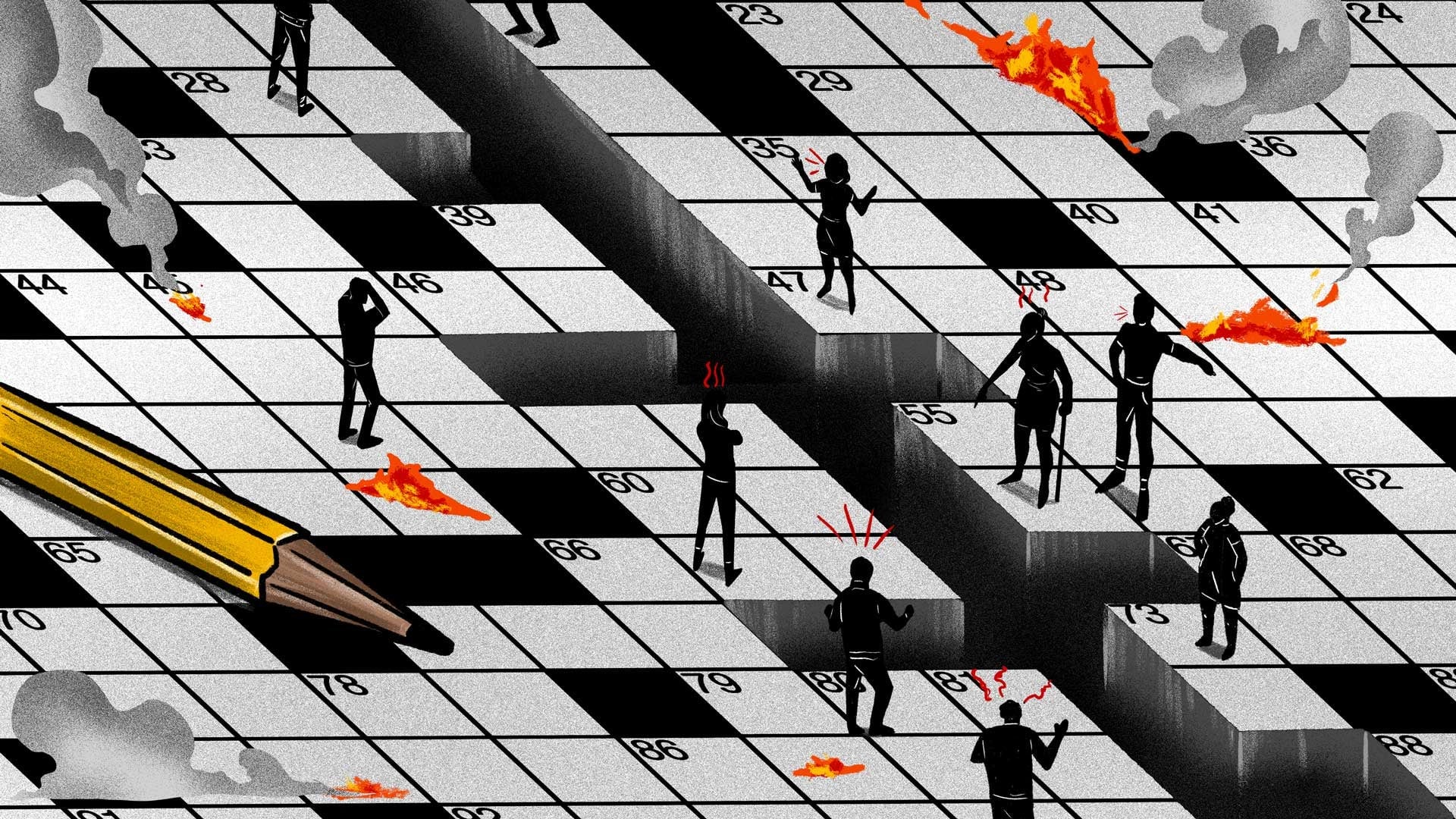
Sex is just one of the many contentious issues surrounding crossword puzzles. At a time when debates about language anchor political discourse and incorrect pronouns spark vicious attacks, the fact that culture wars are being played out in crossword puzzles makes sense.
“During the pandemic, [the crossword community has had] the same type of reckoning that we’ve had in the rest of American society…where we’re looking at representation, we’re looking at inclusion,” said Rebecca Neipris co-host of the Crossnerds podcast. “Hundreds of thousands of people are consuming this thing on a daily basis and paying for it. So you also have this responsibility to at least be aware of what it is that you’re feeding those people.”
Puzzle debates represent a microcosm of larger cultural conflicts surrounding race, class, and gender. Questions arise: should dictators appear in crosswords? Serial killers? What about Donald Trump? Or Hitler? Are terms like “hag” okay?
The types of clues and answers in crosswords have shifted dramatically. On March 21, 1943, the New York Times crossword clue was “author of a bestseller.” The answer: six letters long “HITLER.” Hitler still appears in the Times crosswords, but his last name hasn’t been an answer since 1984 (clued as “history’s blackest.”)
“Whether you want it or not, there’s a kind of inherent politics [to a crossword],” said Michael Sharp, a SUNY-Binghamton English professor who, under the pseudonym Rex Parker, pens a blog critiquing The Times crossword and has constructed puzzles for them “You’re making an assertion about what counts as ‘common knowledge.’”
For decades the people making decisions about what should be in a puzzle have been straight white men according to Tausig, who said crosswords were a “very much elite, hyper educated, white, New York City thing, where if you didn’t know chess and your classics you were screwed.”
When Shortz became editor of The Times crossword in 1993, things began to change. Shortz brought pop culture into crosswords, Tausig said. Yet Shortz doesn’t always get it right. A few years ago, Shortz included the word “beaner” in a puzzle. “It’s baseball slang for a ball that hits the batter’s head. But it’s also, as I did not know at the time, an offensive term for Hispanics,” he said. “There was a lot of anger over that.”
Even Sharp, who is one of Shortz’s biggest critics, said that “Shortz changed the New York Times, radically in terms of how fun it was…turning away from being a test about arcane knowledge and toward a kind of playful, wordplay-oriented kind of puzzle.”
Although crossword constructors and solvers are overwhelmingly left-wing—Shortz surveyed attendees of his American Crossword Puzzle Tournament in March 2017 and found that close to 90 percent voted for Clinton—there is no consensus among editors, podcasters, and solvers on what should be included in a puzzle.
So how do constructors decide what’s in and what’s out? Patrick Berry, a constructor whose puzzles have appeared in The New York Times and The New Yorker, said that he strives to keep his puzzles “apolitical,” which is difficult. “It becomes an endless series of judgment calls. Is this slang term offensive? Is that world leader merely unpleasant, or too toxic to even mention?” Berry said.
While there are some answers that constructors and solvers all agreed were objectionable, such as racial slurs, the community is divided on other types of clues. Berry thinks that mainstream crosswords shouldn’t have “Curse words, certain bodily functions…notorious figures like Harvey Weinstein [because] puzzles are meant to be entertaining, and that stuff generally isn’t.” Yet omitting these terms is a political choice as well. Some people (me) find curse words and bodily functions very entertaining, and who counts as a notorious figure is up for debate. While Berry won’t put references to Nazis in his puzzles, not everyone feels that way.
Shortz will include Nazi if it is clued in a non-offensive way. “I’ve had Nazi in the puzzle a number of times. But usually I clued it Raiders of the Lost Ark villain…or ‘Soup Nazi’ from Seinfeld,” he said. A reference to notorious Nazi doctor Josef Mengele, however, caused him to reject a puzzle. “I just found that so offensive, that I just didn’t want that in the New York Times crossword,” Shortz said.
In response to the “beaner” incident, the Times created a diversity panel that reads over every crossword to find terms that could cause offense. “The standard we use now…is, taken out of context, is the answer, something that is likely to offend people,” Shortz said.
Recently the panel flagged “pig,” because its clue was “gluttonous.” “One of the people…objected to that …because in their mind, it suggested fat shaming,” he said. “And I went to the dictionary…gluttonous is basically one who overeats. It’s not a matter of fat shaming,” he claimed.” It’s just what the word means.” But he took the word out so as not to offend readers.
Yet Sharp believes Shortz and The Times haven’t gone far enough. Last year he posted a link to an open letter to the then Times puzzle executive director asking that “women and/or non-binary puzzle lovers comprise at least half of Will’s test solving team” and more diversity to all of its editorial staff. (The letter noted that The Times has frequently had more than half of its creators be non-male, but urged that there should be a formal policy).
For most of the history of crosswords, “All the constructors were men pretty much men,” said Tausig. He ensures that half of the constructors he publishes are women or non-binary. More diversity means that “Puzzles deal with different material now,” he said, including fewer sexist terms like “hag” and clues about director Ava Duvernay.
This year Tausig published a non-binary themed puzzle by a non-binary creator. He received a few angry emails and lost some subscribers, but most people loved it. Recently The Times has pushed for more diversity as well. On January 10, 2022, the paper announced a crossword constructor diversity fellowship “to provide mentorship and support for constructors from underrepresented groups, including women, people of color and the L.G.B.T.Q. community.” Shortz is serving as one of the members of this fellowship.
More contentious than non-binary creators or Nazism is Donald Trump, who is verboten in many crosswords, and has only appeared twice in The Times (and only once since he was elected president) in comparison to Obama’s 73 showings (to be fair Obama was a 2-term president, but still). “This isn’t about like censorship, it’s about what’s fun. I don’t know if there’s any way to make to put Trump in a puzzle and have it be fun,” said Tausig, who shies away from using any clues that would jolt readers out of the bubble of the game. Yet dictators like Chairman Mao and Idi Amin routinely show up in crosswords with little outcry.
“Why is it okay to have other dictators [than Hitler] who also murdered millions of people?…How directly involved did you have to be in mass murders?” asks Neipris.
“IDI” has been an answer 120 times since Shortz began editing the puzzle, most recently on July 5 of this year. Former Times editor Farrar “ did not allow Idi Amin in a puzzle because he was such a despicable person,” Shortz said. “Nowadays, no one loves to have Idi Amin in a puzzle, but sometimes he makes the interlock work, so it’s all right.” Sharp also notes that few words are three letters beginning and ending with “I,” but he thinks there’s another reason for Amin’s popularity. “It’s a European bias…It’s people who don’t have the experience…of dictators in Africa. They could just look at their names and think of them as just words.”
Hitler is harder to think of as just a word, even though, as Sharp said because “HITLER” is six letters and ends in “ER” the word, he “Probably…would have helped out some constructor but nobody wants to think about Hitler when they’re doing their puzzle.” (“Adolf” has shown up more recently as an answer: unpopular baby name’ March 12, 2017.)
Similarly, “Mao” is a useful word for constructors. “75% of all entries are five letters or fewer. So giving up MAO makes construction harder, whereas giving up DONALD TRUMP has no effect,” said Berry. “Another reason is that Mao’s reign is further back in history, so there’s a layer of remove…feelings about Trump remain immediate and visceral.”
Not everyone has trouble with seeing Trump’s name in a puzzle. Hayley Gold, whose book on the crossword culture wars, Letters to Margaret will be published this year, said, “If someone’s a prominent figure in the world, I personally believe that they’re fair game to be in the puzzle. And it doesn’t mean that you support their views necessarily.”
Can a puzzle truly be apolitical in such a politically-charged country?
Berry thinks so. “Clues are supposed to be based on facts, not opinions. Most clues really will end up being neutral — and I think that’s a good thing overall,” he said. As much as Berry tries to be apolitical, his views sneak in. “A blandly factual clue like [Transgender four-star admiral Rachel] for LEVINE makes a quiet but powerful statement for inclusivity… Since I find it difficult to write a neutral clue for, say, NRA or MAGA, I instead avoid using those entries altogether.”
Other constructors don’t avoid NRA, which has appeared 569 times in The Times, although not always in reference to the gun group. Most recently on December 8, 2021, NRA was clued as “food industry lobby, in brief.” MAGA, however, has never shown up.
Gold cautions that criticism of crosswords can sometimes go too far. “In my experience, Will Shortz has been the nicest guy in the world. I hate all the articles that tried to slander him and make it like, ‘Oh, he’s this old white dude. And he’s trying to keep puzzles, sexist and racist.’…Change is slow and change is happening.”
Correction 2/1/2022 10:52 a.m.: This article has been updated to accurately reflect correct surnames.