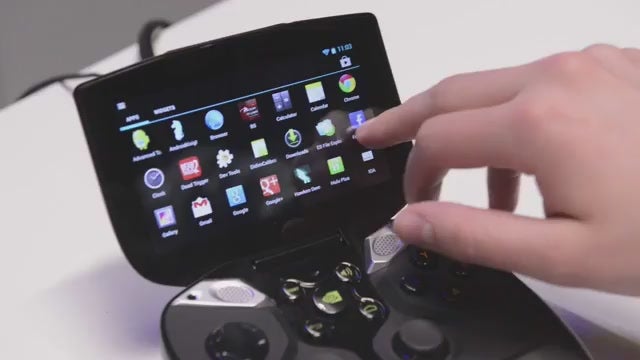
Nvidia’s Project Shield is a curious little device, attempting to toss its hat into a bunch of rings at once. It’s taking shots at handheld gaming, console gaming, tablets, and phones. For the most part, it’s holding under the strain, but it’s hard to imagine going out of your way to use it versus any of those things it’s trying to replace. It’s definitely passable and frequently good at emulating PC and console gaming, but it’s just a little too busy to be a perfect copy.
The controller is a bit light, and while it doesn’t feel extremely cheap, it doesn’t have the sort of heft and weight you would expect from a console controller. Despite being rather chunky, it fits relatively nicely in the hand. For all those edges, there aren’t any that make it uncomfortable. It doesn’t feel nearly as awkward to hold as it looks like it would, which is a pretty big accomplishment considering how it looks.
That said, it has its share of weirdness. The disc-y shape of the controller makes the bumper and trigger placement odd. Literally every time I reached from the trigger to the bumpers, I missed on the first try. Likewise, the way the meat of the controller is concave to accommode the folding screen makes it very easy to get lost on the way from a stick to a button. And the physical buttons for volume, as well as Android’s back and home functionality in the controller’s center make for some crowded real-estate.
It’s largely a matter of personal preference, but I had a difficult time getting used to parallel sticks, as opposed to the off-set ones the Xbox 360 controller has popularized. The downward-sloping nature of the controller’s center also makes for an awkward angle on the sticks, which are already pretty low. It’s almost impossible to tell whether or not you’re clicking them in. All that said, it seems like a gamer could probably get used to the controller after spending a little time with it, though switching back and forth from Shield and traditional controllers could make the transition process a little weirder.
Performance-wise Shield worked great. The Tegra 4-optimized, native Android games ran well and looked great on both the TV and the controller’s built-in (and notably small-ish) screen. The stock Jellybean interface makes navigation as easy as it is on any other Android device, and Nvidia’s own game-choosing apps consist of little more than a simple scroll-able list, making the process just as simple as it should be.
Streaming games from the PC (Nvidia card required, unfortunately/of course) went off largely without a hitch, though it’s worth noting they demoed this feature with a racing game, which wouldn’t demonstrate any lag nearly as clearly as say, a shooter. That said, Nvidia says the lag from PC streaming should be no more intrusive than a that between a console and wireless controller, and there certainly wasn’t anything noticeably glaring.
All in all, Project Shield is a bit weird, but considering the wide spread of things it’s trying to do, that’s not entirely surprising. The weirdness isn’t insurmountable though, or at least might not be depending on the as-yet-to-be-released price-point. Project Shield definitely feels like a product that’s taking on a lot, but it’s not instantly crippled under the load.