Back in April 2020I took a look at a game called Old World, which at the time was both exclusive to the Epic Games Store and also in Early Access. Back then it was a promising if still obviously under-cooked game. Now, two years later, it’s so much more.
The game actually made it out of Early Access in July 2021, but with it only just now coming out on Steam, I figured this was the perfect time to revisit and see what’s up. Here’s how I introduced the game a couple of years ago:
Civ IV designer Soren Johnson took an axe to some long-standing ideas about strategy with Offworld Trading Company, and his Mohawk Games is still swinging with its next game, Old World, which you’ll see for the next few months endlessly (and unavoidably) described as “Civilization meets Crusader Kings.”
It’s a crude comparison, but it’s also the easiest way to get across what Old World is trying to accomplish. In many ways it’s a traditional 4X experience, taking place on a hex-based map as you assume leadership over one of the ancient world’s more prominent civilizations then guiding them through their formative (or defining) years.
You’ll build farms, establish new cities, explore the map, fight barbarians, research technology, and engage in diplomacy (and war) with rival factions. So far, so Civ. Where Old World is trying something new is everything in between those major genre touchstones.
The “Civ x Crusader Kings” comparisons remain unavoidable, because when you first start playing that’s all you can see.It’s a traditional 4X experience, with all the construction and combat and expansion and exploration that entails, but instead of just managing your empire’s roads and cities you also need to keep an eye on its leaders
In Old World you don’t play a faction, you play a person with a name and a family, and just like Crusader Kings you go from there, having kids, making friends, forming relationships and guiding the fates of everyone around you. When you die, you start playing as your heir, and so on and so on until the game ends.
It’s nowhere near as complex as Crusader King’s inter-personal system, which forms the foundations of that entire game, but it’s not supposed to be. The 4X stuff is what we’re here for with Old World, and the character-building present here is just some very well-implemented icing on the cake, as there’s just enough of it to make it feel like you’re running an imperial household (the way it impacts diplomacy is great), but not so much that it ever feels like it’s keeping you from the main action of moving units or building cities.
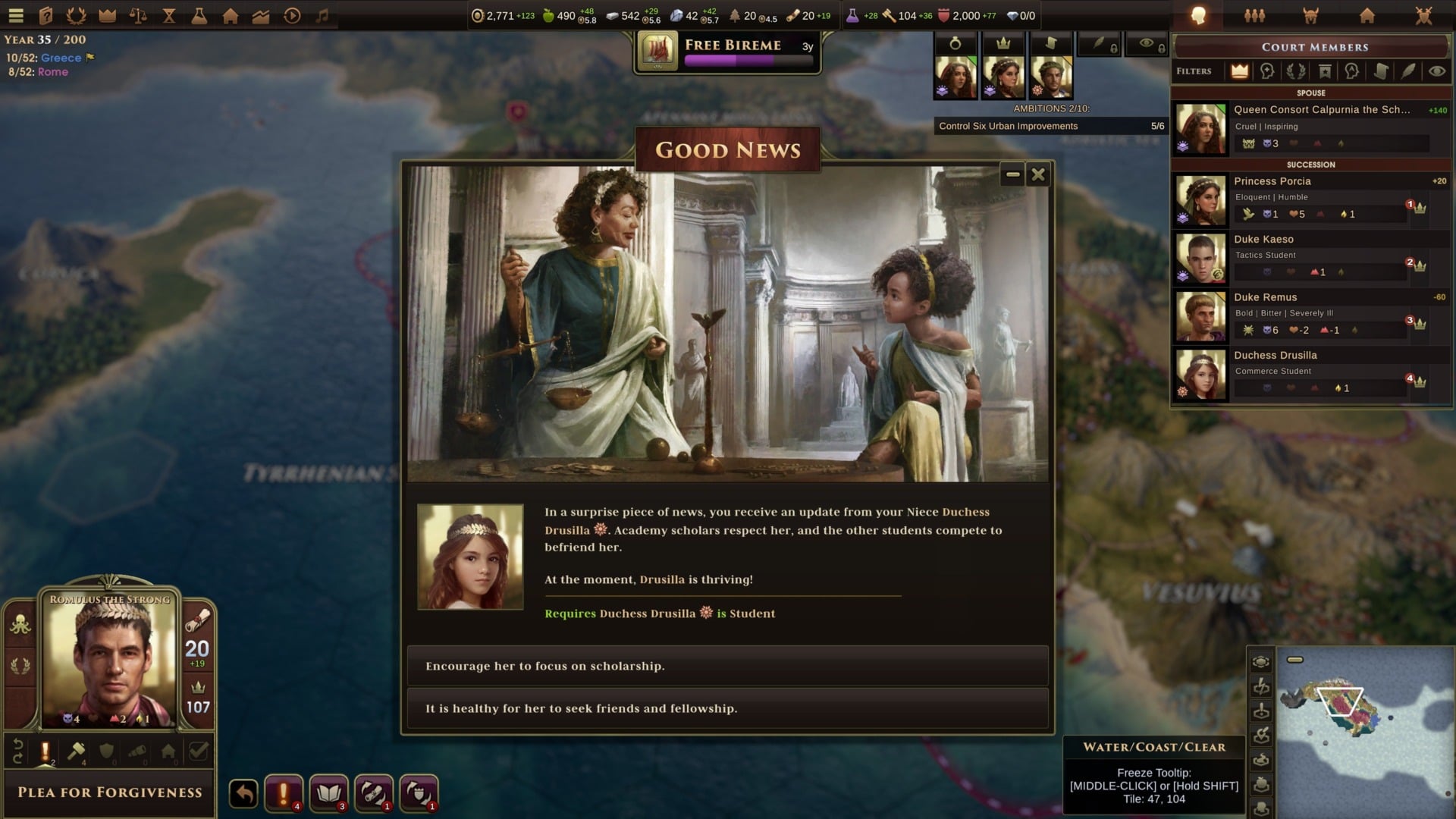
In Civilization games, your relationships with undying faction leaders can feel arbitrary. Crusader Kings, meanwhile, has incredibly complex statistics governing every relationship and conversation in the game, but rarely does it feel like genuine, tangible results come of your interactions with people, because so many of that game’s diplomatic actions are locked behind slower, sometimes immovable systems.
In Old World, diplomacy and imperial management is driven by people, and when you talk to them you get to see direct results. Wars, friendships, alliances, marriage proposals, trade deals, secret missions, there are much more immediate consequences from your conversations in Old World than we’d get from a Paradox game, making it feel so much more like you’re shaping an entire empire not just through buildings, but through relationships.
Stepping away from the character-driven stuff, Old World’s meat-and-potatoes 4X experience is pretty solid. It’ll look familiar, of course, with its settlers, workers, cities, map exploration and building of improvements on tiles surrounding your settlements. If you’ve played Civilization or Endless Legend in the last five years you’ll already know the drill. It’s fine, it ticks all the boxes, though there is one interesting twist in that the way you order your units around treats commands more like a resource.
Here’s me in 2020(it hasn’t really changed):
More exciting than this, though, and this was unexpected, is a major overhaul of how turns work in Old World. This is a turn-based strategy game, and like every other one (it’s in the name!) you just assume that turns work by moving all your units then hitting a big END TURN button. But in Old World, the number of orders you can give per turn is limited. It’s no longer an expectation, but a resource.
It’s a fascinating exercise in turning a gameplay staple into a commodity. As the game begins, and your central authority is limited, you only have a handful of orders you’re able to give to your units. You might find that you’ve got a small army of workers out building roads, some scouts discovering new lands and some warriors besieging barbarian camps, all at the same time.
But you don’t have enough orders to move all of them. So you need to prioritize. And then prioritize further, because many units let you move them more than once per turn, because you’re spending that action from a central pool of orders, not from each individual only being able to do something once. So sure, you could move most units once, that’s fine and a traditional strategy, but you could also move some units a lot if need to, and that’s cool too.
This was easily the most fun I’ve had with the game, as it’s asking questions of me that I can’t remember being asked in a game like this when it came to making decisions about my force’s movements and actions. Particularly cool is the way it’s not just a fresh challenge, but it also makes thematic sense. Of course ancient empires would have trouble communicating with their units at distance or in volume!
There are some other little innovations in the 4X space that I’m digging too. The way cities must be built on designated tiles, but can be claimed before actually being built is interesting, and units like scouts being able to harvest resources directly from tiles helps the early-game hours feel busier and more interactive.
I’m not quite so sold on the combat though, which thanks to the hex-based map and one-unit-per-tile design means battles fall into the same trap they have in the last two Civ games, where depending on the terrain things can quickly get cramped and awkward and become more of a meatgrinder than an exercise in tactics.
I said simply calling this “Civilization x Crusader Kings” was unfair not because it’s technically wrong—five minutes with this game will show you that’s the case—but because it sells the final product short. Old World is so much more than just bolting one game’s popular system into another genre and hoping for the best.
Old World actually feels pretty closer to those older, near-perfect Civ spin-offs like Colonization and Alpha Centauri. Games that took the basic 4X formula and repackaged it into a shorter, more focused setting which swapped out the passing of ages for some more interesting mechanics. In Colonization that meant turning tobacco into cigars and sending them back to Europe. In Old World it’s managing an ancient empire through not just roads and farms, but family ties as well.
A lot of what I’ve written about here in 2022 was also there in the Early Access build I played in 2020, hence me simply repeating myself a couple of times, but in the two years since I played it last Old World has refined and polished pretty much everything it could. It looks better, its splash art is gorgeous, the quests have better writing, there are more military units and the interface is slicker.
We’ve seen a number of big 4X releases in recent years. Civilization VI, Endless Legend and Humankind, just to name a few of the most prominent. Old World is better than any of them. It’s focused, it’s confident, it’s smart and builds on the 4X genre in ways that are some of the most interesting I’ve seen in years.