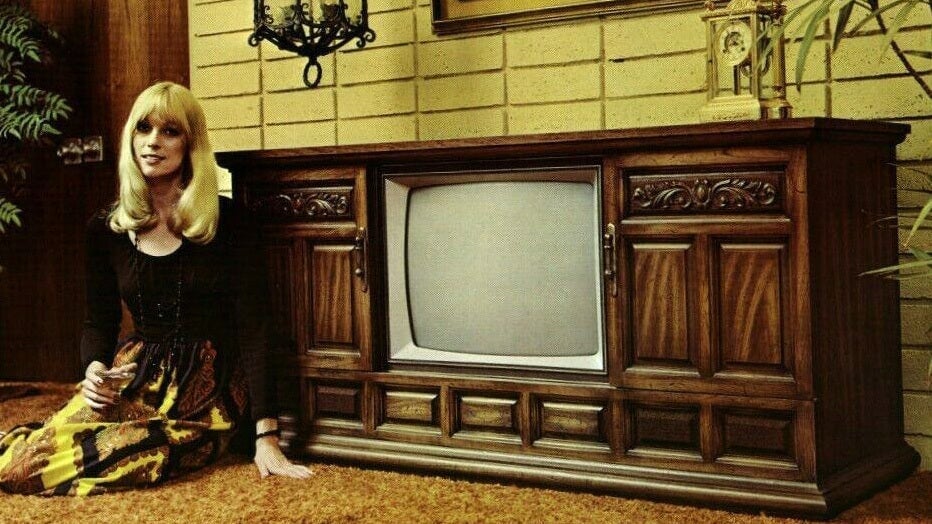
At first glance, this might look like any old 1970s television, its modest-sized screen encased in a massive wooden console. But look deeper and you’ll see that it’s actually one of the rarest and most special televisions in existence.
The brand is Teledyne Packard Bell, which, as Twitter’s resident hardware necromancer Foone points out, isn’t that special. What is, they explain, is the Cartrivision player it holds.
In an era before video stores and the inevitable Netflix, if you wanted to watch a feature film at home that wasn’t broadcast on network television, you typically had to roll out an old-fashioned movie projector. But if you lived in the early 1970s and happened to love bleeding-edge gadgets, you could get a TV console with a Cartrivision player built in.
https://twitter.com/embed/status/1423369057181454339
As Foone explains, Cartrivision was a short-lived analog format for which videos came on massive cartridges. It wasn’t the first proprietary home video technology—those date back to the 1960s—but it was the first to let people rent Hollywood feature films for home viewing. Since there were no video stores, renting was done through a catalogue, and the cartridges were sent via snail mail.
But there was a catch: Most Cartrivision videos could only be watched once. This meant viewers could not skip ahead nor rewind the video. The good news is that there were no rewind fees (they hadn’t been invented yet!), but the bad news is that poorly timed phone calls or bathroom breaks could impact the viewing experience.
Once the viewed cassettes were returned (again, by mail), they were rewound with a special proprietary machine.
Sears sold the Cartrivision + TV units for around $1,600, which as YouTuber Oddity Archive points out, would be around $9,000 in modern money. Although Cartrivision offered an array of major studio films and even released the first adult movie on home video (A History of the Blue Movie), sales were not great. By July 1973, the format went out of production, with leftover stock rotting in warehouses.
While the planned standalone players were never released, some Cartrivision players have survived after being extracted from their original TV consoles, and there exists a small community of enthusiast collectors and refurbishers.
According to electronics site CED Magic, “most of the surviving Cartrivision units today are homemade boxes with the electronics mounted inside. It’s more common to see Cartrivision as two loose pieces of exposed electronics, one piece being the tape transport unit and the other being the fishtank signal processing unit.”
That’s why, as Foone notes, an entire TV console with the Cartrivision still in it is an incredibly rare beast today.
Which brings us to the one that’s currently up for auctionon eBay. A typical example of the wood-enclosed entertainment systems of the era, this original Teledyne Packard Bell Cartridge Television System is massive, weighing approximately 300 pounds. Foone suggests it may be the only surviving specimen in the world.
“This was left behind in a property I purchased,” wrote eBay seller lveldre. “Selling for parts only. I do not know if it works. I removed the back panel to give a view of the internal electronics. It looks like it is all original and still intact.”
Even if it works, don’t get your hopes up for the Cartrivision to actually play the old tapes. The format is highly sensitive to humidity, and as Foone points out, there was actually an Emmy-winning documentary about just how difficult it was to extract the video from a vintage Cartrivision tape.
If you want to learn more about this crazy-archaic dead video format, here’s the trailer for Lost and Found, the documentary about resurrecting a Cartrivision tape of the 1973 NBA Championship.