Toward the end of my time with pirate RPG Pillars of Eternity II, one of my crew members, foul-mouthed furball Serafen, presented me with a gift.
It was a garment meant to be worn by a captain, he said, but after witnessing me pass so many difficult moral tests with flying colors, he’d decided captaining wasn’t for him. He was just happy to be part of my crew. “Aw,” I thought to myself, “When I finish this game, I’m really gonna miss my crew.” Then I paused, and my brow furrowed. Actually, would I? Would I really?
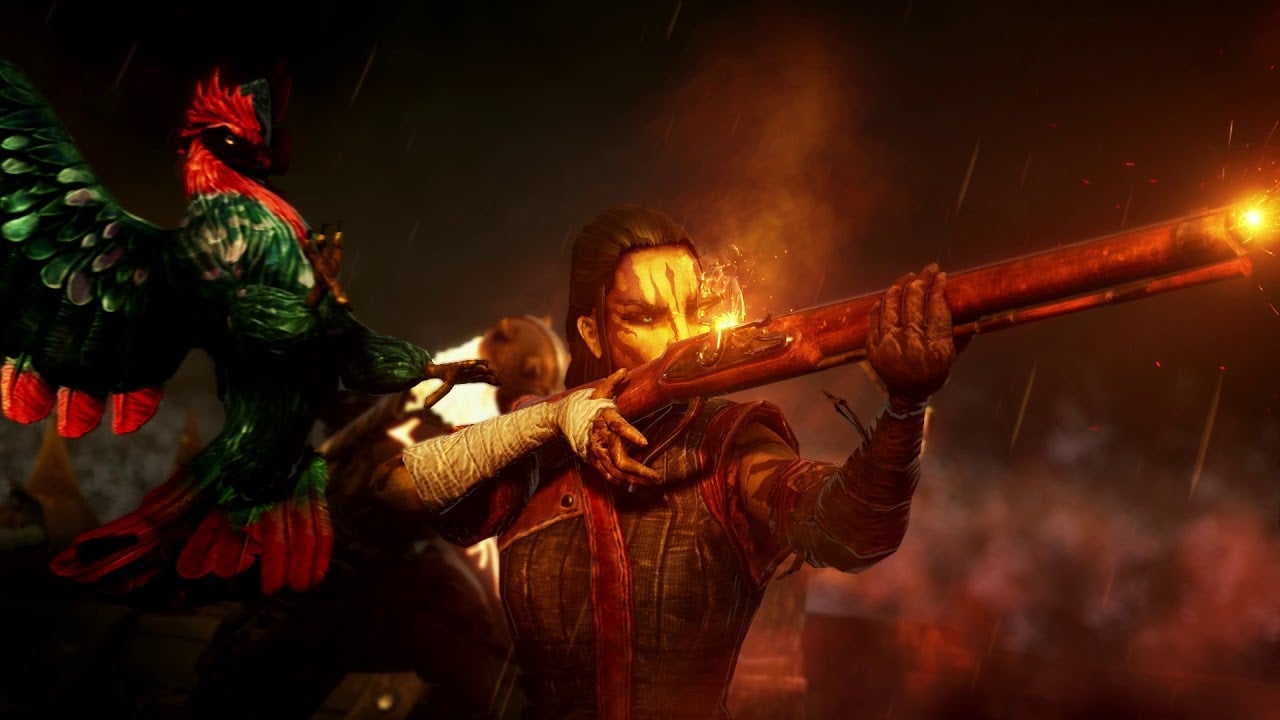
Pillars of Eternity II is the sequel to Obsidian’s Pillars of Eternity, which was itself a spiritual successor to classic PC RPGs like Baldur’s Gate. In it, you once again take on the role of the Watcher of Caed Nua, the main character from the first game. At the start of the sequel, Eothas, a god previously thought dead, rises up from beneath your fort, smashes it to slivers, and steals a piece of your soul. Your character isn’t thrilled about this turn of events, nor are a bunch of other gods. They task you with hunting down Eothas, whether you want to or not. You then find yourself divinely plopped into the Deadfire Archipelago, aka the part of the world where everybody’s pirates.
Pillars Of Eternity II: Deadfire
-
Back Of The Box Quote
"All aboard Baldur's Frigate."
-
Type Of Game
Pirate RPG
-
Liked
A fascinating, history-rich setting, high-seas spins on classic RPG tropes, an intricate faction system, some fun characters.
-
Disliked
Many interesting characters and stories don't get much room to breathe, short main quest, ship-to-ship combat is lacking, the game spreads itself too thin.
-
Developer
Obsidian
-
Platform
PC
-
Release Date
May 8
-
Played
Completed the full main quest and most side quests in 80 hours.
Pillars II has a lot going for it: a vast tropical setting, a story bold enough try unpacking issues like colonialism and oppression, party members who come across as refreshingly grounded and human, a treasure trove of quests for wannabe pirates to plunder, and a bevy of squabbling factions that you can partner up with or piss right off. Oh, and pirate ship fights. It checks nearly all the boxes on my unusually specific wishlist of Things I Want From A Classic RPG Revival That Also Happens To Be About Pirates.
But. You know that mournful feeling you get when you’re about to finish an 80+ hour game and realize that it’s time to say your farewells? With Pillars II, it barely even registered. This massive game, for all its labyrinthine lore and realistic sea shanties, failed to make me feel attached to it.
It took me tens of hours to really recognize this fact, because at first, I was happy to just sail around, do quests, and inhabit the game’s lively, well-realized world. Pillars II’s biggest hub city, Neketaka, is a model RPG hub city, with multiple, varied districts like the palace-dominated Serpent’s Crown and the destitute Gullet nearby. In between them, there’s a locale dedicated to both science and religion, as well as my personal favorite, Periki’s Overlook, which is home to a popular bathhouse that serves as a secret entrance to the manor of a world-renowned asshole archmage named Arkemyr. (One quest lets you make a mess of his posh palace, if you so choose—but there are consequences.) Each area is full of mini-stories that often feed into larger arcs involving the native Huana people, foreign interlopers trying to reshape Deadfire in their image, and the push and pull between those forces. Neketaka is a generously stuffed sandwich of intrigue, and it’s just one island in a sea that’s chock full of them.
I can name so many characters and storylines that dazzled me during the game’s earlier hours: the aging crime boss caught between the plight of his people and his own ambitions; the jerk-off high-ranking pirate I blew up by throwing a rager of a party and wiring his harpsichord to explode; the party member I got to romance while his mom—who, by the way, was a god—said he deserved better; the legendary dragon who was supposed to be a boss fight, but who I convinced to book it when apocalyptic god Eothas showed up; the black market merchant with a spider’s face who respected that I let him read my mind and uncover a plot to murder him (a plot in which I happened to be complicit)… the list goes on.
However, as I passed the 50-hour mark and started to deliberately make real headway in the main quest, I realized that many of Pillars II’s high points were fairly short-lived. Some, like the exploding pirate harpsichord and spider-faced merchant quests, revealed layers: alternate routes on top of alternate routes and surprising, enigmatic characters. But other side stories, including many of the companion quests, ground to a halt just when things were getting good.
For example, there’s the story of Eder, a farmer-turned-fighter who was also a companion in the first Pillars of Eternity. In Pillars II, his personal quest involves searching for a woman he was involved with back in the day. Initially, he wants to make sure she’s OK, given that there’s a mountain-sized titan who slurps up souls as naturally as we breathe on the loose. Then he finds out that she had a son, and apparently begins to wonder if the child is his. He proceeds to go through an arc of being worried, then kind of excited about the prospect of being a father. It’s a decidedly un-epic way for an epic fantasy game to approach the idea of fatherhood, and it really took me by surprise. Then it turned out that the kid didn’t belong to Eder, and—to complicate matters further—that his mom had died. Worse, the kid decided to join a death cult whose members planned to sacrifice themselves to Eothas. I ended up having to chase down the boat Eder’s not-son was on, confront him before the cult leader convinced him to kill himself, and hear him tearfully explain that he was doing this because he felt that, by dying, his mom had abandoned him.
Riveting stuff! But also, that was it. Afterward, the kid ran off, and I never really heard anything about him again until the game’s epilogue. The quest felt like it warranted some kind of part two focused on its aftermath, but it never arrived. And Eder’s quest is actually the best of the companion quests. Others stop at even more puzzling places, and one abrupt ending actually ruined a character for me.
I appreciate how much stuff there is in Pillars of Eternity II, but the game frequently spreads itself too thin. There’s plenty that grabbed my attention, but just as I was getting invested, the quest would wrap up, or the characters would run out of things to say. As I progressed into the end game, I found myself put off by the game’s shifting priorities, as well. The focus moved away from interesting individuals and onto political squabbles between four primary factions. I love a good faction system as much as the next guy—and the one in Pillars II is great—but the way these particular factions influenced this particular story didn’t do a ton for me.
Throughout Pillars II, four main factions are vying for superiority. There’s the Vailian Trading Company, the The Royal Deadfire Company, the Principi, and the Huana. To be fair, the system underlying these factions is really cool. Not only does the game track your standing with each of them, it also tracks your party members’ feelings about those factions and each other. As a result, there’s plenty of infighting, whether it’s an enraged outburst from one of your party members or a quick dialogue prompt that says one of your allies is glowering at you or sighing in barely contained contempt.
But it’s a lot of infighting, and much of it focuses on factions that, frankly, aren’t all that compelling. You’ve got asshole trading company number one, asshole trading company number two, sorta-noble (but not really) pirates, and the native Huana people, who are stuck in the middle. There are plenty of interesting dynamics buried in those factions’ lore. For example, the pirates are descended from the nobles of a fallen civilization, and while the Huana tribes used to despise them, they’re now on semi-decent terms because the trading companies, in their rapacious quest for wealth, have proved a greater threat to the Huana. However, some among the Huana actually appreciate the trading companies, who’ve provided resources badly needed by their lowest caste, which is starving.
Problem is, I uncovered a lot of these fascinating tidbits either through brief NPC dialogues or lore bibles. Faction quests—which can alter how the endgame and ending play out in an impressively large number of ways both significant and granular—mostly focus on faction leaders squabbling and trying to get what they want, often through less-than-savory means. These characters have some layers of complexity, but it’s hard to really rally behind any of them because they mainly serve as extensions of their factions’ priorities. Even at the end, when the magnitude of the threat presented by Eothas is clear, everybody’s out for themselves in hopes of laying claim to a mythical land. Depending on who you side with, some of your party members might up and leave all together. There is an option to side with nobody, though it involves spending a lot of money and results in an ending that’s pretty crummy.
In that respect, Pillars of Eternity II is an extremely 2018 video game. It’s a potent parable about the dangers of the colonial mindset. Self-interested groups continue to prioritize greed and power even as more pressing existential threat looms, none of the factions are ideal, and you start to question the judgement of individuals who unquestioningly line up behind them. But also, in equally 2018 fashion, the game is happy to lean into the notion that, actually, everybody is wrong—sometimes to a fault. I can’t say that I cared all that much about any particular faction by the end, even though my interactions with them stood to have a tremendous impact on the game’s ending.
The main story isn’t actually that long, either. Once I stopped doing sidequests and focused on it, I felt almost hurtled toward the conclusion. I found myself wishing the main story had been expanded in a way that gave the characters more depth—and that showed me that depth instead of just telling me about it. Pillars of Eternity II was at its best when I ignored the rampaging god and spent time getting to know the locals, and it’s too bad that the emotional stakes of those two things felt so detached from one another by the end.
Sailing the high seas is a novel way to traverse a PC RPG world, but for the most part your ship functions as a glorified cursor to be dragged across the map. Some islands have cities, towns, events, and bounties sprinkled across them, but many are barren. The game tries to keep things interesting with choose-your-own-adventure-style text scenarios that might occur if, say, your crew gets sick or you slam face-first into a storm. These moments are great for role-playing, but you’ll only see a handful of them if you keep your ship’s supplies topped off, which is easy to do because supplies are plentiful at every port.
Ship combat, meanwhile, just never clicked for me. Naval battles also takes place within a choose-your-own-adventure-style interface, but with a visual representation of where your ship is relative to the enemy ship at the bottom. You can whip around to one side or another, fire port and starboard cannons, close distance, and all that other good Master and Commander stuff, but it’s an overly abstract interface. Initially, it’s un-intuitive, but even once I got the hang of it, I found that ship-to-ship battles would drag on too long, and it wound up being more efficient to just slam into enemy ships, board them, and win the day with good old-fashioned RPG combat.
That combat is functional, but it’s hard not to look at the ambitious, creative combat systems in other contemporary PC RPGs like Divinity: Original Sin 2 and wonder what Pillars II could be if it wasn’t so indebted to the influence of Baldur’s Gate. While Pillars II uses its own under-the-hood system for calculations, the basic framework is familiar: combat occurs in real-time, but you can pause whenever you want to issue orders. In smaller-scale encounters, it’s all simple enough, but when you’re micromanaging your five party members in a fight against double that number of enemies, things get messy. I’m actually a big fan of Pillars II’s class system, which allows you to multi-class characters into crazy OP hybrids if you know what you’re doing. But I never felt fully comfortable when it was time for my characters to draw their sabers and make with the slashy-slashy. It wasn’t that it was too challenging—I rarely struggled with fights and if anything, the game’s normal difficulty is a little too easy. My gripe is more that combat is too chaotic to be fully satisfying. When battles ended, I was like, “Oh, I guess we won, then.”
Pillars of Eternity II could’ve been brilliant were it more focused. It has a lot of good ingredients—scraps of interesting narrative, clever characterizations, a complex faction system, and pirate-themed spins on the RPG tropes of yore. The game’s got so much unfulfilled promise that, even though I think it’s a plenty enjoyable game on the whole, I can’t help but feel disappointed by it. I had a fine enough time at sea, but frankly, I’m happy to be finished and back on solid ground.