
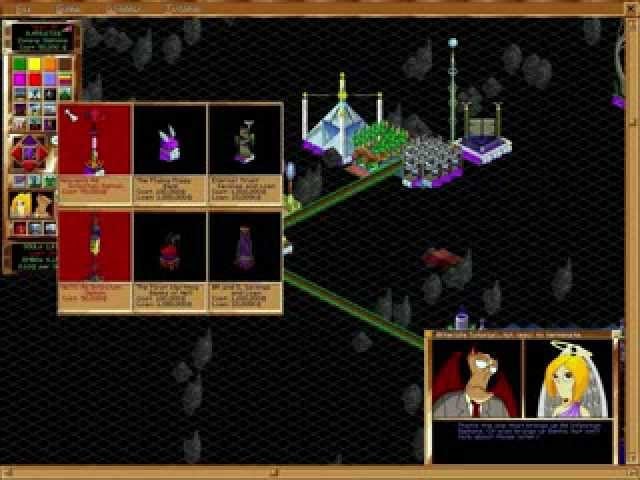
We’re running a religion theme week here on Kotaku. And it would wrong – no, it would be a sin – if we went those seven days without once mentioning Afterlife, a 1996 strategy game by Lucasarts.
Never heard of it? That’s OK. You could have gone through 1996 without hearing about it, let alone making it to 2010. Perhaps because it dealt with a touchy subject matter, perhaps because it wasn’t really that good, Afterlife appeared, got some decent reviews, then disappeared, rarely to be seen again.
Which I think is a shame. Not because it was any good – like I said, it wasn’t that great – but because of what it tried, and very nearly succeeded, in doing. Namely, make religion fun
Afterlife is built on a solid enough foundation. The game controls much the same way SimCity does, and tasks you with planning the construction of the afterlife. So you build support buildings, houses, landmarks, that kind of thing. Only, you’re doing it on two maps at once, not one. And those two maps are, yes, heaven and hell.
The trick in Afterlife is to balance the two. Don’t let one overrun the other, and vice versa. It can get tricky, especially as the world you’re drawing all these dead souls from advances its technology, but in the end, the savvy civic planner can quite easily ensure that the hereafter remains in balance.
Which is how you “win”. Like SimCity, there’s no way to “win” Afterlife. You can only lose. So winning becomes, in effect, the art of not losing, of maintaining the status quo. There’s no scope to forge your own path, or to stage a war between the heavens; indeed, such a thing is one of the losing conditions, complete with one of the most politically and religiously astute cutscenes in video game history.
The whole game is punctuated with pieces of humour like that, which despite the interface’s shortcomings, made the whole thing quite a lot of fun, the overall experience winning out over the frustrating gameplay. But when I said it failed in making religion fun, I meant it; while Afterlife can be fun, it’s not that religious. At least, it’s not based on any real religions.
The souls you’re harvesting aren’t from people. They’re from “Ethically Mature Biological Organisms”. You don’t collect their souls, you collect their SOULS, an acronym for “Stuff Of Unending Life”. And those “EMBOs” weren’t Catholics, or Anglicans, or Baptists, or Mormons; instead they’re given names like NAAAists, OPRAists and RALFists.
No doubt this decision was made to avoid controversy, and also perhaps to avoid seeing the game pigeon-holed as “religious”, a video gaming Stryper, or suffer the same fate as befell recent “religious” game Left Behind
But I wish it had stuck its neck out and made it, literally, heaven and hell that you were controlling. It may as well have. The game’s name, premise and fantastic advisor characters do their best to portray a Christian afterlife, so you know when you get the game, and know when you’re playing, that despite the absence of the actual name (you play as a “Demiurge”), you’re playing God. Literally. Heck, even the game’s seven sins are, you guessed it, based on the church’s Seven Deadly Sins, literally being sloth, envy, avarice, gluttony, pride, wrath and lust.
Sure, it may have made the papers, gotten Lucasarts some bad press. Sure, it may even have been banned in some more conservative areas of the Western world. But at least then it would have been remembered, not just as something brave enough to tackle religion head-on, but for doing so and having some fun with it.
After all, I’m sure even the staunchest of biblical literalists can see the funny side in the four surfers of the apocalypse.