I got a message from a Smash Bros. player recently that made a bold promise: he’d figured out how to reduce every character’s lag time in the game. That’s a tall order, so I was skeptical. But then other players started to think he might be on to something. And that’s when things got really interesting.
“Lag” in Super Smash Bros. refers to the de facto cooldown periods that characters suffer from after performing certain moves. Since Smash is a fighting game, it’s a crucial component that players consider when choosing who to bring into battle. A character with powerful attacks could still be useless if he or she takes too long between pulling off their best moves, for instance, since a high lagtime will leave them open to too many of the opponent’s attacks. It’s no coincidence, then, that characters with little or no lag, like Sheik and Diddy Kong are firmly entrenched as top-tier fighters in the competitive Smash scene.
That’s what Swedish player Enis Al-Maatooq, who goes by the handle “Izaw” in Smash circles online, said he could change. If you could minimize lag, he explained to me, or even removing it entirely, then you could unlock the true potential of characters lower down on the food chain.
He told me that he could show the merit of his new technique with Falco. But he’d also begun to experiment with Bowser Jr., and had similar results. All he needed to verify the legitimacy of his new technique for every Smash character was more time. Or manpower, if his fellow Smash players were up for the task.
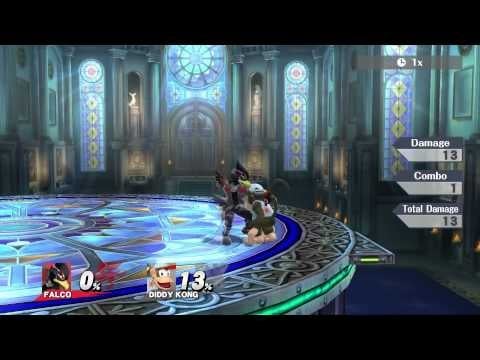
Izaw did manage to prove that he’d discovered something genuinely new on Monday, when he released a video showing the thing in action with Falco, and explaining how it’s done:
The demonstration gets very technical, to the point that others had a hard time believing it was even worth entertaining as an advanced technique for the game. But others felt he was onto something. Even if they didn’t quite understand it yet, the video showed Falco chaining together more complex combos at a faster rate than before. Going from something like this…
…to something like this:
It only truly started to gain traction after he posted it on the popular Smash forum Smashboards, and other similarly-minded players began to agree that, yes, this was a new and promising technique. But they were still left wondering: how the heck does it work? And what’s causing it?
“Linkshot,” an Ontarian Smash pro who participated in the Smashboards thread explained to me that after many rounds of discussion…
…delightfully sophisticated analysis:
…experimentation (i.e., playing):
…and the occasional naysayer who doubted the whole pursuit:
…the group finally settled on an answer earlier this week. And better yet, in the process of reverse-engineering it, they also figured out that the technique works with every character’s aerial attacks, not just Falco and Bowser Jr.’s:
Being able to apply a new advanced Smash-ing technique universally is an exciting prospect in and of itself. But for it to be truly “universal,” it also has to be at least somewhat accessible to a fair number of players. And that’s where the new frame-canceling measure gets into dicey territory.
Essentially, what the technique does is force two separate types of lag that a character experiences—Landing Lag, the lag after getting back on the ground, and hitlag, which is the cooldown after performing a powerful attack—to occur at the same time. By overlapping the two, it therefore minimizes the overall amount of lag time that the characters ends up suffering from. In his words (emphasis added):
To initially perform this, you have to ensure that when the game calculates what to do on the next frame, it ends up resulting in both “land on the ground” AND “hit the opponent”. When you land on the ground during an aerial attack, you end up in a state called Landing Lag, which is the time that has to elapse before you can act again. The amount of time is different for every aerial in the game. When you hit somebody, all parties involved enter a state called “hitlag”, where only the ones getting attacks can move (and really, they can only barely nudge themselves around). The amount of time hitlag lasts depends on the damage of the attack and an extra internal modifier specific to the part of the attack that landed. When this trick is performed correctly, hitlag and landing lag count down at the same time, so the formula ends up being Landing Lag – Hitlag = New Landing Lag. This makes it better for moves that induce a lot of hitlag so that you knock more of the landing lag off, though a move can only benefit up to how much landing lag they would have suffered
If you’re still confused by that explanation, don’t worry. It took me several more emails with Linkshot before I was able to describe the thing in my own words.
The reason that it’s confusing, in my view, is that while Izaw’s video emphasizes the combos he’s now able to pull off with Falco, and the speed with which he executes them, neither of those things are actually the technique in question here. They’re just the positive effects of using the technique the right way. And while those effects are indeed positive, and promise to become even moreso as the diehard Smash tech nerds like the ones over at Smashboards continue to unlock its full potential, the technique is, unfortunately, extremely difficult for many players to pull off.
What makes the move so tricky to pull off is that fact that you can only activate it by hitting your opponent at precisely the right time. Precise as in: the right 1/60th of a second. It also only gets triggered with an aerial attack, so you have to be in the right location at just the right time too.
If it’s so difficult to perform in the first place, what’s the real value of the thing? Well, several other Smash pros I spoke to about this dismiss the idea that it will have any noticeable impact on the game, meanwhile. And even Linkshot admitted that it might not be noticeable to the untrained eye.
Proponents, meanwhile, certainly don’t feel like they’ve mastered the new technique yet, so the best-case possibility that’s most often raised is to say that it will lead to ever more powerful and complex combinations of attacks. See here, for instance:
Since the thing can be applied to any character, meanwhile, its discovery and continued use suggests that any number of new character-specific opportunities could emerge as well.
Regardless of its ultimate value, I find the technique (whatever it ends up being called) interesting simply because of what it tells me about the discovery process that’s constantly at play among high-level Smash players. Techniques only become standardized in fighting games with a serious investment of time and player ingenuity, after all. And the Smashboards users who’ve been tinkering with it only reached a consensus earlier this week. They haven’t even agreed on what to call the thing yet—possible candidates currently include “Lag Overlapping,” “Synchronized Aerial Lag,” “Frame-Syncing,” or, I suppose, “Frame-Canceling,” since that’s the name of the forum thread where it all got started.
One person in the debate couldn’t help but chuckle at the absurdity of arguing about what to name the technique when people still hadn’t gotten many clear answers about its possible uses other than to say that it does indeed work:
Totally valid point, Zef. But at the same time, the debate about the still-pretty-much-unproven-but-nonetheless-discovered technique helps explain why it is people care about something that also makes their heads spin. As Smash player Max Krchmar told me, what’s actually exciting about this find for the game’s wider community is that “the game is showing to have more tech than we initially thought, and it’s promising for the future.”
That’s certainly the impression Izaw gave me when I first started talking to him about his new find.
“Back in the days when Melee came out, it wasn’t about winning,” he told me at one point this week. “It was much more about exploring, developing the character.”
He told me that he originally reached out because he read my article on Diddy Kong’s rise to stardom in the Smash pro scene, which had disappointed him.
“The reason Diddy and Sheik are so good and actually win so much is because the top players started picking these characters up and started exploring and developing,” he said. “Then players see what wins, and play it themselves…so of course Sheik as Diddy will be the most developed characters and have figured out strategies: because of the amount of time the character is played.”
This early in the game’s history, he insisted, people should care more about the coolest things they can find—not the easiest ways they can win a tournament. That’s why he was trying to make a case for Falco to begin with.
“Falco is very under played,” he concluded. “I played him because I enjoy the character; I don’t care about winning with Diddy. And it just so happened with the right amount of time and effort, I found a technique that no one believe would ever exist.”
“This is what interests and impresses Smashers, rather than: ‘I won the biggest tournament with Diddy, no one actually cares about that. We all know what Diddy can do.”
It will be interesting to see what, if any, impact his find and the ensuing discoveries will have on upcoming tournaments, like Apex, which kicks off later this month. I certainly support the idea of exploring Super Smash Bros. in greater detail to uncover all of its hidden secrets—much in the same way other Nintendo fans do with games like Super Mario or The Legend of Zelda.
But at the same time…if the lag-changing-something-or-other technique really does work on everybody, what’s to stop Sheik and Diddy just using it to further their own advantage?
Let’s keep an eye out for more cool stuff like Izaw’s find, Smash fans. There’s no telling when the next challenger will be approaching.
Special thanks to Linkshot for helping me understand the mechanics at play in this story.
To contact the author of this post, write to [email protected] or find him on Twitter at @YannickLeJacq