I keep telling people that the Captain America video game is going to be good, and I keep getting funny looks.
The Captain America game is a movie tie-in. Those generally stink.
It’s about Captain America, who has never had a good video game. (UPDATE: Ok unhappy commenters, how about “not since 1991”?)
And it’s published by Sega, the Sonic The Hedgehog company that has willingly sold consecutive, hated Iron Man games, such is the care that goes into their Marvel Comics movie tie-ins.
Nevertheless, I’ve been proselytizing that the Cap game will be, at least, good. I’m telling people, and now I’m telling you readers that Captain America may not be about to get his own Batman: Arkham Asylum, but he is getting a game worth paying attention to, one that, as it approaches the end of its development is exceeding what I thought it could be.
I first saw the game last October at New York Comic-Con. At that event, the game’s lead designer, Brendan Gill, stood by a kiosk and played through a small bit of action for anyone who passed by. His game looked like a riff on that famously great Arkham adventure. Captain America, like Batman, was going to be beating up bad guys in a relatively confined locale, a World War II-era castle in Cap’s case instead of the Dark Knight’s enemy-filled asylum. There would be an emphasis on sizing up the bad guys in the next room before crushing the whole crowd of them fluidly with hand-to-hand combat and a projectile weapon of choice (a shield, rather than a Batarang).
https://lastchance.cc/captain-americas-next-game-borrows-from-arkham-asylum-5664006%3C/a%3E%3C/p%3E
The game made a decent first impression at the New York con, but I felt like it was a nice showing of Next Level’s talent — proof of whatever Nintendo saw in them — if not proof of a game I had to play.
That was October 2010. I saw the game again last week and now it’s on my must-play list. This time, GIll was allowed to sit. He had a spot in a penthouse suite in New York City, in the same room where Sega was showing their new Sonic and Thor games.
Gill started showing me the game’s progress and started talking like one of those game designers I’m a sucker for. He was saying smart, interesting things. He talked about the kind of hero Captain America is, that he’s a guy who doesn’t use a lot of gadgets or gain powers. Rather, he’s a guy who fights really well, who can learn his enemies and break them down better. That thinking helped produce an unusual combat system that isn’t so much about adding trees of moves to the game’s hero as it is adding ways that he would interact with an enemies, adding context-sensitive counter-attacks, special moves that become available when enemies stagger or stand at different distances and other maneuvers that apply only in certain situations.
https://www.youtube.com/watch?v=KDhrmm3koaE
Gill told me he wanted a “redundant system” that offered “tons of ways to attack and defeat enemies.” He showed me Captain America punching and brawling, as expected. But he also showed me the hero using various dodges against one of the game’s many soldiers, the members of the Nazi-like Hydra force that has overtaken the game’s castle. Captain America could duck out of the way, or he could flip over the enemy to get behind him… or, if the enemy was already wounded, attack that enemy while in mid-flip.
He showed me an encounter that has Captain America surrounded by gun-toting enemies and demonstrated how the hero could “weaponize” one of them by grabbing them and turning the guy’s gun on his allies. Different enemies could be weaponized in a variety of ways, being turned not just into make-shift turrets but into bombs.
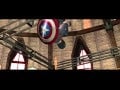
Then there’s the shield. This video game version of Captain America can throw his shield to hurt enemies, but can also use it to block bullets. That block, if timed well, can deflect bullets, a demonstration of the context-sensitive variety in the combat that rewards players for well-timed, fluid moves. The thrown shield can ricochet off enemies, bouncing across as many as five of them, if fully upgraded.
Gill didn’t want to be specific, but he said that players would encounter enemies that would begin to counter Captain America’s go-to abilities. They’d present mini-puzzles, in a sense, challenging players to learn how to find their weakness and defeat them. (The game will give Captain America lots of opportunities to have varied encounters in Hydra’s castle as he faces the likes of Arnim Zola, Baron Strucker, Madame Hydra, and Iron Cross, while crossing paths with Bucky and the Invaders. But you only play as Captain America.)
In an idea inspired from the photography system in BioShock, Captain America will be able able to collect intel on his enemies that makes him a more capable fighter against them.
That overall package would be supplemented with special “crippling attacks” that require tapping into Captain America’s focus meter, a meter filled as the hero fights and jumps around the castle smoothly. Gill wants the whole thing to convey the sense that Captain America is a smart, skilled and acrobatic fighter. The player should feel capable and, as they learn to time their moves better and recognize which moves are available in which situations, they should feel highly skilled.
As I played a bit of the game, I saw the divergence from Arkham. Batman and Captain America are similar, both master fighters and tacticians who seem more vulnerable than a Hulk or Superman. But Cap’s game does feel more appropriately rugged, befitting the distinction between super-soldier and master detective. Captain America’s game doesn’t have the gadgets of a Batman utility belt, just the occasional bit of cracking an enemy code or eavesdropping on the chatter of his enemies. Instead, it emphasizes the adventures of a man who is an Olympian of improvised close-quarters combat, a soldier who is less restrained in a fight.
I very much like where Gill and his team are going with the game, offering a combat system that has depth without having convoluted button-combo complexity. They’re creating a super-hero game in which their star seems genuinely impressive and superior to his foes, while retaining the vulnerability that makes the character interesting. I can’t expect this game to be a classic. Graphically, it’s not quite there and, well, I don’t know how interesting this World War II fiction can be, but the game is coming together far better than I’d expected. Keep your eyes out for more as the game’s July release approaches.