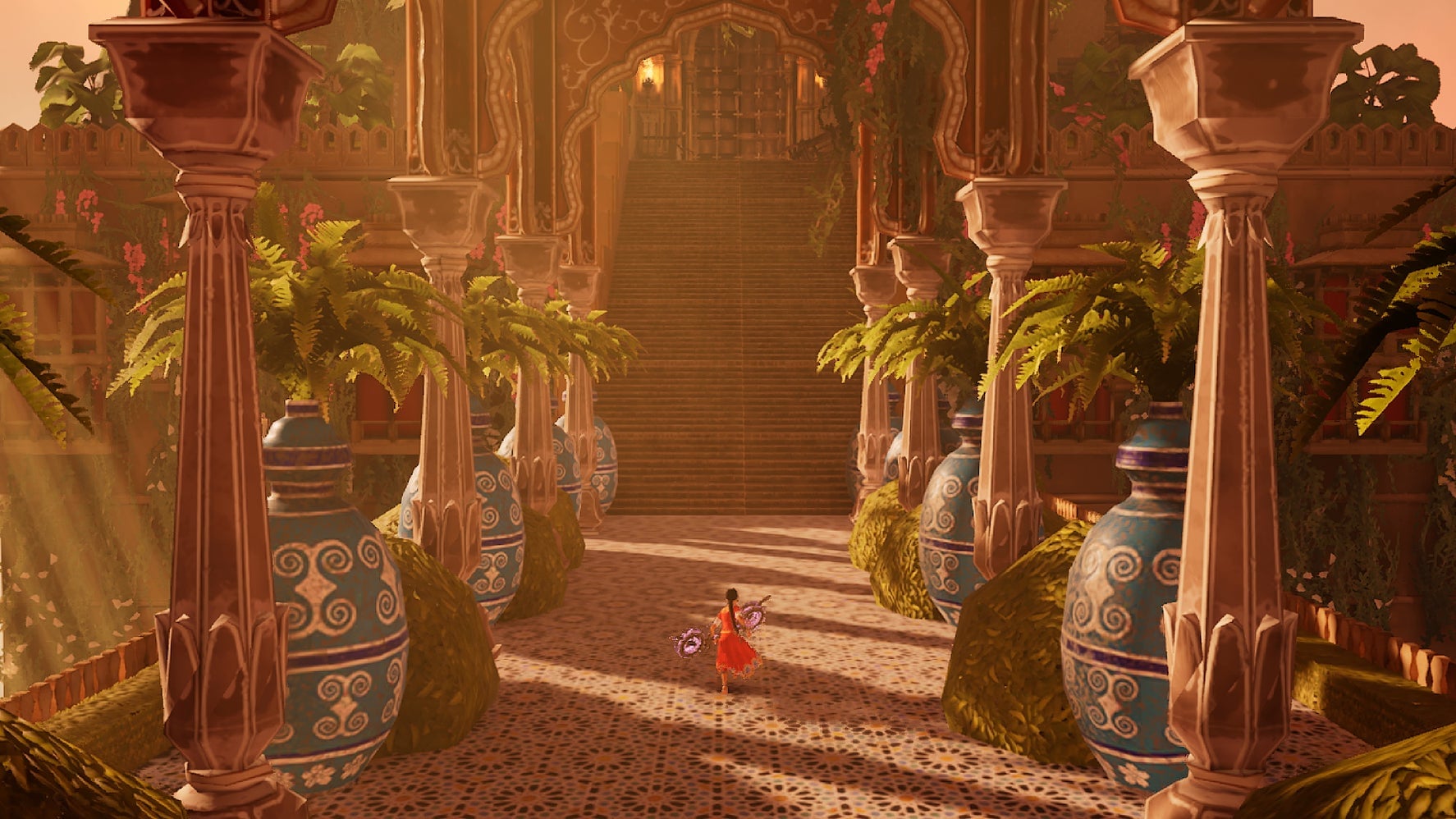
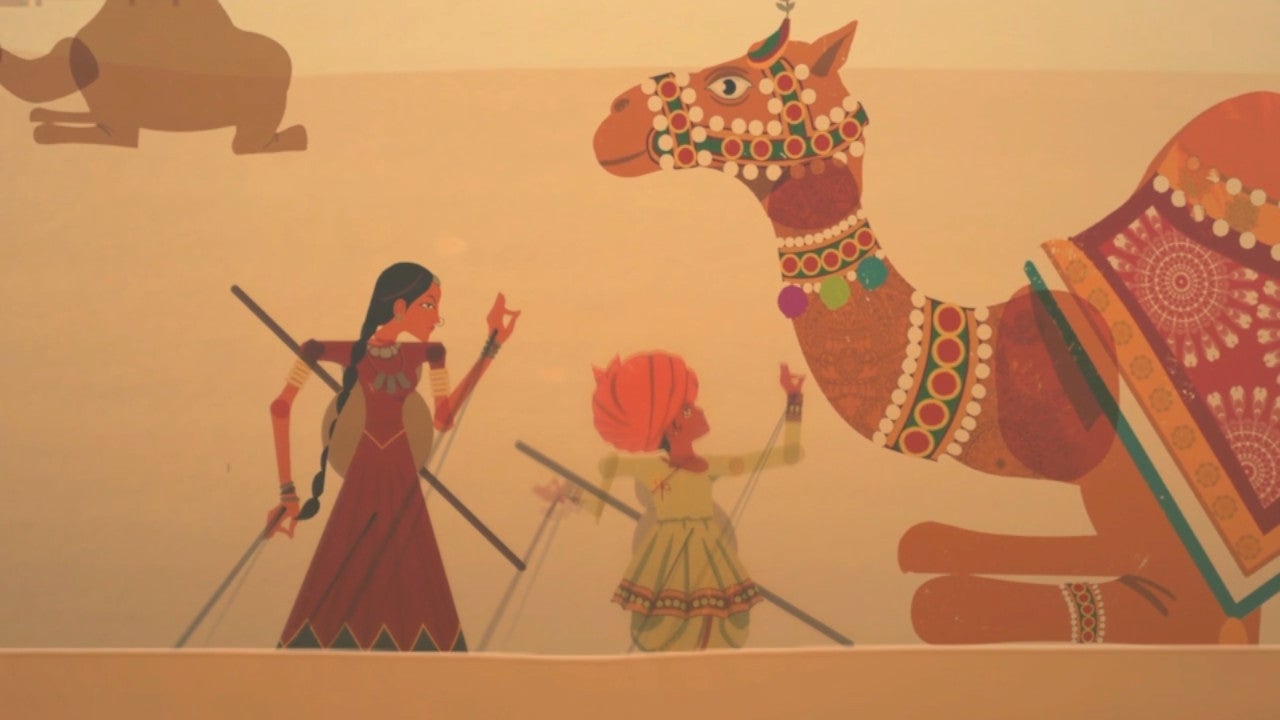
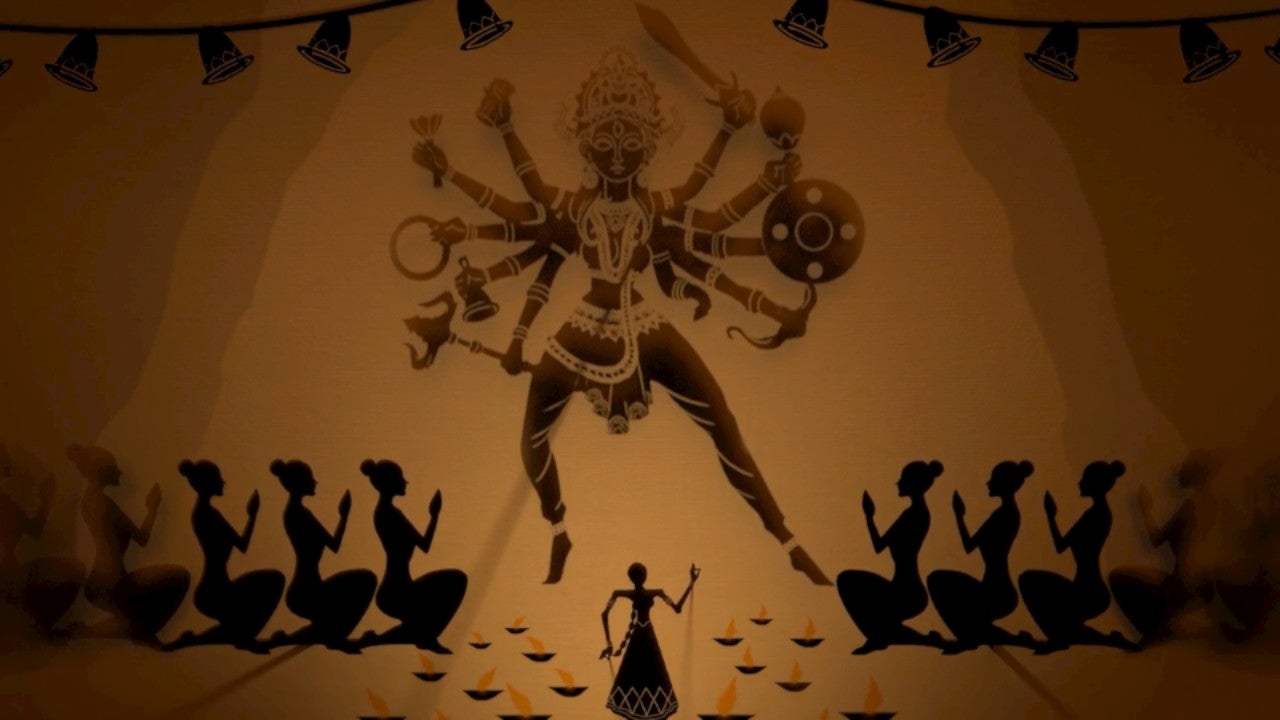
Raji: An Ancient Epic plays like an epic poem. Shadow puppet cutscenes help tell the story of main character Raji and there are murals all over the world displaying stories from Hindu mythology. The music aids the grandness of the storytelling, with a sitar frantically strumming in time with Raji’s spear swipes or the wail of a wooden flute that sounds like a mother’s mourning howl when Raji falls. In a video game landscape dominated by America, Japan, and Europe, it’s refreshing to see a game based outside those three spheres, one developed by people who actually live in the culture the game is about.
You play as the eponymous Raji, a carnival performer who, along with her younger brother Golu, perform for coins on the feast of Rakhsha Bandhan—a Hindu feast day that celebrates the relationship between brothers and sisters. Calamity strikes when demons arrive and kidnap Golu, setting Raji on a journey to fight demons and spirits, with the aid of the gods, to win her brother back.
Raji is Nodding Head Games’s first title, out now on Switch and coming later to PC, Xbox, and PS4. It was created by an international team, but the heart and soul of the game was developed in the studio’s headquarters of Pune, India. There’s a concept in fiction called “own voices” in which an author from a marginalized or minority identity writes about their own culture from their own perspective. Using this definition, Raji is very much an “own voices” game. It’s something that doesn’t happen as often as it should in games. While Raji’s story itself is not unique—the story of a sibling searching for a lost one abounds in video games—Raji brings a new, culturally rich perspective to an oft-seen tale.
With its combat and puzzle-platforming, Raji feels like a kinder, gentler God of War both in gameplay and in story. As in God of War, the gods are your constant companions. But in Raji they are your helpers, not your adversaries. You power up through their gifts given freely, not stolen through violence.
At the beginning of the story, the goddess of war, Durga, to whom Raji often prays in battle, gifts Raji with her spear Trishul and the power of lightning. As Raji searches for her brother, she encounters other gods who gift her new weapons and access to new powers.
Each god from whom Raji earns favor grants her access to an elemental power that can imbue Raji’s weapons. These powers vary depending on the element. The element of lighting grants its weapon the ability to chain lightning and stun enemies, while fire allows Raji to burn enemies over time or rain meteors on the battlefield. Each power has three levels, with each level increasing the chance the power triggers in a fight. You can change Raji’s weapon elements and powers as often as you like through changing a weapon’s affiliated god and investing different powers with orbs of power you find in the world (sometimes in plain sight, other times artfully hidden behind platform puzzles and exploration).
Raji moves effortlessly through the world, hopping, tumbling, and jumping. She is a carnival performer by trade, and those skills seamlessly weave into her combat. She can run up walls and spin around poles, unleashing powerful attacks as she does. She feels weaker when there’s no architecture for her use, relying instead on avoiding enemy attacks before unleashing the fury of her gods. You periodically find stones painted with the face of the goddess of death, Kali. As Raji defeats enemies near the stone—sacrifices to Kali’s bloodlust—the stones power up. Once full, Raji can tap into that power to unleash a devastating area of effect attack unique to her weapon and the elemental power that imbues it. Raji is favored by the gods, and that power is manifest.
Raji feels powerful in combat, as someone gifted with a god’s weapons and powers should. But she’s also a teenage girl, and as such, she is fragile. Enemies you meet in the first area are still as lethal when you meet them again in the third or fourth. While powerful offensively, Raji has very weak defenses and can fall easily if she does not prioritize avoiding or blocking enemy attacks.
This feels especially true in the game’s tough boss fights. The first boss in the game stymied me for two hours before I gave up and searched the internet for help. Raji has no ability to heal herself in combat unless she performs a finishing move on a vanquished enemy. Since there are no other enemies in boss fights, health is a commodity to fiercely protect until you can figure out a way to defeat what’s in front of you. Each of Raji’s weapons are uniquely suited to a boss—figure out the right weapon and you’ll have an easier, but by no means easy, time.
Raji can feel a bit on rails. There’s no open world exploration, and there are no camera controls. The fixed camera sometimes confused me about where to go next; occasionally I wouldn’t know how to proceed because the camera’s focus didn’t adequately show the next pillar or platform. But the way the game shows you just enough to tell you where to go next fits with its themes of gods and faith. You might not know where to go, but if you step out on faith—taking a path where you cannot see where it leads—you can find hidden passageways, health nodes, or orbs of power for your weapons.
This fits with Raji’s personality, which takes a bit to shine through. She is a prayerful yet playful devotee of her gods. She is very much a teenage girl devoted to the care of her brother, but she is not so singular in that purpose that it subsumes her entire identity. She is as likely to recite a prayer for protection for her brother as she is to playfully banter with a demon before slaying them.
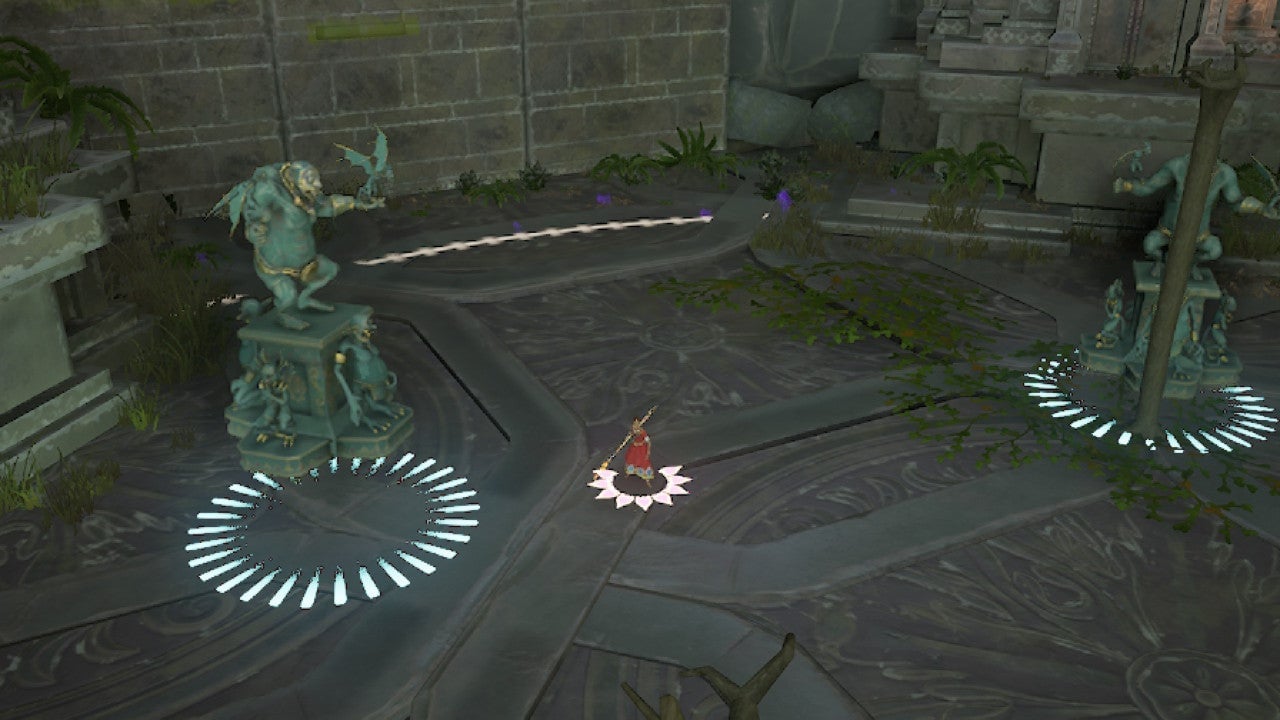
The lack of exploration is also offset by the detail in the game’s environments, which give things depth. Details are especially important in the game’s puzzles, which unlock bits of story or areas to advance the plot. For instance, one of the puzzles is a demon tree covered in misaligned faces that you must reconstruct to banish the demonic energy tainting it. I couldn’t figure out how to reconstruct the faces at first, because visually they didn’t make sense. But then I noticed, in the background, broken statues reconstructing themselves the closer I got to the correct position. So instead of looking at the actual puzzle, I had to look behind it to know if I was solving it correctly.
“You can solve the puzzle by matching the faces, watching the environment rebuild or a combination of the two,” a spokesperson for the game told me in an email. “Essentially you’re healing the environment by returning it to its former glory, ridding the corruption left behind by the demons. We’ve added many details such as butterflies, flowers and grasses blooming, [and] saturation of colours just to name a few.”
Raji is full of these little details that make the world wondrous to travel through. I’ve played seven hours and feel close to the end, and I’m excited to see more of its world. Raji also makes Hindu mythology and culture accessible without finding it necessary to make everything plain for an English speaking, Western audience. Characters often speak Hindi, and the subtitles don’t translate those words to English. Sometimes context makes the meaning plain—like “Didi” being a word for older sister—but sometimes not. It’s like the game is saying “this was made for you to experience and enjoy, and we are happy to share, but it was not made for you.”
I think about the people Raji was made for, the players who will pick up the game and see themselves in Raji and Golu, who will hear the stories the gods Vishnu and Durga tell and recognize them as their own. I teared up at several points in the game, not just because the story was sad or moving but because I felt in my heart that someone would have that spark of recognition that fills them with the joy of being Seen. Everyone should have that feeling.