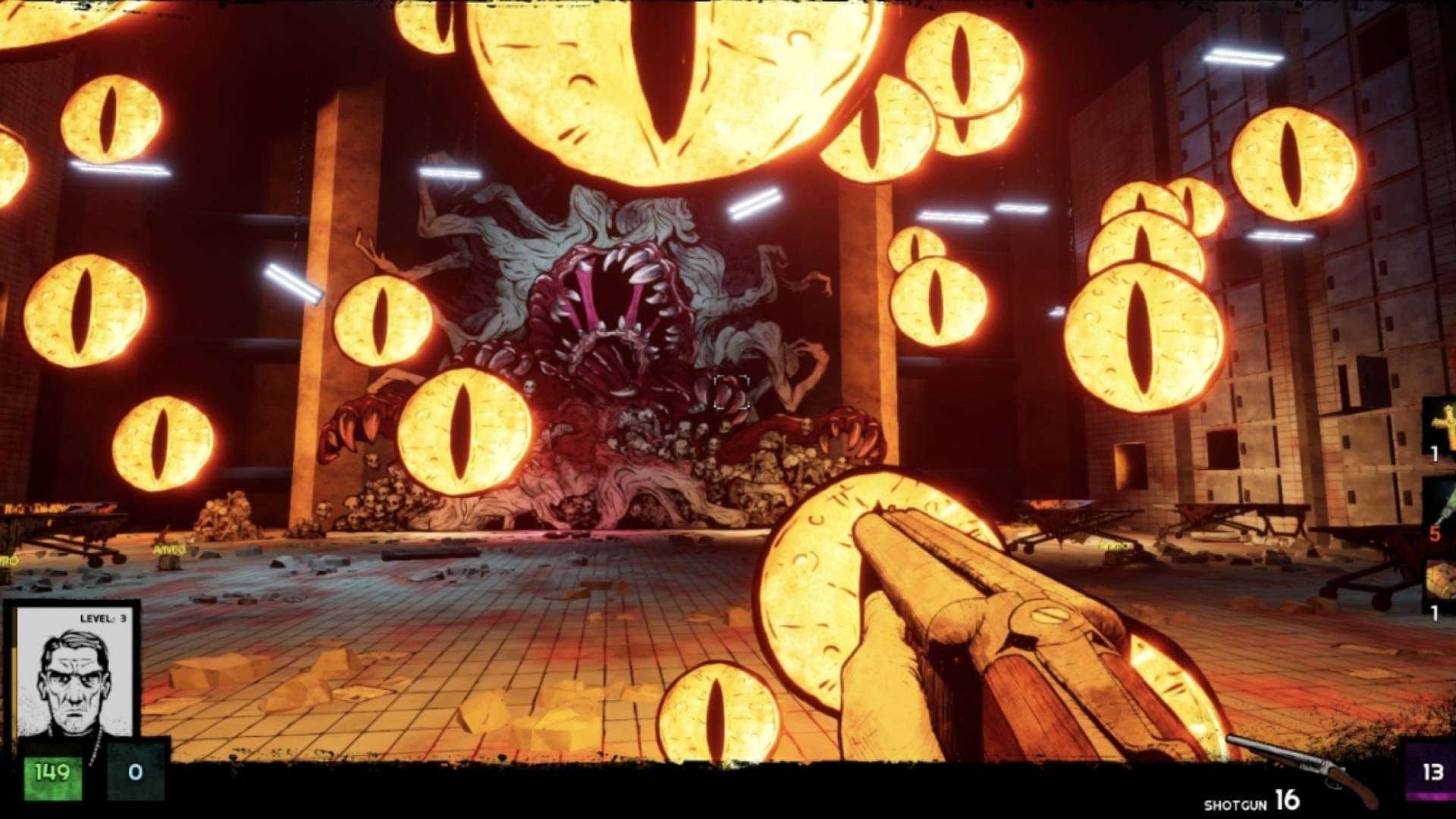
Don’t let the highly stylized art fool you. The first-person shooter Forgive Me Father is unsettling because of its flat comic-book graphics, not in spite of them. At first, I was charmed by how the art style made the game feel like a distant cousin to Paper Mario. By the end of the second level, I was a paranoid mess.
Forgive Me Father takes place in a city in post-apocalyptic New England. In the early access version of the game which just launched this week, you play as a Catholic priest who wakes up to find that you’re the last survivor of some horrific disaster. As you shoot and knife your way through an army of zombies and Lovecraftian horrors, you try to piece together what sort of apocalypse befell your world. Did someone summon something they shouldn’t have? Was there some kind of viral outbreak? Was it aliens?
The game raises more questions than answers. The lore pickups are too ambiguous to provide clarity, but I’m OK if the game never properly spells out what happened. Forgive Me Father feels a bit like one of those starter games that I’ve made in the Unity engine. The level design feels blocky, and there’s no friction between your character’s feet and the floor. I’m not entirely convinced that my character has feet at all. But the game actively takes advantage of its low-fidelity aesthetics to deliver on a constant feeling of unsettling wrongness. There’s horror in seeing objects that are just approximate enough to reality, but behave in unnatural ways. Forgive Me Father uses video game jankiness for dramatic effect. And it works.
The enemies don’t cast much shadow, and they tend to appear without any warning. When I blew a zombie away with my trusty shotgun, I was shocked to see another one immediately appear behind it. It was only several rooms later that I realized these 2D enemies weren’t hiding behind each other; the zombie was putting on a new head after I blew away its old one. And it wasn’t the only enemy with unique traits. If I didn’t immediately headshot an enemy in a suit, his upper torso would crawl forward to attack me. Some explosive barrels were sentient monsters that would charge at me without warning, and my fear of them caused me to shoot them early instead of waiting for other enemies to get into range.
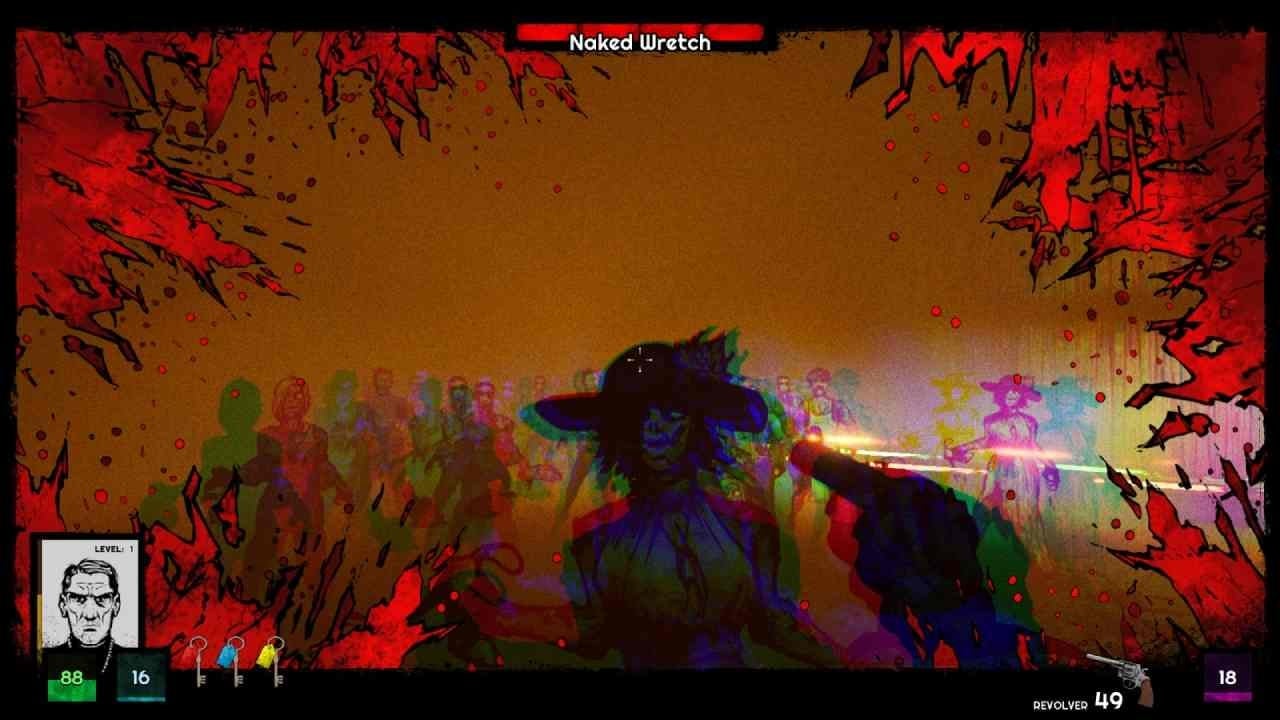
The combat is so fast that I rarely had time to notice anything else The lack of friction in your movement means that the shootouts feel a lot faster than in many modern first-person shooters. I eventually found myself dodging five enemy projectiles at once, which is entirely doable. But it also means that these zombies and ghouls are just as quick to surround you from every direction. There’s no gradual buildup to the suspense. The monsters appear without warning, and your guns don’t fire nearly fast enough. It’s dodge and kill, or be killed.
Like a lot of Lovecraftian games, Forgive Me Father features a madness mechanic, here in the form of a gauge that fills up as you rapidly kill enemies. You can then spend that gauge to use special abilities, such as healing your character or paralyzing enemies. However, a high madness level also applies a blurry grey filter to your camera. Since I wanted to be able to see my enemies clearly at all times, I would often spend madness points on healing my character during harder fights instead of saving the gauge.
However, the satisfying difficulty of these tightly designed early levels doesn’t last. Once I was souped up with weapon upgrades and armor pickups, I felt overpowered in my ability to simply gun down anything that moved. Since the game is still in early access, I’m hoping that the developers tighten up the early game in addition to working on later levels to come. Forgive Me Father has a great atmosphere, a stunning art style, and a ton of unexplored potential. I’ll definitely be revisiting it once the full game is released.