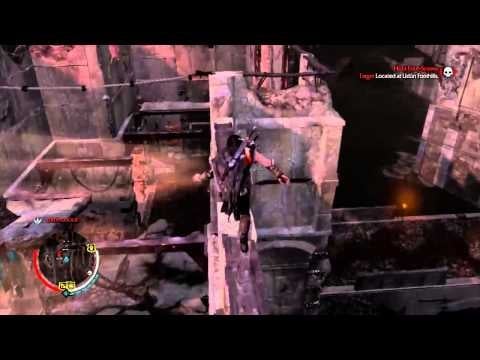
When Shadow of Mordor first arrived in September, it was met with heaps of well-deserved praise. The last-gen versions of the game arrived today to considerably more muted fanfare. After playing a few hours on my PlayStation 3, I can see why. This is not the Mordor I remember falling in love with.
I’ve only managed to sink a little more than four hours into the PS3 version of the game (an Xbox 360 version also came out today), which means that my experience with last-gen Mordor still pales in comparison to the amount of time I’ve spent playing it on PC and PS4 (well over 50 hours). I haven’t been able to investigate every nook and cranny of the game’s nemesis system, which is tough to wrap one’s head around in the first place. I still plan to do that, both because it’s one of the best parts of the original versions of this game and also because Mordor creator Monolith Entertainment made some troubling comments about how it would be compromised on last-gen consoles in an interview with IGN well before any version of the game had been released.
I’m concerned about what I’ll continue to find, in any case, because the newest (yet oldest, technologically speaking) version of this game just isn’t very good.
It Looks Bad, And Runs Even Worse
I wasn’t expecting Mordor to look great on Xbox 360 or PS3, especially in comparison to the gorgeous Xbox One and PS4 versions of the game. Comparing the last-gen versions to their more robust counterparts wouldn’t even be fair, necessarily. But even with that qualification in mind, seeing Mordor in its new pixellated guise was pretty shocking.
The game just looks muddy and chunkily animated in a gross way on my PS3. This is especially striking during the opening segment of the game, which cuts between scripted animations that look nearly identical to the ones in the new-gen versions and moments of actual gameplay. Suddenly, the flashback of Talion fighting with his son looks a lot more pixelated than I remember it being. Many small details have been compromised or erased entirely. The blood that sprays out of orcs’ heads whenever Talion lops them off, for instance, just sort of…jets out rather than spinning around in thick, shiny black globs. The game’s fortresses and enemy encampments got a similar treatment—the finer details of all the stone and rusty metallic architecture sanded away in the transition to last-gen consoles.
Mordor was already a pretty dark and monochromatic game to begin with, mind you. Besides the grass and trees, its color palette primarily consisted of gray, black, dark blue, and maybe the occasional dash of red if something had rust or blood on it. Scrubbing away a layer or two of detail therefore turns the entire world into what looks like a sickly brown pile of mush.
The aesthetic limitations don’t just impinge on Mordor’s eye-candy, either. The animations struggled throughout my time playing the PS3 version, so much so that they made playing the game feel like more of a struggle than it should. Talion and all of his orc (and uruk) enemies move at an awkward, stilted pace. It’s like they’re all trying to attack one another while simultaneously sprinting through a knee-deep pool of molasses.
Take a look at this execution, which I captured on my PS4 for my original review way back in September:
Compare it to this one, which was pulled from an Xbox 360 gameplay video from the YouTube channel Game Check (see above for the whole thing:
Notice the screen-tearing there. I saw many, many technical hiccups and glitches like that while playing on the PS3. Textures popping in and out of the game were the biggest issue I had by far. But Mordor also suffered from many frustratingly long load times that interrupted my gameplay—especially when I was trying to do something as simple as, say, navigate over to the nemesis board or the abilities menu. It’s strange that this game came out more than a month after the new-gen and PC versions did, because it feels far less polished in comparison.
Again: I know that it’s not entirely fair to compare games across generations. But the new Mordor has a lot of problems,and they’re one that can’t be easily forgiven by simply acknowledging the dated tech that’s running it. There are many open world games for the Xbox 360 and PS3 that look incredible and run without a hitch. Or much of one, at least. This new version of Shadow of Mordor doesn’t hold a candle to some of the classic Grand Theft Auto and Assassin’s Creed games I’ve played on those two systems.
The Nemesis System Feels…Different
I spent the majority of my time playing the PS3 version of Mordor today running around the game’s first map doing my best to tinker with the game’s nemesis system. I should admit, though, that I find it more than a little confusing even when I’m playing the new-gen versions of the game.
Simply put: the nemesis system in the last-gen version of Mordor feels slight. It seems limited in comparison to the robust and colorful orc infrastructure that I’ve enjoy so much in the original game. I still had some great moments with my new batch of orcs, don’t get me wrong. One threatened me with the delightfully silly line: “I’ll kill you until you’re so dead you can’t be alive!” But between memorable moments like that, I ran into an unpleasant amount of repetition. Much like I mentioned when describing the scenery of the game, there are a lot of finer details missing in these new orcs. They all seem to have a smaller set of names, weapons, pieces of armor, and snappy orc taunts to draw from. The orcs in my PS4 and PC versions of Mordor got repetitive at a certain point too, for sure. But I only began to notice it then after playing for upwards of 20 hours or so. On my PS3, in comparison, I quickly found myself thinking: “Oh, great, another orc wearing that same suit of body armor just said he wants to kill me.” I guess, on one level, that is what all the orcs in Mordor are doing, regardless of what version I’m playing. But the beauty of the original game came in the sheer amount of diversity it had to offer. While they did and said a lot of stuff that seemed pretty similar, no two orcs ever truly felt like they were the same.
It’s worth remembering that Monolith, which hasn’t said much about how the nemesis system works, acknowledged that last-gen gamers wouldn’t be getting quite the same thing. In an interview with IGN back in February, Mordor design director Michael de Plater made it clear that new-gen consoles were the priority when developing the game, especially in regards to the nemesis system. Here’s the relevant passage, emphasis mine:
“We’re very focused on the PS4 and Xbox One,” he said. “We’re focusing on the next-gen platforms, and then going to do whatever we can to get as much as possible on current-gen.
“To break it down, some of the stuff we’re pretty confident will still be very similar on current gen: the core mechanics, like combat, stealth, ranged and movements; the basic control and gameplay, that should all be really solid. What it won’t have is the same level of depth and variety and simulation within the ‘Nemesis system’.
“The story will be the same and the core gameplay will be the same, but [the ‘Nemesis system’ is] just so huge in terms of content, calculations and AI we’ll just have to try and get as much of it in as we can.“
Given how relentlessly Monolith has promoted Mordor’s nemesis system as a great newfangled idea for open-world games like this, I’m now left wondering why the studio even decided to make a last-gen version of the thing—especially when they were pretty upfront about the risk they ran in impinging on the best parts of the game.
Would Mordor have benefitted from being a next-gen exclusive, like Assassin’s Creed: Unity? It’s an interesting question, but one we can’t really answer. What I can say for sure, however, is that the last-gen version of Shadow of Mordor is not off to a great start for me. If you can avoid playing the game on a PS3 or Xbox 360 in favor of a new-gen version, I would strongly encourage you to do so.
To contact the author of this post, write to [email protected] or find him on Twitter at @YannickLeJacq