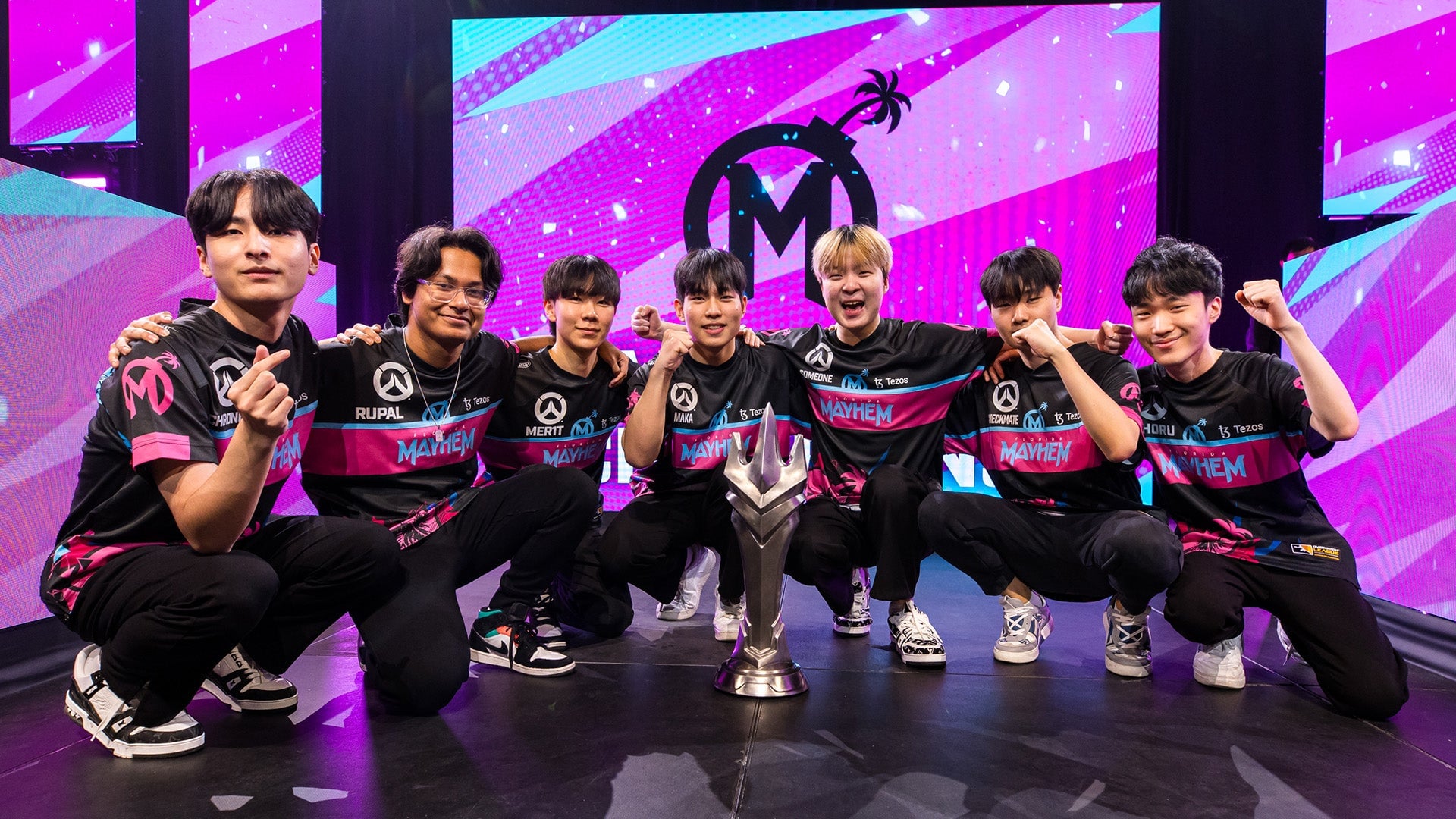
Competitive gaming has millions of fans. Its biggest stars earn six-figure salaries. Yet it’s nowhere to be found on American television. You may happen upon bowling, lumberjack contests, or even rock-paper-scissors while channel surfing, but nary a match of StarCraft or League of Legends
More and more people are devoting their lives to playing in and maintaining professional eSports— electronic sports, a catchall for competitive gaming. For them, continued growth is a must. The professional leagues want to be on TV. They want to become part of the mainstream. But will the gatekeepers of American sports television let them in? Can eSports maintain this trajectory if they don’t?
The people in charge of these leagues believe that eSports has the potential to be as big as it wants to be. A representative from one of America’s biggest sports channels isn’t as sure about this “next big thing.” The men and women behind the biggest online streaming service that currently broadcasts eSports don’t think network TV even needs to enter the picture. At least one of these parties is right, and will likely make a pretty penny because of it. Soon enough, we’ll see who it is.
As it stands, millions of people watch eSports. They watch games like Starcraft II, where fast-fingered players control galactic armies in a dense and strategic war that’s like speed chess via Gene Roddenberry. They watch League Of Legends, where two teams of five digital heroes level up and do methodical battle over towers they’ve sworn to protect. They watch Shootmania, an unreleased first person shooter with lightning fast pace. Knowing Americans, many of them probably dip into a bag of chips and a beer while they do it. And every single one of them is watching through the internet.
***
Believe it or not, it was not always this way. At least, not entirely. Over half a decade ago, a sports TV giant decided to roll the dice and broadcast something new: video games.
“It proved to be what we thought it would be. A bit too niche for our audience.”
“One of the goals that we have is to always be really ahead of the curve, so we’re always looking for how to best serve our fans,” ESPN’s Vice President of Games and Partnerships, Raphael Poplock, said to me on the phone several weeks ago. We were speaking about the 2008 deal ESPN signed with MLG—Major League Gaming—one the first and largest American gaming leagues, which was founded in 2002 and has been growing ever since.
“MLG at the time was up-and-coming and they were doing some really good things,” Poplock said. Using ESPN3—the sports network’s online portal—as an “incubator,” the Disney-owned channel began to roll out its competitive gaming coverage. Eventually, it was supposed to make the jump to TV. But MLG never arrived in the living room. “It proved to be what we thought it would be,” Poplock said. “A bit too niche for our audience.”
After several broadcasts of Halo and football stalwart Madden on ESPN3—including features like “Top 10 Plays”—and written coverage of players and tournaments, ESPN and MLG ended their partnership. “I think one of the challenges that we had as we’ve evaluated this space, and even seen other people produce it, is that it really is hardcore,” Poplock said. “The typical fan in our case, a sports fan, it’s not very easy [for them] to consume or to pick up.”
There was also the question of broadcasting “Mature” titles like Call of Duty. “We’re part of the Walt Disney company so we have to be very considerate as to what kind of content we’re putting on our air,” Poplock said. “For various reasons, [we] just didn’t think it would be a good fit for us.”
More than anything, Poplock felt eSports had issues with production value. “Look at what [ESPN] has done for the sport of poker. We really revolutionized it, made it to a place where fans really could understand what was going on,” Poplock continued. By adding in features like the pocket-cam—which allowed viewers to get a look at the players’ cards in the middle of a hand—ESPN helped turn poker into a mid-2000s juggernaut. From 2003 to 2006, entrants in the World Series of Poker increased from 839 to 8,773, the pot from 2.5 to 12 million dollars. eSports gaming, to Poplock, was not “palatable for a casual fan.”
Today, ESPN’s gaming integration is kept to things like Madden Cover Vote and football simulations, but Poplock said “the more core eSports, shooter games, [are] not an area of focus.” When I asked him if they were worried about missing out on this potentially huge audience, he said they’re not concerned. In fact, he openly encouraged others to capitalize. “If they’re doing it with Twitch.tv or other folks, more power to them. We love that, we love seeing that the overall industry is thriving.”
***
Reaching the mainstream is of the utmost importance to David Ting, founder of IGN Pro League. IPL is an extremely fast growing gaming league which has seen its viewership and prize money increase wildly in its two years of existence. Formerly involved in engineering at IGN, Ting now manages dozens of employees, putting together events viewed worldwide. Over the phone he comes off as a man driven forward, sometimes divergently, by his twin passions for gaming and business. Started as a Starcraft II League in 2011, IPL has grown to include League of Legends, Shootmania, and just recently signed an exclusive deal with Capcom for their fighting franchises, Street Fighter included.
Their last event, IPL 5, had over six million unique viewers, and Ting hopes to increase that number by at least 50% for IPL 6 next month. Ting is a gamer who got inspired to start the league after spending months battling through StarCraft II‘s Diamond multiplayer league, the last step before “Pro.” But in a conversation with me he also harped on concepts like “monetization” and “economically dictated growth.” IPL came from his hobby, but he treats it as very serious business.
And the way Ting sees it, eSports will have to move to TV. “It’s all about monetization at the end of the day,” Ting told me. “The level spent on TV in terms of ads is still way higher than internet for per-minute views.”
“For us, it’s really important to reach the mainstream. Somebody who may not be watching videos on the internet,” he said. “They may discover our program on NBC and fall in love with it.” Ting sees eSports as something that America is waiting to love, just as he does. Hell, he’s banking on it.
“For us, it’s really important to reach the mainstream. Somebody who may not be watching videos on the internet.”
In the months between IPL 4 and 5, the unique viewership for the events more than doubled. Over a long weekend last November, people across the world consumed over 20 million hours of streamed video. At any given moment there were just under half-a-million people watching. It’s hard to say things aren’t on the up-and-up. But Ting believes that putting their content at the fingertips of the channel surfer could make it explode into a cultural force. “eSports losing the ‘e’,” he said repeatedly.
When I asked him about MLG’s ill-fated foray onto network, he confidently replied that times have changed. Now, he says, the time is right. “If you bring up e-commerce, like back when the internet was only available on mainframe, people think you’re crazy. But today it’s second nature. The same ideas that failed in the past—it’s really about window of opportunity.”
IPL is currently on television in China, and open to other foreign markets. For America, Ting believes the switch will come “within the next two years.” Ting said IPL was “entertaining talks” with networks, but wouldn’t reveal which ones. Presumably, it wasn’t ESPN. “The opportunity is definitely in the US,” he told me. “If you look at the majority of our broadcasts, they’re in English. It’s an economic system that dictates that. For now, I’m a person who wants to perfect our current case study and challenge as much as possible. We’re doubling in traffic every six months. I want to keep up that growth rate.”
A few weeks after we spoke, IGN had mass layoffs and closed some of their subsidiary websites like 1up and GameSpy. In an internal memo obtained by Kotaku last week, IGN said they were “actively engaged with parties interested in acquiring IPL.” When asked for more details, neither IGN nor Ting would comment.
https://lastchance.cc/ziff-davis-shuts-down-1up-gamespy-and-ugo-update-5986027%3C/a%3E%3C/p%3E
These leagues are working in uncharted territory. While the concept of average Americans consistently watching competitive games is foreign, it would be much more approachable were it on a nationally recognized sports channel. But what about betting on revenue models that are still rapidly developing in the world of online streaming? Competitive gaming’s current home, Twitch.tv, thinks that’s a no brainer.
Marcus “djWHEAT” Graham is one of StarCraft‘s top announcers and a competitive gaming veteran. He’s also a producer of eSports at Twitch. To him, the future of eSports is destined to stay online, and he thinks it’s actually broadcast television that has something to learn from their model. “It doesn’t matter where I live, it doesn’t matter who I’m a fan of, [on Twitch] I can follow the players, the teams, the competition that I want to follow without any sort of restriction on being subscribed to ‘x’ satellite network or living in ‘x’ region,” Graham said to me on the phone last week.
Twitch’s Vice President of Marketing, Matthew DiPietro, told me “the larger sort of question is ‘what is the future of broadcast or cable television?’ In my mind it’s pretty clear that most broadcast is going online in one form or another. So who knows, I think it would be great if we saw some really well produced content on television, but in my mind that’s not the future, that’s not what’s interesting about this thing, that’s not what’s really scalable.”
“The larger sort of question is ‘what is the future of broadcast or cable television?'”
As the world of competitive gaming grows, so does Twitch. The streaming service, an offshoot of internet-broadcast progenitor Justin.tv, is home to streams of gamers both professional and amateur. According to them, their viewership increases by 10% every month. The numbers they provided me are impressive. 25 million unique viewers per month, several hundred thousand at any given time. 300,000 unique content providers every month, and up to 1/100 of those on at all times.
Currently Twitch engages in yearly deals with both MLG and IPL, and are the preferred streaming service of most professional gamers. They are supported by ads, or if you feel like paying, a premium ad-free service. And they firmly believe that they can and will be the home of eSports when it hits the big time.
Like David Ting, Graham thinks eSports becoming mainstream is only a matter of time. But he sees no reason for it to move to broadcast television. “Some of [the big events] I can see happening in a cable type environment, or a broadcast type of environment. But frankly, I think the audience that you get on Twitch eclipses what you could get on television anyway. That this is the more natural place.”
Not that they want to live exclusively on your computer: “We are very interested in getting Twitch content onto the device that is the television,” DiPietro told me, “But that’s through an internet connected television, through your Xbox, through your Roku, through your internet connected devices of all sorts.” With more internet-enabled televisions hitting the market all the time, not to mention upcoming media-forward machines like PS4 and Durango, the technology is there. But when will this all happen?
***
While IPL’s future is unclear, could David Ting still be right about the two year window? There’s no doubt that the national interest in gaming is there. Video games are a humongous industry with a robust and competitive multiplayer faction. But the cultural familiarity with sports like basketball and football—a familiarity bred over decades and generations—allows casual viewers to consume them on at least a basic level. Something like League of Legends doesn’t have that. Could it ever? Raphael Poplock would probably say no. David Ting would surely like to think so. But both agree that the most popular titles, no matter how deeply their fans are committed to them, suffer from an accessibility issue.
Whether it be the complexity, the length of the matches, the foreign lingo, or even the largely foreign players, there’s an impenetrability to these games. League of Legends publisher Riot Games knows this. “When we first started [broadcasting League of Legends], the average game was over an hour,” Ting said, “Riot made some tweaks in the game to shorten the playtime and allow it to be more watchable. We’re doing the same thing with Blizzard.” But those kind of changes assume people are willing to watch in the first place.
One thing the leagues—and the sport in general—have going for them in the accessibility department is their announcers. Over the years, many of the major eSports have built up teams of surprisingly effective sportscasters. Without commentary, watching a StarCraft game with a real-time-strategy-neophyte friend was an exercise in confusion, which quickly became boredom. The game being played at its best became just so many pixels moving about a screen. With Husky, HD, or Day9 calling the game, I wouldn’t say it was all crystal clear, but the experience was greatly elevated, the more complex elements reframed into dynamic moments of strategy and the climactic battles and maneuvers clearly demarcated. Could it be these personalities that attract new, more diverse viewers?
Ting believes that for eSports to hit primetime, the knowledge base surrounding these games needs to grow, presumably by players inducting their friends. It’s not impossible: I know several avid StarCraft watchers who have never played a match. But the transition from traditional sports fan to eSports fan is ill-defined, unpredictable. Untested. “I think those [viewer] communities are all there,” Ting said. “It just requires people to treat them well, make the content high quality, and bring them in. Instead of being kind of exclusive, you should actually be embracing as many people as possible. Anybody added is a good thing for the community. I think that’s the biggest attitude that’s really keeping the scene so fragmented and so small.”
“Instead of being kind of exclusive, you should actually be embracing as many people as possible. Anybody added is a good thing for the community.”
But how big would the potential gains have to get for another network like ESPN to gamble on video games again? And how long can eSports leagues hold on to their sovereignty, building up their audience and driving up their market value, before locking themselves into a multi-year deal with a network?
eSports leagues are hungry to get on TV. In June of 2012, MLG co-founder Sundance DiGiovanni told a Forbes reporter that there were plans for CBS to broadcast an MLG event later in the year, only to retract the comment later saying it was “not a done deal.” The CBS broadcast never materialized. David Ting, despite saying that he wants to wait for the “right deal” that will expand the viewership by “an order of magnitude,” later said “if ESPN wants to cover IPL on ESPN3 tomorrow, [he] says yes.”
He’s also quick to point out that, production wise, they’re absolutely ready to go to TV immediately. “The crews that we hire are the same crews that produce concerts as well as live fighting like UFC or WWE, or boxing matches. The lights that are used, the staging, the ambiance, the sound: everything is really produced with the same production level as if it’s ready for TV,” Ting told me. When I relayed to him Poplock’s feelings on eSports production values, he said “[he] believes that it’s closer than that particular person thinks.”
With such rapid expansion, you can sense the trepidation that without a new avenue there will be an inevitable bursting of the bubble. Indeed Ting said that “when IPL’s growth starts to stagnate, I will look at [TV deals] very closely.” Clearly he assumes those deals will be there, ready for appraisal.
***
The world of eSports is, to say the least, in an intriguing place. It’s basically been over a decade since America welcomed a new widely watched sport—poker—into the pantheon, and video games have been anointed as that next big thing for most of that span. With the atmosphere surrounding the scene, that time could finally be coming. It’s just a matter of how. From what I can tell, no one is quite sure. Talking to all the parties involved, I was struck by the swirl of numbers they presented. Large numbers, impressively so, in myriad metrics, and growing at wild rates. It feels like something must happen.
Theoretically, ESPN could announce a new partnership with MLG tomorrow that they’ve been secretly working on for months. Then every so often you’d be flipping through channels and stumble upon a video game being played live somewhere far away and for lots of money, sponsors’ logos plastered across the whole thing.
Or maybe that special and unpredictable magic could take hold and several years from now we’ll all be shelling out for League of Legends jerseys and buying tickets to a tournament in Barclay’s Center. Heroes will emerge—they’re to be found anywhere really, just remember ESPN’s Paul Page calling hot-dog-eater Joey Chestnut’s 2007 defeat of Kobayashi “the greatest moment in the history of American sports.” Allegiances wrought, parking lot brawls stumbled through, trophies engraved, glory gained, etc. eSports really could lose the ‘e.’
If the people I spoke to at Twitch are right, the way we consume sports in general might be headed for a shift, with competitive gaming unexpectedly leading the charge. I will say that being able to chat live with other viewers in a way that’s integrated with my sports viewing experience is nice. The thought of doing the same thing while watching my beloved Tampa Bay Buccaneers is… intriguing.
One thing that looks certain is that competitive gaming will attempt to make that final push into being a household staple, a new option for our country’s sport-hungry populous. A small army of loyal troops has been wooed. The resources and infrastructure collected. The will, the plan, the tact: it’s all there. But nothing is guaranteed.
Photo: Andrey_Popov/Shutterstock